
The Static Synchronous Compensator, commonly known as STATCOM, is one of the most important members of the Flexible AC Transmission System (FACTS) family.
It is a power-electronics-based shunt-connected device designed to provide fast, dynamic, and continuous reactive power compensation at the point of common coupling.
Unlike conventional compensation equipment such as switched capacitor banks or reactors, STATCOM uses a Voltage Source Converter (VSC) to synthesize a controllable AC voltage enabling it to exchange reactive power with the grid almost instantaneously.
As power systems increasingly integrate renewable energy sources that operates closer to their stability limits & face rapidly changing load patterns, devices like STATCOM have become important tools for maintaining voltage stability, improving power quality and enhancing overall grid reliability.
Basic Principle of Operation
STATCOM operates on the principle of voltage source conversion.
A DC capacitor supplies energy to a Voltage Source Converter, which converts this DC energy into a three-phase AC voltage waveform that is synchronized in frequency and phase with the power system bus to which it is connected, through a coupling transformer.
The magnitude of the converter’s output voltage relative to the system bus voltage determines the direction and magnitude of reactive power flow between STATCOM and the grid.
When the STATCOM output voltage is higher than the system bus voltage the device behaves capacitively & injects reactive power into the network that is effectively supporting and raising the bus voltage.
Conversely, when the STATCOM output voltage is lower than the system bus voltage, it behaves inductively and absorbs reactive power from the network, helping to reduce an excessively high bus voltage.
When the 2 voltages are equal, no reactive power is exchanged and the device operates in a standby or floating condition.
This voltage-magnitude-based control mechanism allows STATCOM to respond to system disturbances within a few milliseconds far faster than mechanically switched compensation devices.
Primary Components of STATCOM
A STATCOM installation consists of 4 principal components each performing a specific function in the overall reactive power compensation process:
| Component | Function |
| Voltage Source Converter (VSC) | Converts DC power stored in the capacitor into a controllable three phase AC voltage that is synchronized with the system bus voltage. |
| DC Capacitor | Acts as the energy storage element it is maintaining a stable DC link voltage required for the continuous converter operation. |
| Coupling Transformer | Interfaces the VSC output with the power system bus and steps the converter voltage up to the transmission or distribution level. |
| Control System | Continuously measures bus voltage and current, computes the required reactive power, and generates switching pulses for the converter. |
In addition to these core elements, practical STATCOM installations also include protection equipment, harmonic filters, cooling systems for the power electronic switches and a supervisory control and data acquisition (SCADA) interface for integration with the substation automation system.
Working Principle of STATCOM
The control system of a STATCOM continuously monitors the voltage at the point of connection and compares it against a reference value set by the system operator.
Based on the error between the measured and reference voltage, the controller determines whether reactive power needs to be injected (or) absorbed and adjusts the switching pattern of the VSC accordingly.
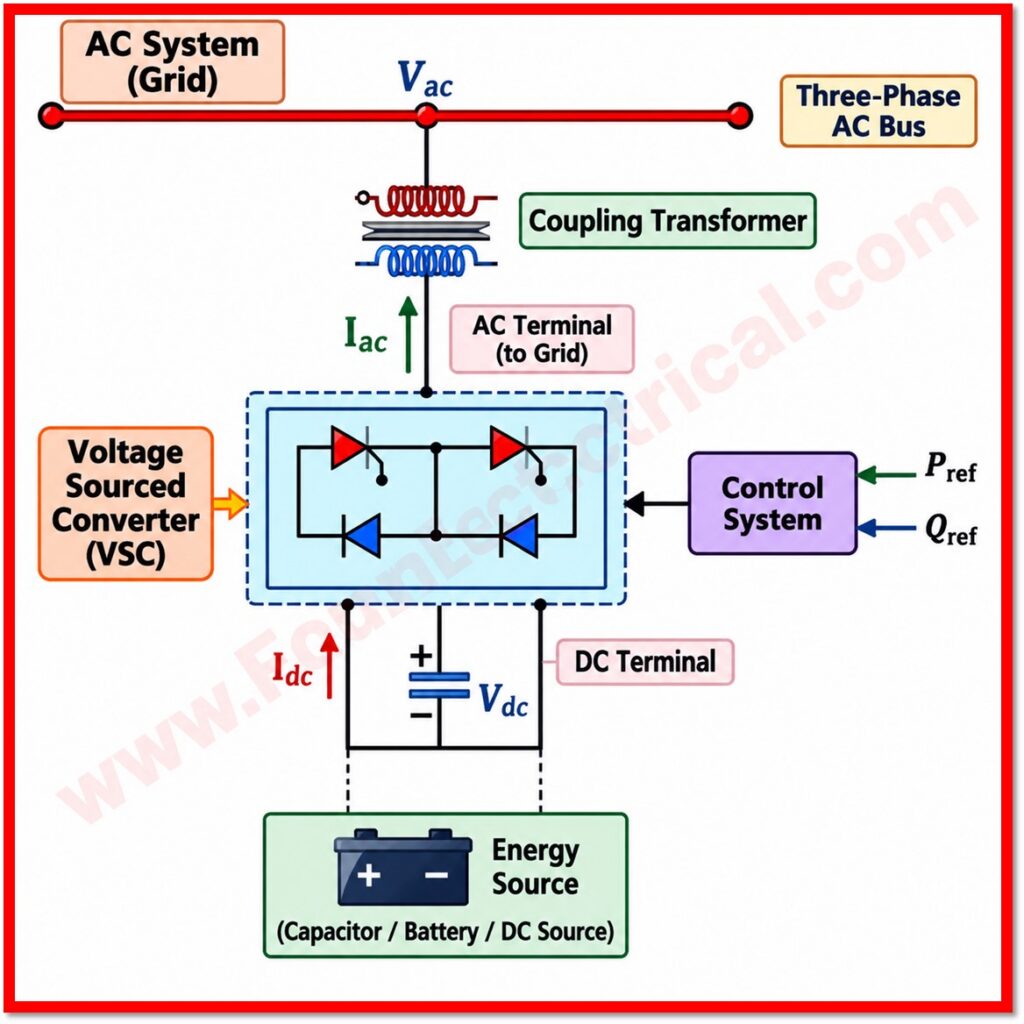
- If the system voltage decreases due to heavy loading, a fault (or) the disconnection of generation, STATCOM increases its output voltage above the bus voltage & injects reactive power to support the voltage.
- If the system voltage increases due to light loading, capacitive line charging (or) the loss of a large load which makes STATCOM decreases its output voltage below the bus voltage and absorbs reactive power to bring the voltage back within limits.
- The controller operates in a closed loop, continuously adjusting the converter output so that the bus voltage is held close to its reference value under both steady-state and transient conditions.
Because the reactive power exchange is governed by semiconductor switching rather than mechanical contactors, STATCOM can modulate its output smoothly and continuously without the step changes associated with switched capacitor or reactor banks.
STATCOM versus SVC
The Static VAR Compensator (SVC) is an earlier generation FACTS device that also provides shunt reactive power compensation but it relies on thyristor-controlled reactors and thyristor-switched capacitors rather than a voltage source converter. STATCOM provides several advantages over SVC, summarized in the table below:
| Feature | SVC | STATCOM |
| Basic technology | Thyristor-controlled reactor/capacitor | Voltage Source Converter (VSC) |
| Response speed | Fast, cycle-level | Faster, sub-cycle level |
| Performance at low voltage | Output falls with voltage (V-I limited) | Maintains rated current even at low voltage |
| Harmonic generation | Higher, needs filters | Lower, cleaner waveform |
| Footprint | Larger (reactors, capacitor banks) | Smaller, more compact |
| Cost | Lower | Higher |
The most significant advantage of STATCOM is its ability to maintain full rated reactive current output even when the system voltage drops significantly, since its output current is largely independent of the AC system voltage.
An SVC, by contrast, behaves as a variable susceptance, and its maximum reactive power output falls off with the square of the system voltage making it less effective during severe voltage sags precisely when support is needed most.
Applications of STATCOM
Owing to its fast response and continuous control capability, STATCOM finds application across a wide range of power system scenarios:
- Renewable energy integration: Smoothing voltage fluctuations caused by the variable output of wind and solar power plants and helping them meet grid-code voltage ride-through requirements.
- Weak grid support: Providing voltage stiffness at buses with low short-circuit capacity where conventional compensation is less effective.
- Wind & solar plant interconnection: Acting as a dedicated reactive power source at the point of interconnection to satisfy the utility power factor & voltage regulation requirements.
- Extra High Voltage (EHV) transmission systems: Improving voltage along long transmission corridors & increasing power transfer capability.
- Industrial substations: Mitigating voltage flicker caused by arc furnaces, rolling mills and other rapidly fluctuating industrial loads & improving power factor.
- Power quality improvement: Reducing voltage sags, swells and flicker thereby protecting sensitive equipment connected to the same network.
- Transient and dynamic stability enhancement: Supporting the network during and after large disturbances such as line faults or the sudden loss of generation.
Advantages
STATCOM offers a number of technical advantages, including fast dynamic response, continuous and smooth control of reactive power, effective performance under low-voltage conditions, a compact physical footprint compared with equivalent SVC installations and lower harmonic distortion due to advanced pulse-width modulation techniques used in modern VSCs.
It also allows for a symmetrical operating range, meaning it can typically supply as much capacitive support as inductive absorption.
Disadvantages
However, these benefits come with certain limitations. STATCOM installations generally have a higher initial capital cost than equivalent SVC installations due to the cost of power electronic switches and associated cooling arrangements.
The converter and its semiconductor devices also require careful protection against overvoltage and overcurrent conditions and the overall system depends on a reliable, fast-acting control and communication infrastructure to achieve its full performance benefits.
Conclusion
STATCOM represents a mature and widely deployed FACTS technology that provides fast, smooth, and reliable reactive power compensation for modern power systems.
By using a Voltage Source Converter to synthesize a controllable AC voltage, it overcomes many of the limitations of earlier compensation technologies such as SVC, particularly in its ability to maintain performance during low-voltage disturbances.
As grids continue to evolve with higher penetrations of renewable energy and more dynamic loading conditions, STATCOM is expected to play an increasingly central role in maintaining voltage stability and strengthening overall system reliability.

