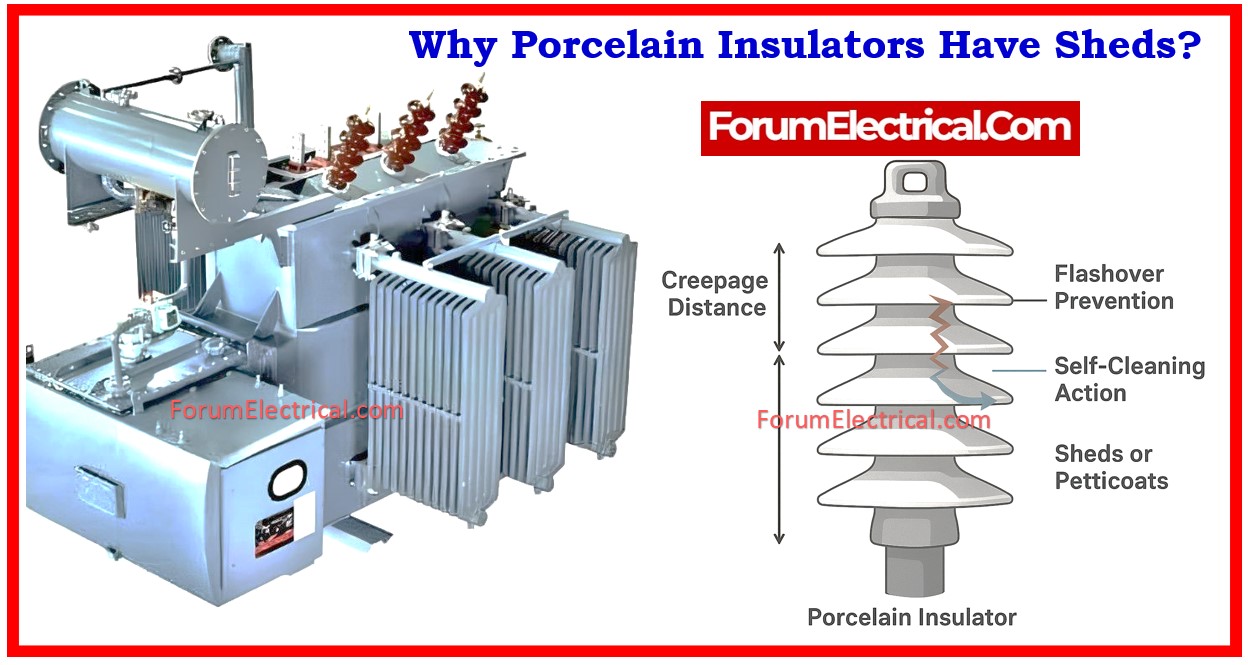
Porcelain insulators are frequently employed in
- Electrical power transmission and
- Electrical distribution systems to support & insulate wires.
One of their distinguishing design aspects is the presence of sheds (also known as petticoats) running the length of the insulator.
These sheds are important not only for structural design but also for assuring the insulator’s electrical performance & reliability particularly in severe exterior conditions.
The reasons why porcelain insulators shed are discussed below:
1). Increased Creepage Distance
2). Flashover Prevention
3). Self-cleaning Action
4). Control Surface Leakage Currents
5). Reduction in Corona Discharge
1). Increased Creepage Distance
The Creepage distance is the shortest path between two conductive components along an insulator’s surface. It is an important factor in preventing electrical breakdown on the surface.
Purpose: Sheds’ purpose is to increase the effective surface distance across the electrified conductor and the grounded sections while keeping the total length of the insulator constant.
Advantage: The prolonged path lowers the possibility of surface tracking caused by impurities like dust, salt, industrial pollutants, or moisture. A larger creepage distance makes it considerably harder for leakage currents to travel, improving insulator performance in polluted or humid conditions.
2). Flashover Prevention
A flashover happens when electricity finds a conductive channel across the surface of an insulator, typically owing to contamination or moisture.
Purpose: Sheds’ purpose is to generate various “steps” along the insulator surface through their overhanging design. This disrupts & breaks the path of an electrical arc.
Advantage: By obstructing a direct path, sheds considerably lower the likelihood of a flashover, ensuring that high-voltage equipment operates continuously and safely.
3). Self-cleaning Action
Outdoor insulators tend to accumulate dirt, dust & other pollutants, which can diminish their efficiency.
Purpose: Sheds serve a purpose by allowing rainwater to run over the insulator thanks to their sloped, overhanging surfaces.
Advantage: Rainwater washes away dust & debris naturally cleaning the insulator & preserving its insulating characteristics even in harsh environmental circumstances. This decreases the need for maintenance while also improving reliability.
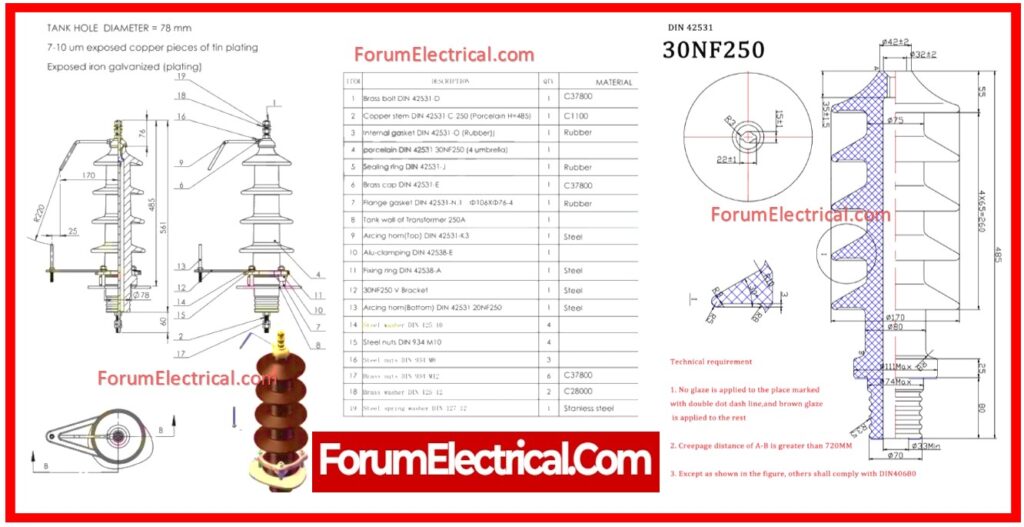
4). Control Surface Leakage Currents
Surface leakage currents are tiny currents that flow across the insulator’s surface, particularly in the presence of moisture or impurities.
Purpose: Sheds work by lengthening the surface path (creepage distance) & forming several steps along the surface, forcing any leakage current to traverse a longer, more convoluted path.
Advantage: This reduces the amplitude of leakage currents and lowers the possibility of surface discharge (or) progressive breakdown, increasing the insulator’s longevity and operational safety.
5). Reduction in Corona Discharge
Corona discharge is the ionization of air near high-voltage conductors, which can cause energy loss, electromagnetic interference, and insulator degradation over time.
Purpose: Sheds serve the purpose of redistributing and managing the electric field surrounding the insulator through their design and shape.
Summary
The sheds on porcelain insulators are important design characteristics that improve their performance in real-world environments.
They serve several purposes:
- Increase the creepage distance to prevent tracking.
- Reduce the risk of flashovers.
- Encourage self-cleaning during rain.
- Control the surface leakage currents.
- Minimize corona discharge.
Porcelain insulators that incorporate these properties can reliably sustain & insulate high-voltage conductors in spite of polluted, damp or humid environments guaranteeing that power transmission & distribution systems operate safely and consistently.

