
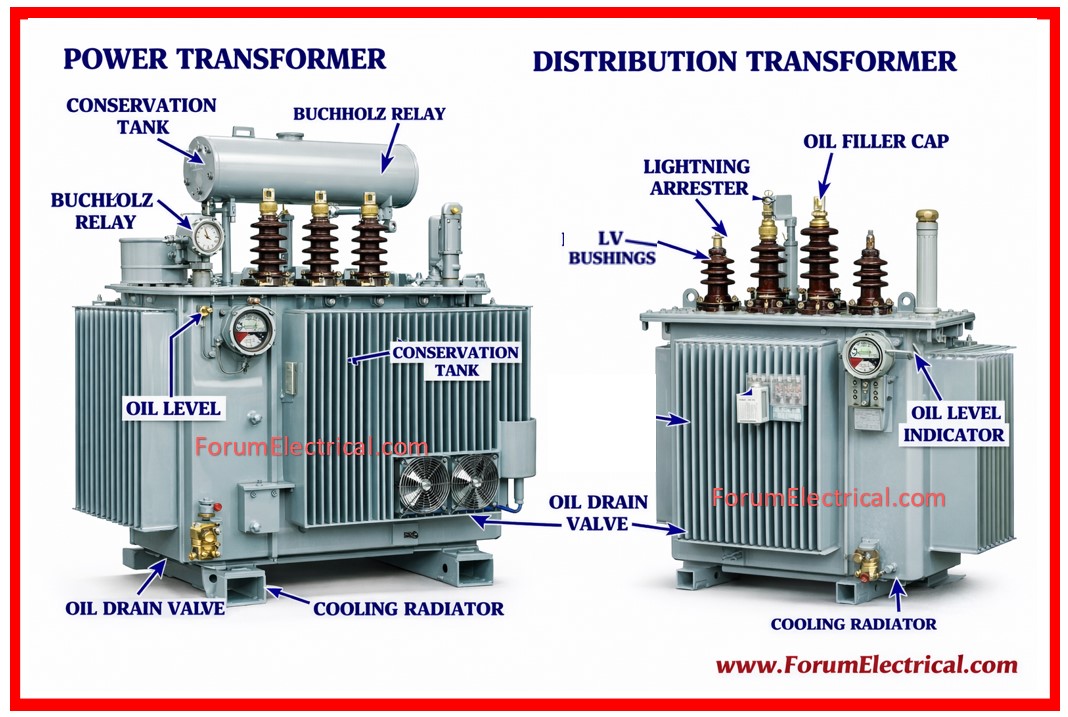
A transformer is a static electrical device that transfers electrical energy between 2 (or) more circuits through electromagnetic induction.
Calculator
⚡ Power & Distribution Transformer Sizing Calculator
IEEE / IEC Standard — Complete Electrical Engineering Design Tool
| ⚡ Winding Current & Voltage Analysis | |
|---|---|
| Primary Full-Load Current (line) | — |
| Secondary Full-Load Current (line) | — |
| Primary Phase Voltage | — |
| Secondary Phase Voltage | — |
| Inrush Current (estimated) | — |
| No-Load Excitation Current | — |
| 🔋 Loss & Efficiency Analysis | |
|---|---|
| Efficiency at Full Load (100%) | — |
| Efficiency at 75% Load | — |
| Efficiency at 50% Load | — |
| Voltage Regulation (at rated load) | — |
| Total Losses at Full Load | — |
| Optimum Load for Max Efficiency | — |
| Energy Loss per Year (at load factor) | — |
| 🌡️ Thermal, Fault & Derating Analysis | |
|---|---|
| Altitude Derating Factor | — |
| Temperature Corrected Rating | — |
| Estimated Hot-Spot Temperature | — |
| Insulation Class / Expected Life | — |
| Three-Phase Fault MVA (at LV bus) | — |
| Three-Phase Short-Circuit Current (LV) | — |
| Percentage Impedance (%Uz) | — |
| Resistance Component (%R) | — |
| Reactance Component (%X) | — |
Click here for more Electrical Calculators
You can also follow us on Facebook and Linkedin to receive daily updates.
Transformers are classified into 2 broad categories
1). Power Transformers and
2). Distribution Transformers
each serving distinct roles in the electrical power delivery chain.
Correct sizing of a transformer is one of the most important tasks in electrical system design.
An undersized transformer causes
1). Voltage drops,
2). Overheating and
3). Premature failure.
An oversized transformer results in unnecessary capital expenditure, excessive no-load losses and poor energy efficiency.
This post serves as the complete details for the Power & Distribution Transformer Sizing Calculator designed for use by electrical engineers, and consultants.
Transformer Types
| Type | Rating Range | Typical Application |
| Distribution | 5 kVA – 5,000 kVA | LV/MV feeders, industrial estates, commercial buildings |
| Power | 5 MVA – 100+ MVA | Grid substations, large industrial, generation step-up/down |
| Auto-Transformer | Varies | Voltage ratio 1.5:1 or less; railway traction, HV transmission |
Standards Reference
- IEEE C57.12.00: General Requirements for Liquid-Immersed Distribution, Power, and Regulating Transformers
- IEC 60076 Parts 1–7: Power Transformers (General, Temperature Rise, Insulation, Connections and Ability to withstand short circuit)
- IS 2026 (Parts 1–4): Indian Standard for Power Transformers
- BS 171: Specification for Power Transformers (British Standard)
- ANSI C57.91: Guide for Loading Mineral-Oil-Immersed Transformers
Input Parameters
The calculator is organized into 6 input sections covering all essential aspects of transformer specification.
Transformer Type & Application
| Parameter | Options | Typical Value | Engineering Notes |
| Transformer Type | Distribution / Power | Distribution for ≤ 5 MVA | Determines standard series (IEC/IEEE) |
| Cooling Method | ONAN, ONAF, OFAF, ODAF, KNAN, KNAF | ONAN (most common) | Affects rating, maintenance, cost |
| Phase Configuration | 3-Phase / 1-Phase | 3-Phase | Single-phase for rural, traction, special loads |
| Frequency | 50 Hz / 60 Hz | 50 Hz (India/Europe) | Core design changes with frequency |
Cooling Method Comparison
| Code | Full Name | Rating Multiplier | Application |
| ONAN | Oil Natural, Air Natural | 1.00× (Base rating) | Standard outdoor substations |
| ONAF | Oil Natural, Air Forced | 1.12 – 1.25x ONAN | Where ONAN is insufficient |
| OFAF | Oil Forced, Air Forced | 1.25 – 1.50x ONAN | Large power transformers |
| ODAF | Oil Directed, Air Forced | Up to 1.67x ONAN | EHV transformers > 100 MVA |
| KNAN | Dry Type, Natural Air | Rated directly | Indoor, fire-sensitive locations |
Load & Demand Parameters
Accurate load assessment is the foundation of correct transformer sizing.
| Parameter | Symbol | Typical Range | Definition & Guidance |
| Connected Load | kVA | – | Sum of all installed equipment ratings. Always in kVA. |
| Power Factor | pf | 0.75 – 0.95 | Ratio of kW to kVA. Industrial load typically 0.8–0.9 lagging. |
| Demand Factor | Fd | 0.5 – 0.9 | Max. demand / total connected load. Not all loads run simultaneously at full load. |
| Diversity Factor | FD | 1.0 – 1.5 | Sum of individual maxima / simultaneous maximum. Values > 1 reduce total demand. |
| Future Growth | % | 10 – 30% | Typical 20% for 10-year horizon. Add to design kVA before sizing. |
| Load Factor | LF | 0.5 – 0.85 | Average load / peak load over a period. Used for energy loss calculation. |
Design kVA = (Connected Load x Demand Factor / Diversity Factor) x (1 + Growth%/100) x (1 + Overload%/100)
Voltage & Winding Configuration
The voltage levels and winding arrangement determine the transformers turns ratio, winding currents and insulation class requirements.
| Parameter | Common Values | Typical | Notes |
| Primary (HV) Voltage | 0.415, 3.3, 6.6, 11, 33, 66, 110, 132, 220, 400 kV | 11 kV (MV) | Line-to-line voltage |
| Secondary (LV) Voltage | 0.240, 0.415, 0.433, 3.3, 6.6, 11 kV | 0.433 kV | LV distribution standard |
| HV Connection | Delta, Star, Zigzag | Delta | Delta eliminates 3rd harmonic from system |
| LV Connection | Star (with N), Delta | Star-N | Star with neutral provides 3-phase 4-wire supply |
| Vector Group | Dyn11, YNyn0, Yd1, Yyn0 | Dyn11 | Dyn11 most common for distribution |
| Neutral Grounding | Solid, Resistance, Reactance, Unearthed | Solid | Determines earth fault current levels |
Vector Group Reference
| Vector Group | HV/LV Connection | Phase Shift | Application |
| Dyn11 | Delta / Star-N | 30° lag | Standard 11/0.415 kV distribution transformer |
| YNyn0 | Star-N / Star-N | 0° | Grid & auto-transformers, parallel operation |
| Yd1 | Star / Delta | -30° | Generator step-up transformers |
| Yd11 | Star / Delta | +30° | Industrial rectifier transformers |
Electrical Characteristics
These parameters define the transformer’s electromagnetic and electrical performance and are critical for protection coordination, voltage regulation and efficiency analysis.
| Parameter | Symbol | Typical Values | Significance |
| Impedance Voltage | %Uz | 4 – 8% | Controls fault current; higher %Z = lower Isc but worse regulation |
| X/R Ratio | X/R | 5 – 15 | Ratio of leakage reactance to resistance. Higher for large units. |
| No-Load (Core) Loss | P₀ | 0.1 – 0.5% kVA | Present 24/7; energize-time loss in core iron. minimise with CRGO steel. |
| Full-Load (Cu) Loss | Pcu | 0.8 – 2% kVA | I²R loss in windings; varies as square of loading. |
| No-Load Current | I₀% | 0.3 – 2% | Magnetizing current; higher in older designs. |
| Inrush Current | — | 6 – 12x In | Occurs on energisation; decays in 100–500 ms. Affects protection settings. |
Standard Impedance Voltage by Rating (IEC 60076)
| Transformer Rating | Minimum %Uz | Typical %Uz | Maximum %Uz |
| ≤ 630 kVA | 4.0% | 4.5% | 6.0% |
| 631 – 1600 kVA | 5.0% | 5.75% | 6.5% |
| 1601 – 6300 kVA | 5.5% | 6.25% | 8.0% |
| > 6300 kVA | 6.5% | 8.0 – 12.5% | 12.5% |
Thermal & Environmental Parameters
Ambient conditions significantly affect the transformer rating.
The calculator applies IEC derating factors that is automatically based on altitude and ambient temperature inputs.
| Parameter | Symbol | Standard Value | Derating Guidance |
| Ambient Temperature | Ta | 40°C max | For each 1°C above 40°C it derate by 1% rated capacity |
| Altitude | H | ≤ 1000 m | Oil-type: 0.3% reduction per 100 m above 1000 m (IEC 60076 – 2) |
| Winding Temp. Rise | ΔTw | 65°C (oil), 80°C (dry) | Max permitted rise above ambient for insulation class |
| Hot-Spot Gradient | Hg | 13°C (ONAN) | Temperature difference between hot-spot and top oil. Per IEC 60076-7. |
| Top-Oil Temp. Rise | ΔTo | ~52°C (65°C class) | Typically 80% of winding temp rise for ONAN units. |
Insulation Thermal Classes
| Class | Max Temp (°C) | Hot-Spot Limit | Insulation Material | Remaining Life Impact |
| A | 105°C | 98°C | Cellulose/paper (standard oil TX) | Normal life: > 200,000 hrs (Montsinger rule) |
| E | 120°C | 113°C | Polyester film | Every 6°C above 98°C halves insulation life |
| B | 130°C | 123°C | Mica, glass fiber | Accelerated aging begins above class limit |
| F | 155°C | 145°C | Aramid paper (Nomex) | Dry-type transformers at elevated ratings |
| H | 180°C | 155°C | Silicone rubber | High ambient / traction applications |
Overload, Protection & Redundancy
Operational margin, system protection scheme and redundancy configuration determine the final rated kVA and quantity of transformer units required.
| Parameter | Typical | Range | Notes |
| Planned Overload | 10% | 0 – 30% | Short-term overload (< 2 hrs per IEC 60076-7). Reduces insulation life. |
| Utilization Factor | 0.80 | 0.6 – 0.9 | Economic loading limit to balance losses and asset life. |
| Redundancy (N) | – | Single unit | No standby; outage = loss of supply. |
| Redundancy (N+1) | – | 2 units | One standby unit. Recommended for critical installations. |
| Redundancy (2N) | – | 2 full-rated units | Full duplicate feed and transformer. Data centres, hospitals, defence. |
| Fault Level (HV bus) | 250 MVA | Site-specific | Determines LV fault current. Input from upstream network study. |
Output Parameters
The calculator generates a comprehensive set of outputs grouped into 4 analytical categories.
Primary Sizing Outputs
| Output | Unit | Description & Interpretation |
| Required kVA Rating | kVA | Minimum continuous rating accounting for all load, growth, and overload factors. |
| Recommended Standard Size | kVA | Next IEC/IEEE standard size above the required kVA. Use this for procurement. |
| Active Power Load | kW | Real power component. kW = kVA × Power Factor. |
| Reactive Power Load | kVAr | Reactive component. kVAr = kVA × sin(arccos(pf)). |
| Turns Ratio (N₁:N₂) | – | Ratio of HV to LV line voltage. Equals winding turns ratio for delta; scaled by √3 for star. |
Winding Current & Voltage Analysis
| Output | Unit | Formula & Significance |
| Primary Full-Load Current | A | 3-phase: I = kVA / (√3 × kVp). 1-phase: I = kVA / kVp. Size HV cables & protection to this. |
| Secondary Full-Load Current | A | 3-phase: I = kVA / (√3 × kVs). Determines LV busbar, cable, and breaker ratings. |
| Primary Phase Voltage | V | Voltage across each primary winding. Star: VL/√3. Delta: VL. |
| Secondary Phase Voltage | V | Voltage across each secondary winding. Used for winding insulation design. |
| Inrush Current | A | Estimated as (inrush multiplier) × Full-Load Secondary Current. Size protection with delay. |
| No-Load Excitation Current | A | I₀% × I rated / 100. Magnetising current drawn even at zero load. |
Loss & Efficiency Analysis
Transformer efficiency analysis is essential for energy cost assessments and compliance with IE Rules.
| Output | Unit | Formula & Engineering Significance |
| Efficiency @ Full Load | % | η = Output / (Output + P₀ + Pcu) × 100. Typically 98.5 – 99.5% for distribution TX. |
| Efficiency @ 75% Load | % | η₇₅ with Pcu scaled by 0.75² = 0.5625. Often the peak efficiency point. |
| Efficiency @ 50% Load | % | η₅₀ with Pcu scaled by 0.25. Relevant for lightly-loaded transformers. |
| Voltage Regulation | % | VR ≈ %R·pf + %X·sin(θ). Acceptable limit typically < 5% at full load. |
| Total Losses at Full Load | kW | P₀ + Pcu. Total heat dissipated; used for HVAC and cooling design. |
| Optimum Load for Max η | % of rated | At P₀ = Pcu. Load% = √(P₀/Pcu) × 100. Size TX to run near this point. |
| Annual Energy Loss | kWh/yr | = (P₀ × 8760) + (Pcu × LF² × 8760). Used for capitalized cost of losses. |
Thermal, Fault & Derating Analysis
| Output | Unit | Formula & Interpretation |
| Altitude Derating Factor | % | (1 – 0.003 × (H-1000)/100) × 100 for H > 1000 m. Per IEC 60076-2. |
| Temperature Corrected Rating | kVA | Rated kVA × altitude factor × temperature factor. Must exceed required kVA. |
| Estimated Hot-Spot Temp. | °C | Ta + Top-oil rise + Hot-spot gradient. Compared against insulation class limit. |
| Insulation Class & Life | — | Determined from hot-spot temp. Each 6°C above rated = 50% life reduction (Montsinger). |
| 3-Phase Fault MVA | MVA | = kVA rating / (%Uz / 100) / 1000. Represents maximum short-circuit power. |
| Short-Circuit Current (LV) | A | Isc = Fault MVA × 1000 / (√3 × kVs). Must be within LV switchgear Icu rating. |
| Resistance Component %R | % | = Pcu(W) / (kVA × 1000) × 100. Used in regulation and loss calculations. |
| Reactance Component %X | % | = √(%Uz² – %R²). Dominates voltage regulation in most transformers. |
Standard Transformer Sizes (IEC / IEEE)
The calculator automatically selects the next standard size above the calculated requirement from the IEC/IEEE preferred series.
| 5 kVA | 10 kVA | 15 kVA | 25 kVA | 37.5 kVA |
| 50 kVA | 63 kVA | 75 kVA | 100 kVA | 125 kVA |
| 160 kVA | 200 kVA | 250 kVA | 315 kVA | 400 kVA |
| 500 kVA | 630 kVA | 800 kVA | 1,000 kVA | 1,250 kVA |
| 1,600 kVA | 2,000 kVA | 2,500 kVA | 3,150 kVA | 4,000 kVA |
| 5,000 kVA | 6,300 kVA | 8,000 kVA | 10,000 kVA | 12,500 kVA |
| 16 MVA | 20 MVA | 25 MVA | 31.5 MVA | 40 MVA |
| 50 MVA | 63 MVA | 80 MVA | 100 MVA | 125 MVA |
How to use the Calculator?
Step-1: Open the calculator in your browser or embed in your WordPress site using the Custom HTML block.
Step-2: Select transformer type (Distribution or Power), cooling method, phase and frequency. These define the baseline standard series.
Step-3: Enter the total all connected load in kVA. Apply demand factor, diversity factor, future growth % and load factor. The calculator determines the design of the electrical load internally.
Step-4: Enter primary and secondary voltages in kV (line-to-line voltage). Select HV & LV winding connections and vector group. Choose neutral grounding configuration.
Step-5: Enter impedance voltage (%Uz), X/R ratio, no-load losses (W), full-load losses (W), no-load current (%) and inrush multiplier. These enable full loss and fault analysis.
Step-6: Enter ambient temperature (°C), site altitude (m), winding temperature rise class, hot-spot gradient and installation type.
Step-7: Set planned overload margin (%), utilisation factor, redundancy configuration, upstream fault level (MVA), and protection scheme.
Step-8: Click calculate transformer rating to generate all results instantly.
Step-9: Review the output tables. The ‘Final Standard Size Selected’ in the bottom card is the recommended procurement rating.
Step-10: Check all warning messages. If any derating warning fires, either select the next larger standard size (or) add forced cooling.
Solved Example
In 11 kV / 433 V Distribution Transformer
Given Data
| Parameter | Value |
| Total Connected Load | 800 kVA |
| Power Factor | 0.85 lagging |
| Demand Factor | 0.80 |
| Diversity Factor | 1.10 |
| Future Growth | 20% (10-year) |
| Primary Voltage | 11 kV (3-phase) |
| Secondary Voltage | 0.433 kV (3-phase, star-N) |
| Vector Group | Dyn11 |
| Impedance Voltage | 5.0% |
| No-Load Loss | 1,400 W |
| Full-Load Loss | 5,200 W |
| Ambient Temperature | 45°C |
| Altitude | 1,500 m above MSL |
| Planned Overload | 10% |
| Redundancy | None (N) |
Step-by-Step Calculation
Step 1: Demand Load
Design Load = (800 x 0.80) / 1.10 = 581.8 kVA
Step 2: Future Growth
Load with growth = 581.8 x 1.20 = 698.2 kVA
Step 3: Overload Margin
Required kVA = 698.2 x 1.10 = 768.0 kVA
Step 4: Turns Ratio
N₁:N₂ = 11 / 0.433 = 25.405 : 1
Step 5: Winding Currents (3-phase)
Primary Current (HV) = 768 / (√3 x 11) = 40.3 A
Secondary Current (LV) = 768 / (√3 x 0.433) = 1023.4 A
Step 6: Altitude Derating (1500 m)
Altitude factor = 1 – (0.003 x (1500-1000)/100) = 1 – 0.015 = 0.985 = 98.5%
Step 7: Temperature Derating (45°C ambient)
Temp factor = 1 – ((45-40) x 0.01) = 0.95 = 95.0%
Step 8: Derated Rating
Derated rating = 768 / (0.985 x 0.95) = 821.3 kVA (standard unit must exceed this)
Step 9: Standard Size Selection
Next IEC standard size above 821.3 kVA = 1000 kVA. Select 1000 kVA transformer.
Step 10: Efficiency at Full Load
η = (768,000 x 0.85) / ((768,000 x 0.85) + 1400 + 5200) × 100 = 98.89%
Step 11: Fault Current (LV)
Fault MVA = 768 / (5.0/100) / 1000 = 15.36 MVA
3-phase Isc = 15360 / (√3 x 0.433) = 20469 A ≈ 20.5 kA
Results
| Result | Value |
| Required kVA Rating | 768 kVA |
| Recommended Standard Size | 1000 kVA — Dyn11, 11 kV / 433 V, ONAN |
| Primary Current | 40.3 A |
| Secondary Current | 1,023 A |
| Efficiency (Full Load) | 98.89% |
| Voltage Regulation | 3.84% |
| 3-Ph Fault Current (LV) | 20,469 A (20.5 kA) |
| Hot-Spot Temperature | 45 + 52 + 13 = 110°C — within Class A |