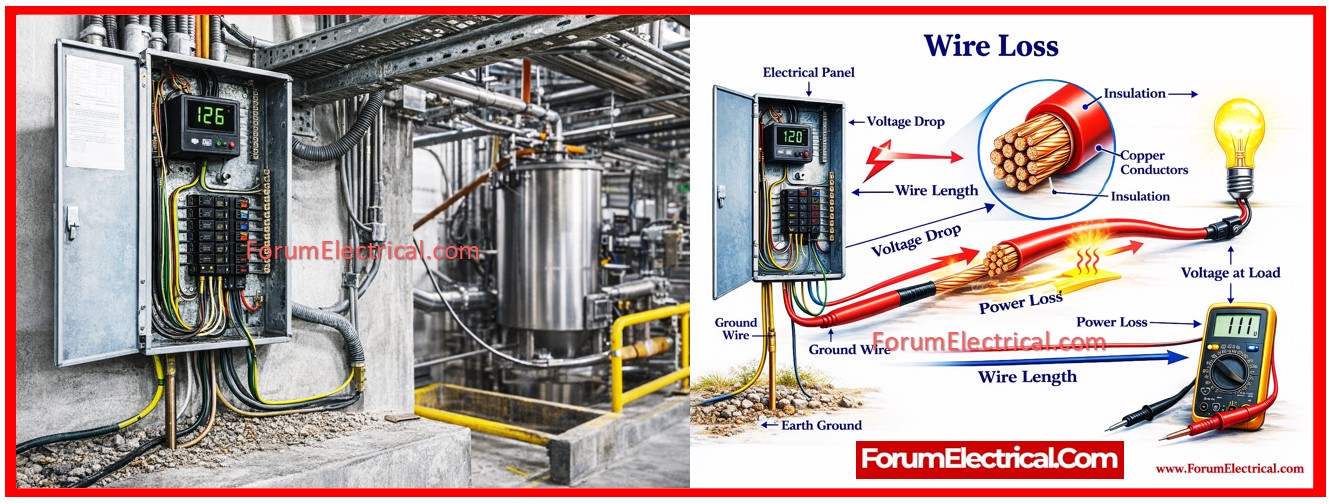
Wire loss also called cable loss, voltage drop (or) conductor loss is the reduction in electrical energy that occurs when current flows through a conductor.
Calculator
Wire Loss Calculator
DC & AC Electrical Cable Voltage Drop & Power Loss
Click here for more Electrical Calculators
You can also follow us on Facebook and Linkedin to receive daily updates.
Understanding and calculating wire loss is essential for any electrical installation from residential wiring to industrial power systems and solar PV arrays.
This post explains every parameter involved in wire loss calculation presents the governing formulas and power loss in cables.
Why Wire Loss is Important?
- Motors may fail to start (or) overheat if supply voltage drops below rated value.
- LED drivers and electronic equipment are sensitive to voltage variation.
- Excessive power loss means wasted energy and higher electricity bills.
- Most electrical codes limit voltage drop to 3% (final circuit) or 5% (total installation).
- Solar PV and battery systems suffer significant yield loss with undersized cables.
Input Parameters
The wire loss calculator requires the following electrical and cable parameters.
| Parameter | Symbol | Unit | Description |
|---|---|---|---|
| Load Current (A) | I | Amperes (A) | The actual current drawn by the load. For AC circuits, this is the RMS current. |
| System Voltage (V) | V | Volts (V) | The nominal supply voltage at the source end of the cable. |
| Power Factor | cosφ | 0 to 1 (unitless) | Ratio of real to apparent power. Use 1.0 for purely resistive DC loads. |
| System Type | – | DC / 1-Ph / 3-Ph | DC uses 2xL loop length; 3-phase uses √3 multiplier in voltage drop formula. |
| Cable Length (m) | L | Metres (m) | One-way length from source to load. The calculator doubles this for DC loop. |
| Cable CSA (mm²) | A | mm² | Cross-sectional area of the conductor. Larger CSA = lower resistance. |
| Conductor Material | ρ | Copper / Aluminium | Copper: 0.01724 Ω·mm²/m at 20°C. Aluminium: 0.02825 Ω·mm²/m. |
| Temperature (°C) | T | Degrees Celsius | Resistance increases with temperature. Reference is 20°C. |
| Parallel Conductors | n | Integer | Multiple conductors in parallel reduce effective resistance proportionally. |
| Reactance XL (mΩ/m) | XL | mΩ/m | AC only. Cable inductive reactance. Typically 0.06–0.08 mΩ/m for LV cables. |
| Allowed Drop (%) | – | Percentage | Maximum permissible voltage drop. Calculator flags when this is exceeded. |
Wire Loss Formulas
The following formulas are used to calculate wire resistance, voltage drop, power loss and efficiency for DC, single phase AC and three phase AC systems.
Temperature: Corrected Resistivity
ρT = ρ₀ × [1 + α × (T − 20)]
Where
ρ₀ – Resistivity at 20°C (copper: 0.01724, aluminium: 0.02825 Ω·mm²/m)
α – Temperature coefficient (copper: 0.00393, aluminium: 0.00403 per °C)
T – Actual operating temperature in °C
Conductor Resistance
R = ρT × Ltotal / (A × n)
Ltotal = 2 x L for DC (both go and return conductors); L for AC (per-phase length)
A – Cross sectional area in mm²
n – Number of parallel conductors per phase
Voltage Drop Formulas
| Formula | Parameters | Application |
|---|---|---|
| Vdrop = I x R | I = current (A)R = resistance (Ω) | DC Systems |
| Vdrop = I x R | Single phase, resistive dominant | Single-Phase AC (simplified) |
| Vdrop = I x (Rcosφ + X sinφ) | Full impedance model | Single-Phase AC (precise) |
| Vdrop = √3 x I x (Rcosφ + X sinφ) | √3 accounts for line-to-line geometry | Three-Phase AC |
| Ploss = I² × R | Ohmic / Joule heating loss | All systems |
| Ploss(3ph) = 3 x I² x R | Three conductors each dissipate | Three-Phase AC |
| Efficiency = (Pin − Ploss) / Pin × 100% | Pin = V x I x cosφ (x√3 for 3ph) | All systems |
Output Parameters
The wire loss calculator provides 8 calculated results and each giving valuable insight into cable performance.
Conductor Resistance (R) in Ohms
The total DC resistance of the cable circuit corrected for temperature and accounting for multiple parallel conductors.
Voltage Drop (V)
This is absolute voltage lost across the wire. For a 230 V supply with a 5 V drop the load receives 225 V. Important for compliance with IEC & NEC voltage drop limits.
Voltage Drop (%)
Voltage drop expressed as a percentage of the source voltage. The most commonly referenced figure in electrical standards. IEC 60364-5-52 recommends a maximum of 3% for final circuits and 5% for the total installation.
Power Loss (W)
Heat energy that is dissipated in the cable conductors calculated by Joules law.
P = I²R
This energy is used to be permanently lost & it represents a direct operating cost.
Receiving-End Voltage (V)
The actual voltage that is available at the load terminals after accounting for the cable drop. Compare this against the minimum operating voltage of the equipment.
Efficiency (%)
The ratio of power delivered to the load vs power that is drawn from the source. A cable system at 98% efficiency is generally acceptable & < 95% indicates significant loss.
Energy Loss per Hour (Wh)
Watt hours of energy wasted / hour of operation. Multiply this by daily operating hours & electricity tariff to calculate annual cost of wire loss.
Minimum CSA for Allowed Drop (mm²)
The smallest cable cross sectional area that maintains voltage drop within the specified limit.
Utilize this as a minimum cable sizing guide alongside the current carrying capacity requirements.
Frequently Asked Questions
1). What is voltage drop in electrical wiring?
Voltage drop is the reduction in voltage that is occurs as current flows through a conductor due to its electrical resistance (and reactance in AC systems).
Ohms law (V = IR) used to governs this and the greater the current (or) resistance the larger the voltage drop.
2). What is the maximum allowable voltage drop?
Most electrical codes specify:
- IEC 60364 – 3% for final circuits and 5% total.
- NEC (USA) – 3% for branch circuits and 5% total (feeders + branch).
Solar PV standards like IEC 62548 that is often require 1-2% maximum. Always check the local regulations.
3). What causes voltage drop in wires?
The main causes are:
- Long cable runs increasing total resistance,
- High load current,
- Undersized cable (small CSA),
- High conductor temperature,
- Poor connections with high contact resistance and
- Use of aluminium instead of copper conductors.
Standard Cable Resistance Reference
The following table shows typical resistance values for common copper cable sizes at 20°C.
Values are per meter per conductor.
| CSA (mm²) | R copper (mΩ/m) | R aluminium (mΩ/m) | Typical Rating (A) |
|---|---|---|---|
| 1.5 | 12.10 | 19.84 | 15–18 |
| 2.5 | 7.41 | 12.15 | 21–27 |
| 4 | 4.61 | 7.56 | 28–36 |
| 6 | 3.08 | 5.05 | 36–46 |
| 10 | 1.83 | 3.00 | 50–63 |
| 16 | 1.15 | 1.89 | 66–85 |
| 25 | 0.727 | 1.19 | 85–110 |
| 35 | 0.524 | 0.868 | 105–135 |
| 50 | 0.387 | 0.641 | 123–160 |
| 70 | 0.268 | 0.443 | 155–200 |
| 95 | 0.193 | 0.320 | 188–245 |
| 120 | 0.153 | 0.253 | 216–282 |

