
Calculator
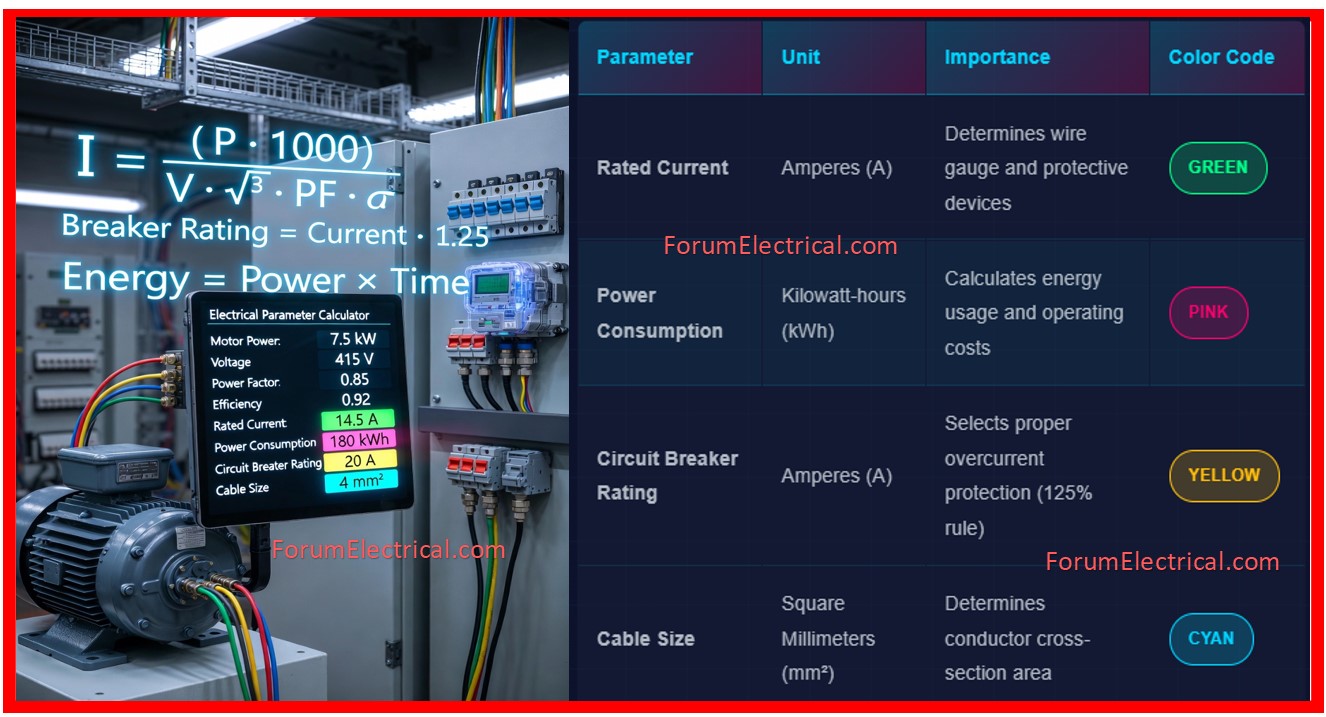
Electrical Parameter Calculator
Industrial Electrical Parameters
Click here for Electrical Calculators
The Electrical Parameter Calculator is an online calculator tool designed for electrical engineers, technicians and industrial professionals.
If you are designing motor circuits, selecting proper protection devices (or) calculating power consumption, this calculator delivers accurate results based on the industry standard formulas.
Calculation Formulas
Single-Phase Current Calculation
I = (P x 1000) / (V x PF x η)
Where
I – Rated Current (A)
P – Motor Power (kW)
V – Voltage (V)
PF – Power Factor
η – Efficiency
Three-Phase Current Calculation
I = (P x 1000) / (V x √3 x PF x η)
Where
I – Rated Current (A)
P – Motor Power (kW)
V – Voltage (V)
PF – Power Factor
η – Efficiency
√3 – 1.732 (constant for all three-phase systems)
Power Consumption
Energy = Power x Time
E = P x t (kWh)
Example: 7.5 kW x 24 hours = 180 kWh/day
Circuit Breaker Rating
Breaker Rating = Calculated Current x 1.25 (Rounds up to next standard rating)
Standard Breaker Ratings: 10A, 15A, 20A, 25A, 32A, 40A, 50A, 63A, 80A, 100A, 125A.
Technical Specifications
Input Parameters Range
Motor Power: 0.1 kW – Unlimited
Voltage: 208V to 600V
Power Factor: 0.5 to 1.0 (typical: 0.8 – 0.9)
Efficiency: 0.5 to 1.0 (typical: 0.85 – 0.95)
Operating Time: 1 hour to 24+ hours/day
Cable Sizing Database
The calculator includes comprehensive cable sizing tables for both the single-phase and three-phase systems:
Current range: 10A to 200A+
Cable sizes: 1.5mm² to 95mm² (up to 200mm²)
Based on IEC 60364 and similar standards.
Standard Breaker Ratings
Supports all the common industrial circuit breaker ratings with automatic selection based on the calculated current:
10A, 15A, 20A, 25A, 32A, 40A, 50A, 63A, 80A, 100A, 125A, 160A, 200A, 250A, 315A, 400A, 500A.
How to use the Calculator?
Step-1: Enter Motor Power
Input the motor power rating in kilowatts (kW).
Example: A 7.5 kW motor is common in industrial applications.
Step-2: Select Power Supply Type
Choose between Single-Phase (residential/light commercial) (or) Three-Phase (industrial standard).
Three-phase motors are more efficient and require different calculation formulas.
Step-3: Choose Voltage
Select your required electrical system voltage.
Industrial facilities typically uses 220V, 230V for single-phase systems and 380V, 400V, 415V, 420V (or) 440V three-phase systems.
Residential systems uses 220V (or) 240V single-phase.
Step-4: Set Power Factor
Power factor (PF) ranges from 0.5 to 1.0 with a typical values between 0.8-0.9 for motors.
Step-5: Enter Efficiency
Motor efficiency is typically ranges from 0.85 to 0.95 (85%-95%).
Higher efficiency motors consume a very less current.
Step-6: Operating Time
Enter how many hours/day that the motor operates.
This calculates total energy consumption for the cost (requirement) estimation.
Step-7: Calculate
Click the Calculate parameters button to get accurate results with all 4 electrical parameters.
Essential Electrical Parameters Results
Our calculator quickly calculates the 4 essential electrical parameters that form the foundation of every motor circuit design:
| Parameter | Unit | Importance | Color Code |
|---|---|---|---|
| Rated Current | Amperes (A) | Determines wire gauge & protective devices | GREEN |
| Power Consumption | Kilowatt-hours (kWh) | Calculates energy usage & operating costs | PINK |
| Circuit Breaker Rating | Amperes (A) | Selects the proper overcurrent protection (125% rule) | YELLOW |
| Cable Size | Square Millimeters (mm²) | Determines the conductor cross-section area | CYAN |
Frequently Asked Questions (FAQ)
1). What is the main difference between single-phase and three-phase motor?
The difference between a single phase (1 phase) and three phase (3 phase) motor is that a single phase motor requires a capacitor to start since it only use to generate an alternate field.
The three phase motor generates a rotating magnetic field so it does not requires any capacitor.
2). What is the 125% rule for Breakers?
The 125% rule for breakers means that the a circuit breaker should be rated at 125% of the continuous load current to prevent the nuisance tripping and to ensure safe operation.
Continuous loads are those that run for 3 hours (or) more.
Since breakers can heat up over time they are not designed to carry a 100% of their rated current continuously without margin.
Therefore, the breaker size should be increased to 125% of the continuous load.
Formula
Breaker Rating = Continuous Load x 1.25
Comply with NEC standards (NEC 210.20 & NEC 215.3)
3). How do I choose the correct cable size?
Cable size must be selected based on:
• Calculated motor current (larger current = larger cable).
• Distance from the source to motor (longer distances require larger cables).
• Acceptable voltage drop (usually at 3-5% maximum).
• Ambient temperature and installation method.
The calculator provides the minimum recommended size.
Always consult a local electrical codes and engineer specifications.