1). What is Preventive Maintenance?
Preventive maintenance is the process of inspecting, testing and servicing electrical equipment at regular intervals to prevent unexpected failures and ensure reliable operation.
It helps to increase equipment lifespan, reduce downtime and improve system safety.
Preventive maintenance include:
• Insulation resistance testing,
• Cleaning electrical panels,
• Tightening electrical connections,
• Checking transformer oil level etc.
2). What is Predictive Maintenance?
Predictive maintenance is a maintenance technique that uses condition monitoring tools to detect early signs of the equipment deterioration and predict potential failures before they occur.
This maintenance procedure helps in scheduling maintenance only when required thereby reducing the unnecessary maintenance and preventing unexpected breakdowns.
Common predictive maintenance methods include:
• Thermographic inspection,
• Vibration analysis,
• Oil analysis etc.
3). What is Insulation Resistance?
Insulation resistance is the resistance provided by the insulation material between electrical conductors and earth (or) between conductors.
It indicates the condition of insulation and is measured using a Megger in megaohms (MΩ).
Higher insulation resistance indicates a better insulation condition.
4). What is the minimum insulation resistance (IR) value for a motor?
The minimum insulation resistance (IR) value for a motor must be at least 1 megaohm (1 MΩ) per kilovolt (i.e., 1 MΩ/kV) of operating voltage plus 1 megaohm(1 MΩ).
For example: A 415 V motor must have a minimum value insulation resistance of at least 1 megaohm (1MΩ) to ensure a safe operation.
5). What is a Megger?
A Megger is a portable measuring instrument that is used to measure the insulation resistance (IR) by applying a high DC voltage to the equipment.
Megger is commonly utilized to test the transformers, motors, cables & switchgear to ensure insulation integrity.
6). What causes Motor Overheating?
Motor overheating occurs due to abnormal operating conditions that increase the internal temperature beyond a permissible limit.
The common causes include:
• Overloading of the motor,
• Single phasing condition,
• Poor ventilation,
• Bearing failure,
• Low (or) unbalanced voltage supply.
7). What is Single Phasing?
Single phasing is a condition in which one phase of a three-phase power supply is lost while the motor is running.
This condition causes excessive current flow in the remaining phases leading to overheating and damage to the motor winding.
8). What is Earthing?
Earthing is the process of connecting the metallic parts of electrical equipment to the earth using a low resistance conductor.
This provides a safe path for the fault current to flow into the ground thereby protecting the equipment and personnel from an electrical shock.
9). What is the purpose of Earthing?
The primary purpose of earthing is to ensure safety and proper operation of electrical systems.
It helps to:
• Protect human beings from electric shock,
• Protect equipment from damage,
• Provide a path for fault current,
• Stabilize system voltage.
10). What is the difference between MCB and MCCB?
| MCB | MCCB |
| An MCB (Miniature Circuit Breaker) is used for the low current applications typically up to 100 A and has fixed protection settings. | An MCCB (Molded Case Circuit Breaker) is used for the higher current applications up to 3200 A and has adjustable protection settings for overload and short circuit protection. |
11). What is a Circuit Breaker?
A circuit breaker is a protective switching device used to interrupt electrical current automatically during abnormal conditions such as overload (or) short circuit.
It protects electrical equipment from damage by isolating the faulty section.
12). What is the difference between Isolator and Circuit Breaker?
| Isolator | Circuit Breaker |
| An isolator is a mechanical switching device used to disconnect equipment from the power supply under no load conditions. | A circuit breaker is capable of interrupting current under both normal & fault conditions. |
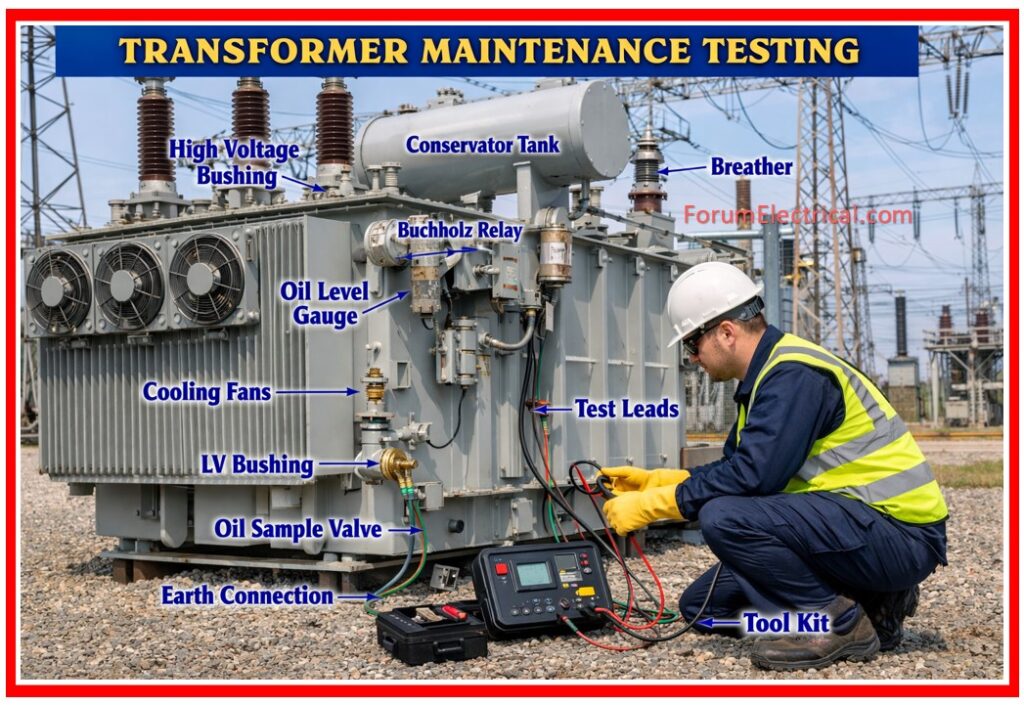
13). What maintenance is required for a transformer?
Transformer maintenance involves a regular inspection and testing to ensure the reliable operation.
The primary maintenance steps include:
• Checking the transformer oil level,
• Measuring the insulation resistance,
• Testing transformer oil dielectric strength (BDV),
• Inspecting bushings & connections.
14). What is the function of Transformer Oil?
Transformer oil serves 2 primary functions.
• It provides the electrical insulation between all transformer components.
• It helps in cooling the all transformer by dissipating the heat generated during operation.
15). What is Dielectric Strength of Transformer Oil?
Dielectric strength is the ability of transformer oil to withstand electrical stress without any breakdown.
It is measured in kilovolts (kV) and a higher dielectric strength indicates a better insulating properties of the oil.
16). What is a Relay?
A relay is a protective device that is used to detect abnormal electrical conditions such as overload, short circuit (or) earth fault & sends a signal to the circuit breaker to isolate the faulty section.
17). What is overload?
Overload is a condition in which the electrical equipment draws more current than its rated capacity for an extended period.
This may cause overheating and damage to the equipment if not properly protected.
18). What is a short circuit?
A short circuit is a fault condition in which a very low resistance path is formed between two conductors (or) between a conductor and ground.
This results in excessive current flow that can damage equipment.
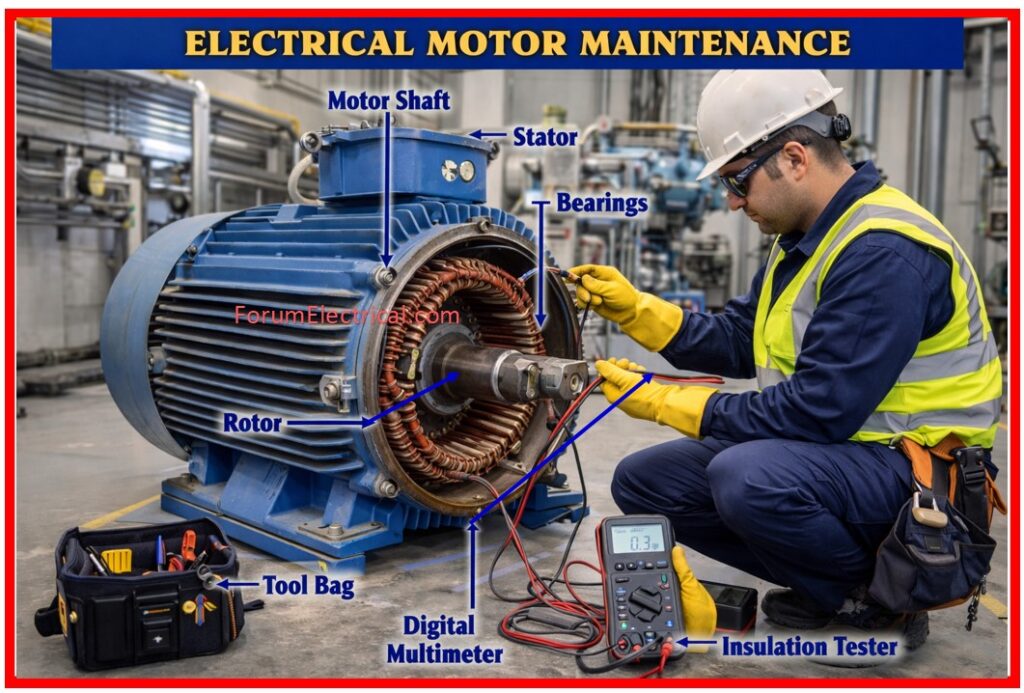
19). What maintenance should be performed on a motor?
Motor maintenance must be performed regularly to ensure a proper operation and reliability.
It includes:
• Checking insulation resistance,
• Inspecting bearings,
• Checking alignment,
• Monitoring temperature.
20). What is an Earth Fault?
An earth fault occurs when a live conductor comes into contact with the earth (or) grounded equipment causing fault current to flow through the earth path.
21). What is Phase Sequence?
Phase sequence refers to the order in which the three phases (3 phases) reach their maximum voltage values.
The correct sequence ensures proper rotation of three phase motors.
22). What is the purpose of a Current Transformer (CT)?
A current transformer is used to reduce high current to a lower measurable value for the use in meters and protective relays.
It also provides isolation between the high voltage and measuring instruments.
23). What is the purpose of a Voltage Transformer (VT)?
A voltage transformer is used to reduce high voltage to a lower standard value suitable for the measurement and protection purposes.
24). What happens if the phase sequence is wrong?
If the phase sequence is wrong the motor will rotate in the opposite direction which may damage the equipment (or) affect the process.
25). How do you troubleshoot a motor that is not starting?
When troubleshooting a motor that is not starting the following checks must be performed:
• Check power supply voltage,
• Check circuit breaker condition,
• Check contactor operation,
• Check overload relay condition,
• Check the motor winding condition.

