
Introduction
Electrical drive panels are the foundation of the industrial motor control systems.
- Introduction
- What is an Electrical Drive Panel?
- What is a Standard Operating Procedure (SOP)?
- Importance of SOPs in Electrical Drive Panel Maintenance
- Scope
- Roles and Responsibilities
- Safety Precautions
- Procedure
- A). Pre-Maintenance Procedure
- B). Main Maintenance Procedure
- C). Post-Maintenance Procedure
- Documentation
- Standard Operating Procedure (SOP)
- Conclusion
They use advanced electronic devices such as variable frequency drives (VFDs) or direct current drives to control the speed, torque & direction of electric motors.
These panels are widely utilized in process industries, utilities & manufacturing facilities that require accurate control and energy efficiency.
Routine maintenance of these panels is essential for ensuring reliability, preventing malfunctions and maintaining safety.
Dust accumulation, weak connections and insulation degradation can all have an impact on performance and lead to serious failures like short circuits and arc flashes.
As a result, a planned maintenance routine is required to keep the panel in optimal condition.
What is an Electrical Drive Panel?
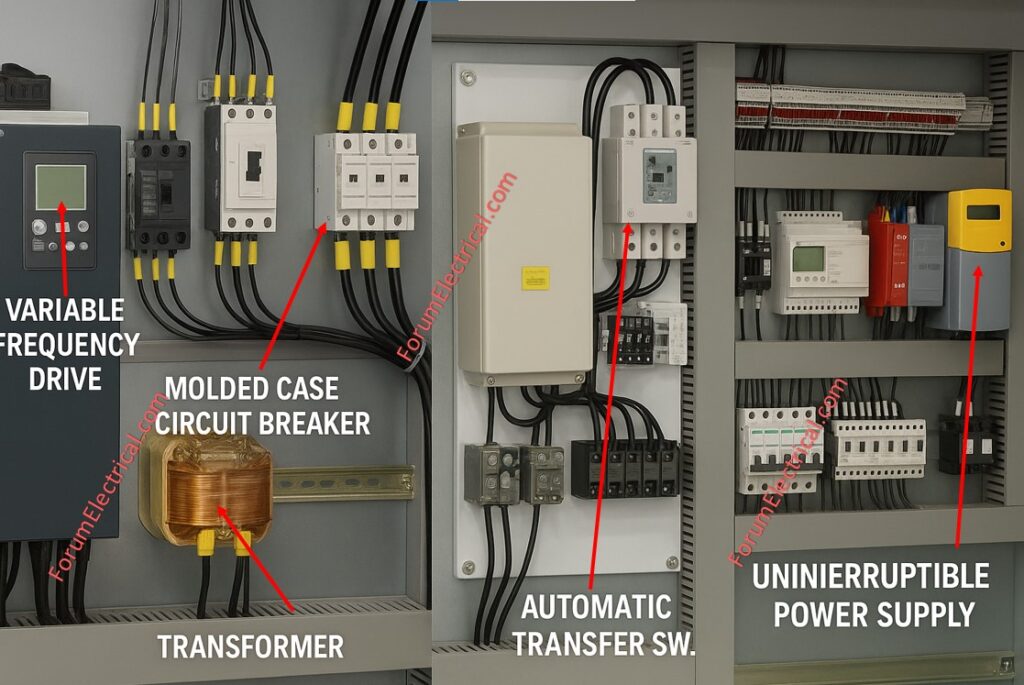
An Electrical Drive Panel is a box that contains control & protection equipment for electric motors.
Its primary duty is to regulate the motor’s functioning by using a
- Variable Frequency Drive (VFD) (or)
- Soft Starter
to adjust the speed and torque in response to process requirements.
Main Components Include:
Incoming Circuit Breaker / Isolator: Provides power isolation and protection.
Rectifier & Inverter Modules: Rectifier and inverter modules convert AC to DC and then back to variable frequency AC.
Contactors and Relays: Contactors and relays control switching & interlocks.
Overload Relays & Fuses: Protect against faults.
Control Circuit Wiring: Connects all logic & sensing components.
HMI or Display: Allows monitoring & operation of the drive.
Cooling Fans & Filters: Control the temperature & prevent overheating.
Each component must function properly to ensure continued & safe operation making preventative maintenance an essential duty.
What is a Standard Operating Procedure (SOP)?
A Standard Operating Procedure (SOP) outlines step-by-step instructions for doing specified tasks safely and efficiently.
In terms of electrical maintenance, a SOP ensures that all technicians use uniform and safe techniques when maintaining equipment.
It specifies responsibilities, safety precautions and maintenance sequences in order to reduce human error preserve electrical compliance and assure accessible documentation of all maintenance procedures.
Importance of SOPs in Electrical Drive Panel Maintenance
Electrical systems run at high voltages and feature components that store a lot of energy. Performing maintenance without standard criteria may result in:
- Electric shock
- Arc flash occurrences
- Equipment Damage
- Unplanned downtime
An SOP ensures:
Safety Compliance: Before performing maintenance, technicians follow lockout/tagout (LOTO) & isolation measures.
Operational Consistency: All tasks are completed in the same, verifiable order.
Documentation: Maintenance records are retained for future reference and audits.
Reliability: Reduces premature failures and assures peak driving performance.
Regulatory Conformity: Compliant with worldwide safety standards such as NFPA 70E, IEC 60204 & local electrical codes.
Scope
This SOP is applicable to all electrical drive panels utilized in
- Low-Tension (LT) and
- High-Tension (HT) systems
that control motors, pumps, compressors (or) conveyors.
It is designed for electrical maintenance engineers, technicians, safety officials and supervisors who check and service control and drive panels.
Roles and Responsibilities
- Maintenance Technicians: Maintenance Technicians perform maintenance chores and adhere to safety regulations.
- Section Incharge: Verify isolation, supervise work & ensure procedural adherence.
- Control Room Operator: helps to coordinate power isolation and re-energization.
Safety Precautions
- Maintain Lockout/Tagout (LOTO) protocols at all times.
- Only use tools that are insulated and tested.
- Keep fire extinguishers & first aid kits nearby.
- Never work on electrified circuits unless absolutely required.
- Maintain a safe distance from live parts.
- For high-voltage work, use suitable PPE such as arc-rated clothing.
- To avoid component damage do not use compressed air at high pressures.
- Always check for zero energy prior to starting to work.
Procedure
A drive panel’s maintenance is divided into three primary procedures:
- Pre-Maintenance Procedures: Preparation, isolation & safety procedures.
- Main maintenance Procedures: include cleaning, inspection, tightening & testing.
- Post-Maintenance Procedures: Re-energizing, verifying and documenting.
Each procedure is distinguished by its own set of safety measures, responsibilities and procedures.
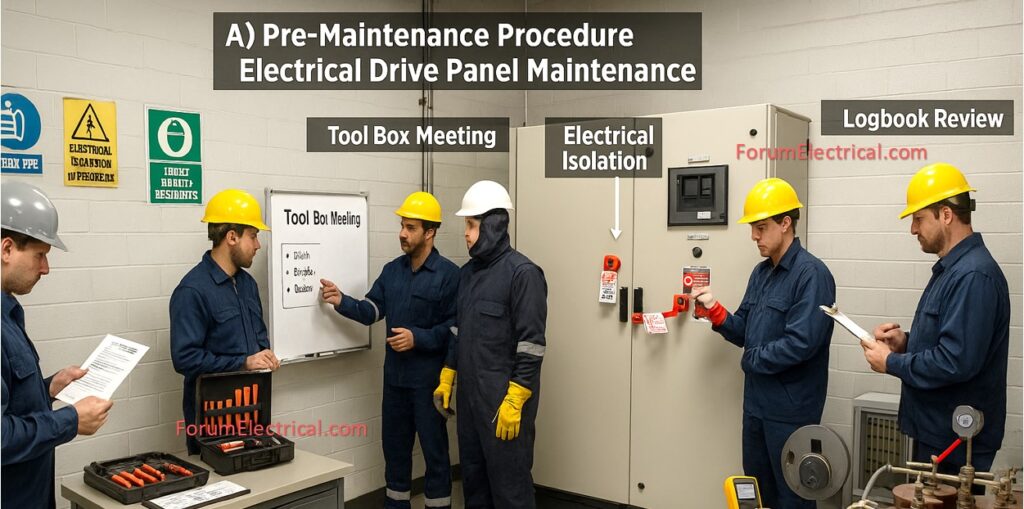
A). Pre-Maintenance Procedure
This procedure guarantees that the drive panel is entirely separated and safe to operate.
Key Procedures:
Before performing maintenance, obtain written authority from the control room or shift incharge.
Ensure that the permission is properly documented.
Conduct a Tool Box Meeting to discuss scope of work, safety precautions and assign duties to team members.
Collect and use insulated tools such as screwdrivers, torque wrenches and multimeters. Verify their condition before utilization.
Wear appropriate personal protection equipment (PPE) such as gloves, arc flash suits, helmets, goggles and shoes.
To isolate an electrical system, de-energize it by opening breakers, removing isolators and checking voltage with a tester.
To apply LOTO (Lockout/Tagout), secure isolated sites with personal locks and affix warning tags.
Check logbook for maintenance history, faults and anomalous readings.
Record Pre-Maintenance Measure operational voltage, current, speed, temperature & vibration.
To discharge stored energy, wait 5-10 minutes and check zero voltage across DC bus capacitors before contacting internal parts.
These measures are crucial for removing electrical, mechanical, and stored energy dangers before beginning maintenance.
B). Main Maintenance Procedure
This procedure involves inspecting, cleaning, testing & tightening procedures.
Key Procedures:
To clean, carefully open panel doors and use low-pressure compressed air (less than 30 PSI) to remove dust.
Use lint-free towels and keep delicate electronics protected.
Inspect components for burn marks, discolouration, broken insulation and loose terminals.
To check power contacts and relays, clean the contact surfaces, inspect for pitting (or) wear & test mechanical operation.
Check auxiliary devices, including meters, overload relays & coils for appropriate operation.
To tighten busbars, MCBs and connectors use a torque wrench according to manufacturer requirements.
Check cooling and filters by cleaning or replacing clogged filters and ensuring proper fan rotation.
To reassemble, remove any tools and close all covers and latches firmly.
Each step must be carefully followed to avoid mechanical damage (or) reassembly problems.
C). Post-Maintenance Procedure
The final step is to check functionality and restore normal operation.
Key Procedures:
Clear the work area by removing any tools, garbage and cleaning items. Maintain proper housekeeping.
Conduct a control trial to test circuits, interlocks & emergency stop switches prior to complete energization.
Check HMI and Display Units by testing the alarm, display & touchscreen functionalities. Ensure that communication with the driver is healthy.
To power on the drive, remove LOTO locks and recharge gradually observing startup performance.
When monitoring operation keep attention out for any unexpected vibrations, temperature changes or sounds.
Update documentation by recording readings, component replacements and upcoming maintenance dates in the logbook.
This guarantees that the system is safely recovered and operates within normal parameters.
Documentation
Proper documentation is essential for traceability and ongoing improvement.
All maintenance tasks must be documented in the logbook (or) digital maintenance management system (CMMS) which include:
- Panel Identification Details
- Date and length of maintenance
- Work accomplished
- Observations & Test Results
- Replaced parts
- Signature of the technician and supervisor
Records are used as a reference for future maintenance planning & fault analysis.
Standard Operating Procedure (SOP)
Conclusion
A properly organized SOP for Electrical Drive Panel Maintenance improves operational reliability, employee safety and overall plant performance.
It ensures that all maintenance tasks from isolation to re-energization are completed systematically and securely.
Following SOPs reduces electrical dangers like arc flashes and short circuits, increases equipment life & provides a uniform basis for documentation & audits.
Regular training, correct PPE use and adherence to established procedures are essential components of a safe and effective electrical maintenance system.

 for Electrical Drive Panels: guidelines for safe operation, inspection, start-up, shutdown, maintenance and fault handling.)