
Understanding the functioning of an electrical networks under various operating conditions is more essential in power system engineering to ensure stability, reliability & equipment protection.
- Load Flow Analysis (Power Flow Study)
- Purpose
- Scope
- Objective
- Method and Analysis
- Static Motor Starting Study
- Purpose
- Scope
- Objective
- Method & Analysis
- Difference between Load Flow Analysis & Static Motor Starting Study
- 1). System Scope
- 2). Operating Conditions
- 3). Engineering Purpose
- 4). Output Parameters
- 5). Impact Assessment
- Load Flow Analysis vs Static Motor Starting Study
- Conclusion
Two major commonly used studies are:
1). Load Flow Analysis and
2). Static Motor Starting Study
which provide essential insights into how electrical systems perform under steady-state and motor-starting conditions.
Although both analyses involve assessing the voltages, currents & power conditions, their objectives, scope & outcomes differ in all significantly.
This detailed comparison describes each study’s objectives, methods and the important differences that engineers must recognize during the system design, commissioning & troubleshooting.
Load Flow Analysis (Power Flow Study)
Purpose
To calculate the steady-state operating conditions of an electrical power system which includes voltages, currents, active/reactive power flow and system losses.
Scope
Load flow analysis considers the entire electrical network, including:
1). Generators
2). Transmission lines
3). Distribution feeders
4). Transformers
5). Loads
6). Reactive power compensation devices.
Objective
To ensure:
The system voltage levels stay within allowed limits.
Efficient and steady power transmission.
Optimal load on transformers, wires and generators &
Effective reactive power management.
Method and Analysis
Load flow analysis measures:
Bus voltages (magnitude and angle),
Each node receives both reactive and real power injection,
Line Currents & losses,
Voltage falls under normal steady-state settings.
It helps engineers to decide:
Load balance,
Capacitor or reactor placement,
Transformer Tap Settings &
Network reconfiguration to minimize losses.
Static Motor Starting Study
Purpose
To study how motors function under starting conditions such as voltage drops, strong inrush currents & torque performance.
Scope
Individual motors and their feeders, upstream transformers and system strength are all checked throughout the startup procedure.
Objective
To ensure:
Motors start reliably and without stalling
There is no excessive voltage drop in the system.
Other associated loads are not negatively affected.
Protection devices are well coordinated.
Method & Analysis
This study evaluates:
Starting current is typically 4-7 times FLA for the induction motors,
Voltage drops at motor terminals and system buses,
Motor torque against load torque &
System response under transient motor starting conditions.
It also determines that:
Soft starts and VFDs are necessary,
The autotransformer (or) star-delta starting system must be employed &
The power system is in good condition enough for the direct-on-line (DOL) starting.
Difference between Load Flow Analysis & Static Motor Starting Study
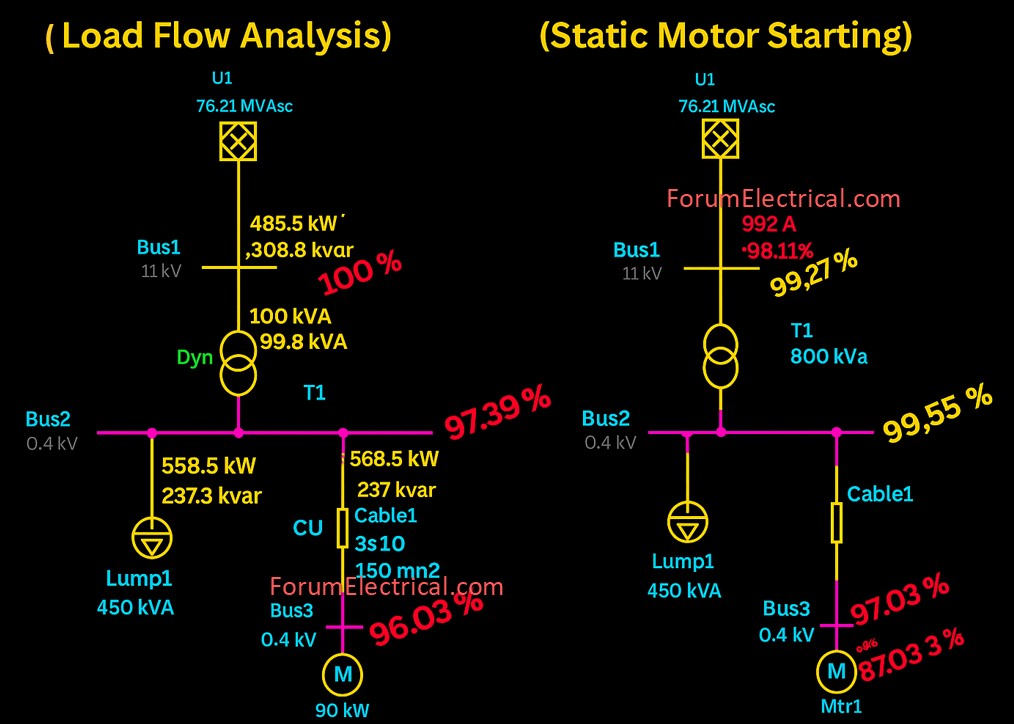
The figures demonstrate how steady-state performance is different from abrupt motor-starting operation.
The illustration compares Load Flow Analysis & Static Motor Starting Study with simplified single-line diagrams.
In the Load Flow Analysis, the system is in normal steady-state mode with stable voltage levels (around 100%) & balanced kW/kvar flows across the transformer, buses, cable & 90 kW motor.
In the Static Motor Starting Study, the motor draws a high inrush current (992 A), resulting in considerable drops in voltage at the buses and motor terminals (as low as 87%), highlighting the effect of motor starting on system voltage stability.
1). System Scope
The key difference between the two analyses is their depth.
Load Flow Analysis assesses the complete power system which includes
- Generators,
- Transformers,
- Transmission lines,
- Distribution feeders &
- All connected loads.
The purpose of this study is to understand how electrical power flows across the system under typical conditions.
In other end, a Static Motor Starting Study focuses on a single motor or group of motors as well as their upstream feeders, transformers and the network segment affected by motor acceleration.
While load flow considers the entire system’s steady-state function, motor starting analysis focuses on a specific region influenced during motor energization.
2). Operating Conditions
Load Flow Analysis is carried out in steady-state operating conditions which means that voltages, currents & power flows are constant and do not fluctuate fast.
It represents the network when it is operating normally and the loads remain consistent.
However, the Static Motor Starting Study focuses on a transient & high-stress operating condition.
During motor startup current surges to the several multiples of full-load current resulting in
- Voltage drops,
- Lower torque and
- Unexpected network interruption.
These conditions are dynamic, short-lived & more severe necessitating separate methods from steady-state analysis.
3). Engineering Purpose
The two analyses have fundamentally distinct engineering objectives.
The purpose of load flow analysis is to ensure that the electrical system is stable, efficient, voltage regulated and has proper power distribution during normal operation.
It focuses on long-term performance & planning.
The Motor Starting Study on the other end seeks to provide safe and reliable motor acceleration by ensuring that the motor generates enough torque to start without stalling and that the resulting voltage drop does not disrupt neighboring sensitive loads (or) negatively affect system operations.
As a result, the motor starting study is more concerned with equipment safety and operational reliability during transient events.
4). Output Parameters
The outcome parameters for each research reflect their different design objectives.
Load Flow Analysis generates data such as bus voltages, line currents, real & reactive power flows and power factor & system losses allowing engineers to optimize the entire network.
In contrast, a Motor Starting Study provides metrics that describe the motor’s starting operation such as starting current, voltage drop at important busses, motor torque characteristics, acceleration time & the degree of voltage sag throughout the system.
These outputs are essential for ensuring that motors may start without negatively influencing system performance (or) causing nuisance tripping.
5). Impact Assessment
The impact timeframe & severity vary significantly.
Load Flow Analysis focuses on long-term, continuous elements of network operation.
It enables utilities and companies to maintain an optimum voltage levels, reduce losses & increase the system efficiency and dependability over time.
On the other end, the Motor Starting Study focuses on the short-lived yet significant occurrences.
A motor starting condition normally lasts a few seconds but the electrical stress induced by high inrush current can have a substantial impact on the power system.
As a result, while load flow supports long-term system integrity, motor starting analysis provides short-term stability during important operational conditions.
Load Flow Analysis vs Static Motor Starting Study
| Parameter | Load Flow Analysis | Static Motor Starting Study |
| Operating Condition | Load Flow Analysis is carried out in steady-state conditions in which all system variables are stable. | The Static Motor Starting Study is conducted during transient starting conditions, when the motor draws a large inrush current. |
| Primary Purpose | Load Flow Analysis evaluates system voltage, power flow distribution, & overall network losses. | The purpose of the Static Motor Starting Study is to evaluate motor starting current, available torque & the associated voltage drop in the system. |
| Scope | Load flow analysis examines the complete electrical network, including buses, feeders, transformers and associated loads. | Static Motor Starting Study focuses solely on a single motor and the upstream network that powers it. |
| Key Outputs | Under normal operation, Load Flow Analysis outputs bus voltages, power flow values and system losses. | The Static Motor Starting Study produces results such as motor starting current, torque curves & the extent of voltage drop during motor acceleration. |
| Focus Area | The primary focus of Load Flow Analysis is to maintain the system stability, effective voltage regulation & efficient power transmission. | Making sure that the motor can start safely without any significantly disruption in the electrical system is the main objective in Static Motor Starting Study. |
| Simulation Type | Load Flow Analysis employs a balanced steady-state simulation under a constant load and power flow conditions. | The Static Motor Starting Study simulates motor operation at startup using a dynamic acceleration system (approximated statically). |
| Effects Studied | Load Flow Analysis analyzes consequences such as overload, voltage control difficulties & low power factor conditions. | The Static Motor Starting Study analyzes voltage sag severity, motor torque sufficiency & the potential impact on the equipment protection. |
| Application | Load Flow Analysis is used to plan power systems, design networks and optimize their operations. | Static Motor Starting Study is utilized to choose motors, appropriate starters and ensure proper protective settings. |
| Output Analysis | The overall objective of Load Flow Analysis is to make sure that the electrical system runs smoothly, reliably and efficiently. | The Static Motor Starting Study analysis is to make sure that motors start safely while not negatively impacting the overall electrical power system. |
Conclusion
Load Flow Analysis & Static Motor Starting Study are important electrical system design methods although they operate under different operating conditions.
To maintain voltage stability and power transmission in steady-state settings,
Load Flow monitors power system health.
However, Static Motor Starting Study which analyses motor starting in a transient condition that can cause high currents and voltage drops that decrease system reliability.
Engineers may design safer and more dependable electrical systems and choose motor starting techniques, protection settings & equipment ratings by understanding these studies.

