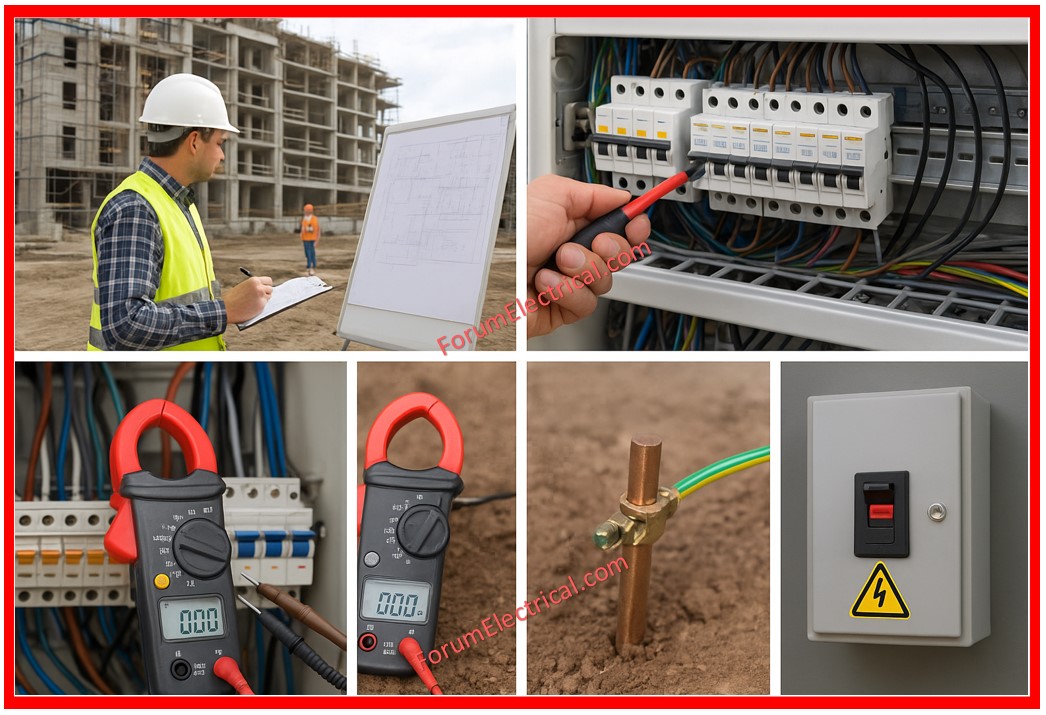
1). What do you do as an Electrical Engineer in a construction project?
My responsibilities include reviewing electrical drawings, preparing BOQs, coordinating with civil & mechanical teams, monitoring installation of the electrical systems like LV/MV cables, switchgear, lighting, earthing and fire alarms, ensuring compliance with standards & conducting inspections and testing before commissioning.
2). What standards and codes are commonly used in construction electrical work?
Commonly used standards include:
- Equipment standards defined by the International Electrotechnical Commission (IEC).
- For wiring rules, refer to the NEC (National Electrical Code).
- In the United Kingdom, the IET Wiring Regulations are known as BS 7671.
- NFPA 70 is a fire protection standard.
- Local government rules & power company requirements.
3). What is the difference between LV, MV and HV systems?
The difference between LV, MV and HV systems are:
| Low Voltage (LV) | Medium Voltage (MV) | High Voltage (HV) |
| Low Voltage systems typically run at voltages of up to 1 kV AC or 1.5 kV DC. | Medium voltage systems typically operate between 1 kV and approximately 33 kV. | High Voltage systems operate at voltages greater than 33 kV, typically reaching hundreds of kilovolts (kV) in transmission networks. |
| LV is mostly utilized for residential, commercial & small-scale industrial power distribution. | MV is used to transfer power between substations and major industrial complexes. | High voltage is used to transmit large amounts of power over great distances. |
| LV equipment is smaller, cheaper, and easier to maintain. | MV equipment necessitates more insulation, increased safety precautions & specialist handling. | High-voltage equipment is huge, expensive, and requires tight safety approvals. |
| LV cables have a thinner insulation layer and may be handled without specialist gear. | MV cables have stronger insulation & require special terminations & testing prior to energization. | Before being commissioned, HV cables & overhead lines must have improved insulation systems and undergo high-voltage testing. |
| LV faults produce less arc-flash energy yet can still be harmful. | MV faults generate higher energy arcs, necessitating the use of safety relays for fast separation. | HV faults can result in extremely high energy discharges, necessitating fast-acting protection devices. |
| LV systems usually have lower distribution lengths within buildings (or) local grids. | MV networks transmit power over medium distances, which includes between towns (or) industrial zones. | HV systems transmit power over large distances between generating plants and important substations. |
4). How do you determine the cable size for a building (or) construction project?
Cable size depends on:
> Load current I = P/ (√3 x V x PF)for three-phase systems.
> Voltage drop limits.
> Capable of withstanding short circuits.
> Installation method & ambient temperature.
> Relevant cable derating factors.
5). What is the significance of Earthing in buildings?
Earthing uses a low-resistance channel to discharge fault currents, preventing electric shock and equipment damage.
It guarantees that protection devices (MCBs and RCCBs) operate properly.
6). What are the common types of earthing systems utilized in construction?
> TN-S: Separate the neutral & earth conductors.
> TN-C-S: A combination of neutral & earth in a system.
> TT: Earth connection at the consumer’s premises.
> IT: An isolated neutral (or) impedance earthed system.
7). What are the most frequent electrical systems installed in the high-rise buildings?
The most frequent electrical systems installed in the high-rise buildings are:
> Power distribution (LV and MV panels, transformers),
> Lighting systems,
> Emergency Lighting,
> Fire alarms and smoke detection,
> HVAC Controls,
> Public Address Systems,
> CCTV and security systems &
> Earthing and lightning protection.
8). How do you assure electrical safety at a building site?
To ensure safety, implement lockout/tagout (LOTO) protocols, use PPE, ground properly, examine equipment and cables regularly, display safety signage, and adhere to approved method statements & risk assessments.
9). What is the difference between MCB, MCCB and ELCB?
| MCB (Miniature Circuit Breaker) | MCCB (Moulded Case Circuit Breaker) | ELCB (Earth Leakage Circuit Breaker) |
| MCBs protect against overcurrent & circuits in small circuits, with current limits of up to ~125A. | MCCBs protect against overcurrent, short circuits and earth faults in large circuits, with current ratings of up to ~2500A. | ELCBs are intended to protect individuals from electric shocks by detecting and terminating the circuit during earth leakage faults. |
| It uses a thermal-magnetic system to trip automatically at overload or fault circumstances. | It has an adjustable trip setting that includes thermal-magnetic or electrical tripping for exact protection. | It detects leakage current (typically greater than 30mA) and rapidly disconnects the supply to prevent harm. |
| MCBs are commonly utilized in household and light business applications. | MCCB is commonly used in industrial, commercial & large-scale power distribution systems. | ELCBs are utilized in residential, commercial & industrial systems to provide additional protection against leakage currents. |
10). What is the typical sequence of electrical installation in a construction project?
The typical sequence of electrical installation in a construction project are
> Conduit and cable tray installation,
> Pulling of cables,
> Termination and jointing,
> Mounting panels and DBs,
> Lighting, sockets and equipment installation,
> Testing and commissioning.
11). How do you conduct Continuity & Insulation Resistance Tests?
Continuity Test: Use a multimeter (or) low-ohm meter to confirm that no conductors are broken.
Insulation Resistance Test: Using a megger, apply DC voltage (usually 500 V or 1000 V) across conductors / between conductor & ground to assess insulation quality.
12). What is the purpose of a building’s lightning protection system?
The purpose of a building’s lightning protection system is to properly discharge lightning strikes into the earth, protecting the building’s structure, electrical systems, and people.
13). How do you manage voltage drops in long cable runs?
Use larger cable cross-sections, higher voltage levels (e.g: 415 V instead of 230 V), lower load current, or parallel cables.
14). What is the function of a Capacitor Bank in a building?
The function of a capacitor bank in a building is to compensating reactive power improves power factor, minimizing utility penalty and increasing system efficiency.
15). What is the difference between a Single Line Diagram (SLD) and a Schematic Diagram?
| Single Line Diagram (SLD) | Schematic Diagram |
| A Single Line Diagram illustrates the entire electrical network utilizing single lines & standard symbols for demonstrating the flow of electrical power. | A schematic diagram represents the detailed connections and relationships between individual components in a circuit. |
| It makes the system planning easier by employing a single line to represent many conductors in a 3-phase system. | It shows each conductor and connect accurately as they exist in reality. |
| It is primarily employed for system design, load flow analysis, & fault analysis in power distribution networks. | Its primary applications include troubleshooting, wiring and electrical equipment assembly. |
| It emphasizes functional representation over component location. | It focuses on the actual wire routes and component placement. |
| It is commonly used in substation designs, industrial power distribution plans & utility systems. | It is frequently seen in control circuits, panel wiring layouts, and electronic equipment. |
| It removes extraneous wiring details for clarity & simplicity. | It contains complete wiring information, including terminal numbers, wire numbers & connection points. |
16). What types of Cable Trays are used in construction?
The types of cable trays are used in construction are:
- Ladder type,
- Perforated type,
- Solid bottom type,
- Wire mesh type.
Selection depends on ventilation, load capacity & installation conditions.
17). How do you choose a transformer for a building project?
To calculate total connected load, apply diversity factors, plan for future expansion, select the appropriate voltage ratio, and meet efficiency & cooling requirements.
18). What is the purpose of an Automatic Transfer Switch (ATS)?
Automatic Transfer Switch (ATS) is a system automatically transfers the load from the main supply to generator during a power outage and returns to the main supply once power is restored.
19). What tests are performed before powering electrical systems under construction?
The tests are performed before powering electrical systems under construction
are
- Continuity Test
- Insulation Resistance Test
- Polarity Test
- Earth Resistance Test
- Functional Test on of protective devices
- Load Test after Energization.
20). What is the difference between 3-Phase and Single-Phase Supply?
3-Phase Supply vs Single-Phase Supply
| 3-Phase Supply | Single-Phase Supply |
| A 3-phase supply uses three alternating currents, each 120° out of phase with the others. | A single-phase supply uses only one alternating current that changes polarity every cycle. |
| It delivers power more efficiently and is suitable for heavy loads. | It is less efficient and mainly used for light loads. |
| The voltage is generally higher (e.g., 400V in many countries). | The voltage is generally lower (e.g., 230V in many countries). |
| Power delivery is continuous and smoother, reducing vibration in motors. | Power delivery is pulsating, which can cause more vibration in motors. |
| It requires three live wires and a neutral. | It requires one live wire and a neutral. |
| It can power large motors and industrial equipment directly. | It is used for domestic appliances and small machines. |
| Transmission losses are lower for the same power capacity. | Transmission losses are higher for the same power capacity. |
| Equipment cost is higher but more durable for industrial use. | Equipment cost is lower and better for residential use. |
| Startup torque for motors is high and stable. | Startup torque for motors is lower and less stable. |
| Often used in factories, large buildings, and power distribution networks. | Commonly used in homes, shops, and small offices. |
21). What is a Lux level? How is it determined?
Lux is the measurement of lighting. It is measured with a lux meter to check that the lighting satisfies the design criteria.
22). How do you work with the civil & mechanical teams in construction/civil work?
Attend coordination meetings, share updated designs, resolve discrepancies with BIM or shop drawings, and arrange installation sequences to save rework.
23). What is the difference between MCC and SMDB?
| MCC (Motor Control Center) | SMDB (Sub Main Distribution Board) |
| MCC is intended to control, protect & monitor motors & motor-driven equipment in an electrical system. | The SMDB is intended to distribute electrical power from main distribution board to different sub-circuits or loads. |
| It largely consists of motor starters, overload relays, contactors & motor-specific protective devices. | It mostly includes circuit breakers, fuses & protective devices for the general load distribution. |
| MCC panels are commonly utilized in industrial applications when several motors require centralized control. | SMDB panels are utilized in commercial, industrial, and residential facilities to distribute power to various locations or departments. |
| MCC focuses on motor functioning, protection and control logic. | The priority of SMDB is on safe and dependable distribution of power. |
| MCC often comprises metering, control switches, and, in certain cases, PLC integration for automation. | SMDB often just contains protection devices and load monitoring. |
| MCC requires more mechanical and thermal protection because of motor starting currents. | SMDB requires appropriate short-circuit protection dependent on downstream loads. |
| MCC powers motors directly or via Variable Frequency Drives (VFDs). | SMDB supplies additional distribution boards, final distribution boards and end-user loads. |
24). How do you measure Earthing Resistance?
To ensure resistance is within the set limit, use an earth tester (megger) with the fall-of-potential method (or) clamp-on tester (usually <1 or 2 ohms for safety systems).
25). How important is Cable Glanding and Termination?
Cable glanding and cable termination provides mechanical support, electrical continuity, dust/moisture protection, and safety in hazardous places.

