Calculator
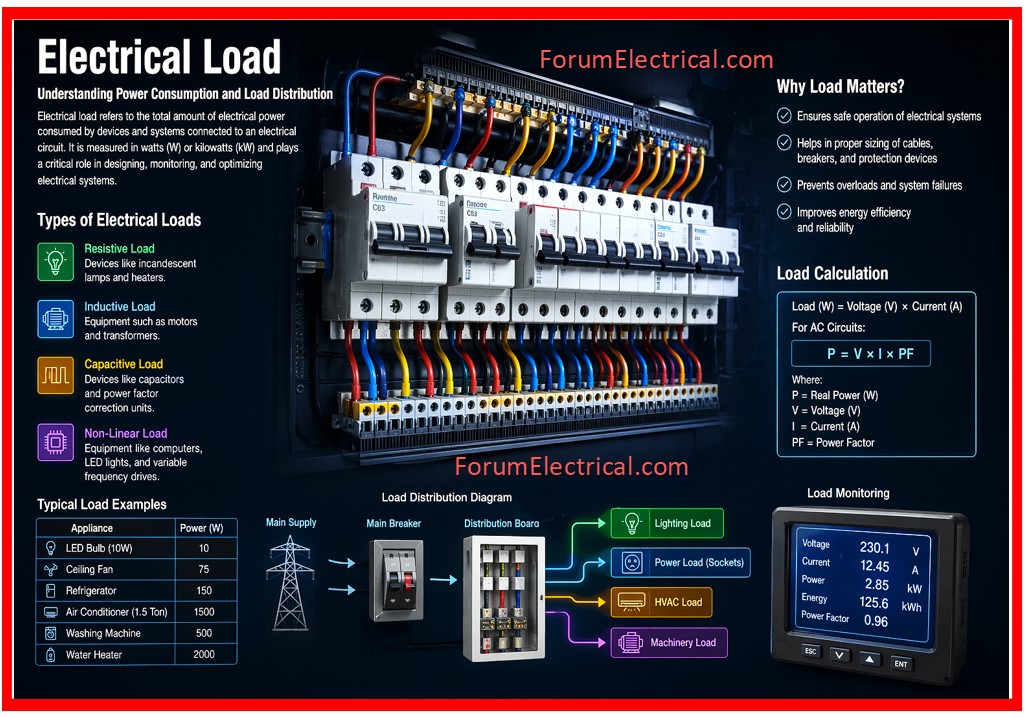
This Electrical Load Calculator is a professional grade online calculator tool designed to calculate total electrical demand loads for residential and commercial installations.
ELECTRICAL LOAD CALCULATOR
Professional sizing tool for residential and commercial electrical systems worldwide
Click here for more Electrical Calculators
You can also follow us on Facebook and Linkedin to receive daily updates.
It follows the international electrical codes and standards to determine the
- Correct service panel size,
- Connected load and
- Demand load for any building.
The calculator covers the following installation types:
- Residential (Home): Single and multi-family dwellings
- Commercial (Office): Office buildings, retail spaces and light industrial facilities
| Parameter | Residential | Commercial |
| Standard | NEC Article 220 | NEC Article 220 / IEC |
| Phase | Single Phase (1Ø) | Three Phase (3Ø) |
| Voltage | 120/240V | 208Y/120V or 400V |
| Lighting Rate | 3 VA/sq ft | 3.5 VA/sq ft |
| Demand Factor | Per NEC Table 220.42 | Per load type |
Calculator Input Parameters
Installation Type
Select the installation type based on the building classification.
This determines the applicable calculation method and demand factors.
Building Parameters
Living / Working Area (sq ft)
Enter the total floor area of habitable (or) usable space.
This value is utilized to calculate the general lighting & receptacle load per NEC 220.12.
| Occupancy Type | VA per sq ft |
| Residential (Dwelling) | 3 VA/sq ft |
| Office Buildings | 3.5 VA/sq ft |
| Banks | 3.5 VA/sq ft |
| Auditoriums / Theatres | 1 VA/sq ft |
| Hospitals | 2 VA/sq ft |
Electrical System Type
Single Phase (1Ø)
It is typical for residential installations in North America.
It uses 2 hot conductors and one neutral.
Three Phase (3Ø)
Standard for commercial and industrial facilities.
More efficient power delivery for large loads.
Current is calculated using
I = Total VA / (V x 1.732)
System Voltage
Select the voltage standard applicable to your region
| Voltage | Region | Application |
| 120/240V | USA / Canada | Residential single phase |
| 208Y/120V | USA Commercial | Three phase commercial |
| 230V | Europe / UK / India / Australia | Single phase standard |
| 220V | China / Asia | Residential and commercial |
| 110V | Japan / Taiwan | Residential standard |
| 400V | Europe / Asia | Three phase industrial |
| 415V | UK / Australia | Three phase commercial |
| 380V | Legacy European | Older installations |
Base Electrical Loads (NEC 220.52)
Base loads represent the minimum electrical capacity that is required by code for general lighting and receptacle circuits.
They are used to calculated from the building area.
General Lighting Load
Formula: Lighting VA = Living Area (sq ft) x 3 VA
Small Appliance Circuits (NEC 220.52(A))
Each small appliance circuit in the kitchen and dining area is rated at 1500 VA.
A minimum of 2 circuits is required by code for most residential kitchens.
- Formula: Small Appliance VA = Number of Circuits x 1500 VA
- Minimum circuits required: 2 (per NEC 210.11(C)(1))
- Applied at 100% demand factor
Laundry Circuits (NEC 220.52(B))
Each laundry circuit is rated at 1500 VA. Residential installations require at least one dedicated laundry circuit.
- Formula: Laundry VA = Number of Circuits x 1500 VA
- Minimum circuits required: 1 (per NEC 210.11(C)(2))
- Applied at 100% demand factor
Appliances & Equipment Reference
The following table lists all appliances that are available in the calculator with their rated wattage values.
These are standard nameplate ratings used for load calculations.
| Appliance / Equipment | Watts (W) | kW | Circuit Type |
| Electric Range / Oven | 12000 | 12.0 | 240V 2-pole 50A |
| EV Charger Level 2 | 7000 | 7.0 | 240V 2-pole 40A |
| Water Heater | 4500 | 4.5 | 240V 2-pole 30A |
| Clothes Dryer | 4000 | 4.0 | 240V 2-pole 30A |
| Central AC / Heat Pump | 3500 | 3.5 | 240V 2-pole 20A |
| AC Split Unit (1.5 Ton) | 1500 | 1.5 | 240V dedicated |
| Portable Heater | 1500 | 1.5 | 120V 15A |
| Dishwasher | 1200 | 1.2 | 120V 20A dedicated |
| Microwave Oven | 1200 | 1.2 | 120V 20A dedicated |
| Coffee Maker | 1000 | 1.0 | 120V 15A |
| Washing Machine | 500 | 0.5 | 120V 20A dedicated |
| Desktop PC / Gaming | 300 | 0.3 | 120V 15A |
| Refrigerator | 200 | 0.2 | 120V 20A dedicated |
| LED TV 55″ | 100 | 0.1 | 120V 15A |
| Ceiling Fan | 60 | 0.06 | 120V 15A |
Custom Equipment
The calculator accepts custom equipment entries.
Enter the equipment name and rated wattage in watts (W).
Use the nameplate rating (or) manufacturer specifications.
HVAC: Non Coincident Load Calculation
Cooling and heating systems do not operate simultaneously.
The NEC and IEC standards allow engineers to utilize the larger of the 2 loads (AC or heating) rather than adding both together.
AC / Cooling Load
Enter the total wattage of all cooling equipment: central AC, split units, window units (or) refrigeration systems. Sum all cooling loads in watts.
Electric Heating Load
Enter the total wattage of all electric heating: resistance heating elements, heat pump heating mode (or) portable space heaters.
Non-Coincident Rule: HVAC Demand = MAX (AC Load, Heating Load). Only the larger value is included in the total demand calculation. This is permitted by NEC 220.60.
Calculation Method & Formulas
Total Connected Load
The connected load is the sum of all loads before demand factors are applied:
Connected VA = Lighting VA + Small Appliance VA + Laundry VA + Appliances VA + HVAC VA
Total Demand Load
The demand load applies code specified demand factors
| Load Component | Demand Factor | Notes |
| Lighting (first 3000 VA) | 100% | Full demand |
| Lighting (above 3000 VA) | 35% | NEC Table 220.42 |
| Small Appliance Circuits | 100% | Full demand |
| Laundry Circuits | 100% | Full demand |
| Added Appliances | 100% | Nameplate rating |
| HVAC (Non-coincident) | 100% | Larger of AC/Heat |
Service Amperage Calculation
Single Phase: Amps = Total Demand VA / Voltage
Three Phase: Amps = Total Demand VA / (Voltage x 1.732)
The calculated amperage is then rounded up to the nearest standard breaker/service size:
15A, 20A, 30A, 40A, 50A, 60A, 70A, 80A, 100A, 125A, 150A, 175A, 200A, 225A, 250A, 300A, 400A
Calculator Output & Results
| Result Field | Unit | Description |
| Recommended Service | Amps | Minimum service panel size required |
| System Voltage | Volts | Selected regional voltage standard |
| Total Connected Load | kVA | Sum of all connected loads |
| Total Demand Load | kVA / kW | Demand-factored total load |
| Total Connected | VA | Raw VA before demand factors |
Load Breakdown
The detailed breakdown shows each load category separately.
- General Lighting & Circuits: demand-adjusted lighting load
- Small Appliance Circuits: kitchen and dining area loads
- Laundry Circuits: washing area loads
- Added Appliances: sum of all individually added equipment
- HVAC System: the larger of AC or heating load
Service Panel Recommendations
Based on the calculated service amperage, the tool recommends:
- Main Service Panel: the minimum rated main breaker for the installation
- Subpanel (if needed): sized at 50% of main service for secondary distributions
Standards & Code Compliance
This calculator is designed for compliance with the following international standards.
| Standard | Country | Scope |
| NEC Article 220 | USA / Canada | Load calculation methodology |
| NEC 210.11(C) | USA / Canada | Small appliance circuit requirements |
| NEC 220.52 | USA / Canada | Kitchen and laundry loads |
| NEC 220.60 | USA / Canada | Non-coincident loads (HVAC) |
| IEC 60364 | Europe / International | Low-voltage electrical installations |
| BS 7671 | United Kingdom | Wiring regulations |
| IS 732 | India | Electrical wiring installations |
| AS/NZS 3000 | Australia / NZ | Wiring rules standard |
Solved Example
Residential 2000 sq.ft Home
Inputs
- Living Area: 2000 sq.ft
- System: Single Phase 240V (USA)
- Small Appliance Circuits: 2
- Laundry Circuits: 1
- Appliances: Electric Range (12000W), Water Heater (4500W), Clothes Dryer (4000W), Refrigerator (200W)
- AC Load: 3500W
- Heating Load: 0W
Calculation
| Load Component | Connected VA | Demand VA |
| General Lighting (2,000 x 3) | 6000 | 3000 + (3000 x 35%) = 4050 |
| Small Appliance (2 x 1500) | 3000 | 3000 |
| Laundry (1 x 1500) | 1500 | 1500 |
| Electric Range | 12000 | 12000 |
| Water Heater | 4500 | 4500 |
| Clothes Dryer | 4000 | 4000 |
| Refrigerator | 200 | 200 |
| HVAC (AC: 3,500 > Heat: 0) | 3500 | 3500 |
| TOTAL | 34700 VA | 32750 VA |
Result
Service Amps = 32750 VA / 240V = 136.5A
Recommended Service Panel = 150 Amps
Important Notes
- Always verify inputs against actual equipment nameplate ratings
- Future load growth of 20-25% is recommended as a safety margin
- Local utility requirements may impose additional constraints
- Motor loads require additional starting current calculations (NEC 430)
- For large commercial projects, hire a Professional Engineer (PE) for load studies.

