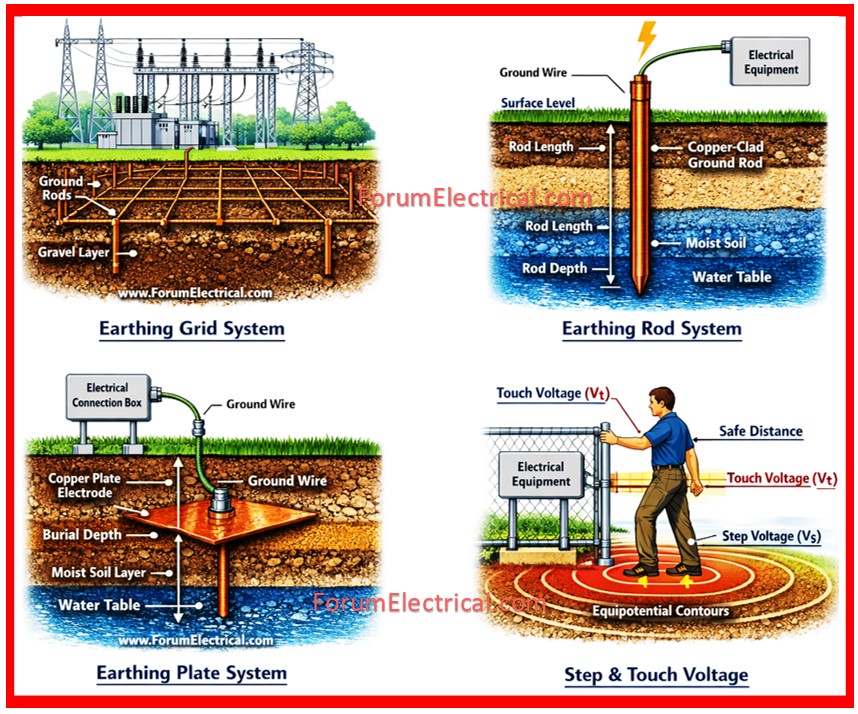
The Earthing Resistance Calculator is a comprehensive calculator tool designed based on international standards such as IEEE 80, IS 3043 and BS 7430.
Calculator
Earthing Resistance Calculator
IEEE 80 • IS 3043 • BS 7430 — Grounding System Design
Click here for more Electrical Calculators
You can also follow us on Facebook and Linkedin to receive daily updates.
It assists engineers to evaluate the effectiveness of grounding systems by calculating
- Earthing resistance,
- Ground potential rise,
- Touch and step voltages and
- Conductor sizing.
This post ensures safety, reliability and compliance in electrical installations, especially in substations, industrial plants and power systems.
What is the Normal Earthing Resistance?
A standard earth resistance value must ideally be for important infrastructure and for general residential/commercial systems to make sure safety.
While the National Electrical Code (NEC) used to permits up to lower resistance is always better to efficiently divert fault current & provide effective lightning protection.
Soil & Site Parameters
Soil resistivity is one of the most essential factors in earthing system design.
It represents the resistance provided by soil to the flow of electric current and is typically measured using the Wenner four-pin method.
The resistivity value can vary widely depending on the
- Soil composition,
- Moisture content and
- Temperature.
Surface layer resistivity refers to the resistivity of the top layer that is usually consisting of crushed rock (or) gravel.
This layer improves safety by increasing contact resistance and reducing step and touch voltage risks.
Surface layer thickness defines the depth of the protective layer.
A thicker layer used to provides better insulation and enhances safety performance especially in high voltage (HV) substations.
Electrode Geometry
The type and geometry of electrode that is significantly influence earth resistance values.
A vertical rod (or) pipe electrode is commonly utilized due to its simplicity and effectiveness in penetrating the deeper soil layers with lower resistivity.
A plate electrode is utilized where space permits and offers a larger contact area with the soil.
Its effectiveness depends on burial depth and soil conditions.
Grid (or) mat electrodes are extensively used in substations and large installations.
They consist of interconnected conductors forming a grid which helps in uniform potential distribution and minimizes step and touch voltages.
Horizontal strip (or) wire electrodes are buried conductors used to cover a large area.
They are effective in reducing resistance when long lengths are used.
Ring (or) loop electrodes are circular conductors installed around structures.
They provide uniform grounding and are commonly utilized in buildings and communication towers.
Fault & Safety Parameters
Ground fault current represents the maximum fault current that is used to flows into the ground during a fault condition.
This parameter value is important for calculating the ground potential increase and determining the system safety.
Fault duration is the time taken by the protective devices such as
- Relays &
- Circuit breakers
to clear the fault.
Shorter fault duration reduces the thermal and electrical stress on the system.
Body weight is considered in safety calculations for determining the tolerable touch and step voltages.
Standard values like 50 kg (or) 70 kg are utilized based on the IEEE standards.
Earthing Conductor Parameters
The cross sectional area of the earthing conductor that is used to determines its ability to carry fault current without any damage.
It should be adequately sized to withstand thermal stress during the fault conditions.
The conductor material also affects performance.
- Copper is use to provides excellent conductivity and corrosion resistance,
- Galvanized steel is use to provides mechanical strength.
- Aluminium and stainless steel are also used based on the application requirements.
Formulas
R = (ρ / 2πL) x [ln(4L/d) − 1] Dwight formula – single vertical rod
GPR = If x Re
Etouch = (1000 + 1.5 Cs ρs) × k / √tf
Estep = (1000 + 6.0 Cs ρs) × k / √tf
Amin = If √tf / kmat [k = 0.116 for 50 kg, 0.157 for 70 kg – IEEE 80 Eq 37/38]
Calculation Results
The earth resistance value is calculated based on the soil resistivity and electrode configuration.
Lower resistance indicates a more effective and essential grounding system.
Ground Potential Rise (GPR) is the voltage rise at the grounding system during a fault.
It is calculated using the fault current and earthing resistance.
Tolerable touch voltage is used to represents the maximum safe voltage a person can touch without danger while step voltage use to refers the potential difference between 2 feet on the ground.
Minimum conductor area is calculated using the fault current and duration to make sure the conductor can safely carry the fault current.
Surface layer factor accounts for the effect of surface material in reducing the shock risk.
Compliance Assessment
The electrical system evaluates whether the calculated earthing resistance value (ground resistance value) meets the standard limits.
Typically the values below 1 ohm (<1Ω) are considered ideal while the values above 5 ohms (5 Ω) require redesign.
It also checks whether the conductor size is sufficient & whether ground potential rise is within safe limits compared to touch voltage.
Summary
The earthing resistance calculator is an essential online calculator tool for electrical engineers to design the safe and compliant grounding systems.
By considering soil properties, electrode configuration and fault conditions it ensures protection of both equipment and personnel in electrical installations.

