Electrical projects rarely fail due to installation issues alone and most problems start at the planning and estimation procedure itself.
Accurate electrical project estimation and a properly structured Bill of Quantities (BOQ) are essential for delivering projects on time within budget and according to technical specifications.
- What is Electrical Project Estimation?
- Importance of BOQ (Bill of Quantities) in Electrical Projects
- Example BOQ Format
- Steps in Electrical Project Estimation
- Step-1: Study Project Drawings and Specifications
- Step-2: Prepare the Material Take Off (MTO)
- Step-3: Estimate Manpower Requirements
- Step-4: Cost Calculation
- Step-5: Risk and Contingency Planning
- Components of an Electrical BOQ
- Advantages of Accurate Electrical Estimation & BOQ
- Standards Applicable in Electrical Project Estimation
- Practical Tips for Engineers Preparing BOQ
- Conclusion
In electrical engineering projects such as substations, industrial plants, buildings (or) infrastructure installations, estimation forms the financial and technical blueprint that guides procurement, installation and commissioning.
A well prepared BOQ ensures that all materials, equipment & labour requirements are clearly defined before the project begins.
What is Electrical Project Estimation?
Electrical project estimation is the systematic procedure of forecasting the total cost, resources and time required to complete an electrical installation project.
The estimation process typically includes:
- Material cost calculation,
- Labor cost estimation,
- Equipment and tool requirements,
- Testing and commissioning expenses,
- Overhead and profit margins,
- Risk allowances and contingencies.
Accurate estimation helps the engineers to determine whether a project is technically feasible and financially viable.
For contractors and EPC companies estimation is also the foundation of tender preparation and bidding ideas.
Importance of BOQ (Bill of Quantities) in Electrical Projects
A Bill of Quantities (BOQ) is a structured document that lists all materials, equipment and work quantities required for the project.
It acts as a financial and technical checklist that allows engineers, contractors and clients to clearly understand the project scope and costs.
A typical BOQ includes:
- Item description
- Quantity
- Unit of measurement
- Unit rate
- Total cost
Example BOQ Format
| Equipment | Description | Unit | Quantity |
|---|---|---|---|
| Power Cable | 3.5C x 240 sq.mm XLPE cable | Meter | 500 |
| Lighting Fixture | LED industrial light 100W | Nos | 80 |
| Cable Tray | 300mm perforated GI tray | Meter | 200 |
| Earthing Rod | Copper bonded rod | Nos | 12 |
A properly prepared BOQ allows for accurate budgeting and transparent procurement.
Steps in Electrical Project Estimation
Electrical estimation is performed in a structured engineering workflow to ensure no component (or) cost element is missed.
Step-1: Study Project Drawings and Specifications
The first step is to carefully analyze project documents such as:
- Single Line Diagrams (SLD),
- Electrical layout drawings,
- Cable routing plans,
- Electrical equipment specifications,
- Client requirements and
- Electrical design standards.
These drawings provide essential information about:
- Power distribution architecture,
- Electrical equipment ratings,
- Installation locations and
- Protection (Differential/Overload/Overcurrent) schemes.
Without studying the drawings thoroughly, estimation errors are inevitable.
Step-2: Prepare the Material Take Off (MTO)
Material take off involves identifying and quantifying every material that is required for installation.
Typical electrical materials include:
Power Distribution Equipment
- Transformers (Power & Distribution),
- Switchgear panels,
- Motor Control Centers (MCC),
- Electrical distribution boards.
Cabling System
- Electrical power cables,
- Control cables,
- Instrument cables,
- Cable trays and ladders.
Lighting and Small Power
- Lighting fixtures,
- Switches and sockets,
- Junction boxes.
Earthing System
- Earthing electrodes,
- Earthing conductors,
- Earthing pits.
Installation Accessories
- Cable glands,
- Lugs and ferrules,
- Conduits and trunking,
- Termination kits.
Each equipment should be measured in accurate quantities based on the drawings and layouts.
Step-3: Estimate Manpower Requirements
Labor cost is a major part of electrical project estimation.
Manpower estimation involves determining:
- Number of electricians (technicians) required,
- Number of helpers (or) technicians,
- Installation supervisors,
- Testing engineers.
Typical labor activities include:
- Cable laying (Electrical cable),
- Cable termination (Electrical cable),
- Panel installation,
- Earthing system installation,
- Lighting installation,
- Testing & commissioning.
The total manpower cost depends on:
- Project size,
- Installation complexity &
- Project duration.
Step-4: Cost Calculation
After identifying the materials and labor requirements the next step in this procedure is detailed cost analysis.
The following components are usually included:
Material Cost
Cost of all electrical equipment and installation materials.
Labor Cost
Installation manpower wages and supervision charges.
Equipment and Tools
Special tools, cranes, cable pulling equipment and testing instruments.
Testing and Commissioning
Testing and commissioning includes insulation resistance testing, relay testing and functional testing.
Overheads
Administrative expenses such as:
- Site office,
- Transportation,
- Safety equipment and
- Documentation.
Profit Margin
Contractor profit added to the final estimate.
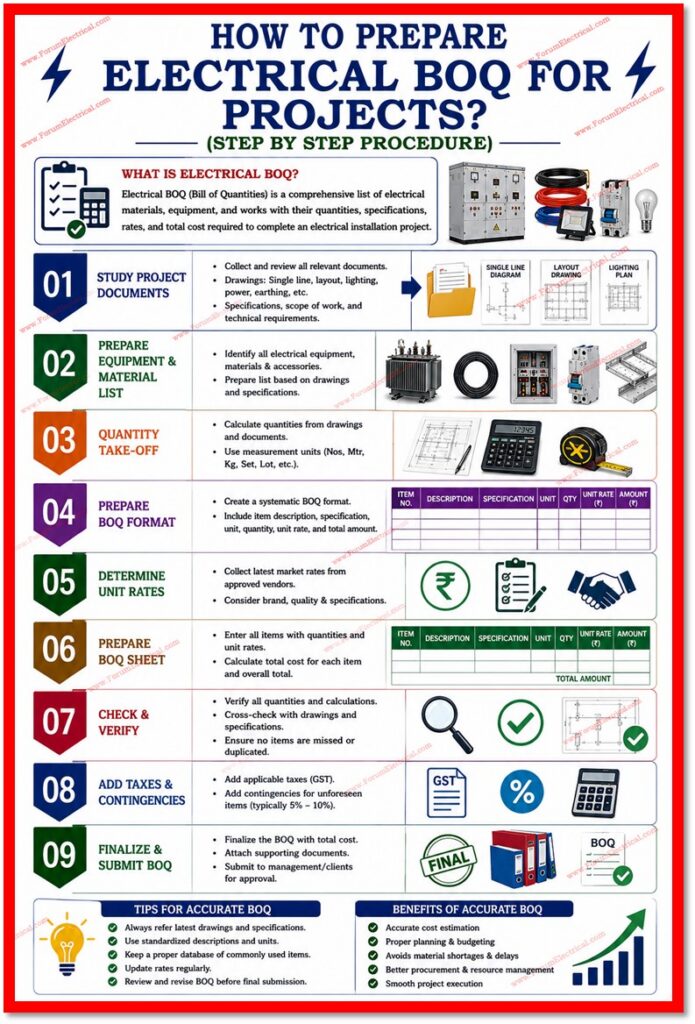
Step-5: Risk and Contingency Planning
Electrical projects often face uncertainties during execution.
Common risks include:
- Design modifications,
- Site condition changes,
- Material price fluctuations,
- Delivery delays and
- Unexpected technical issues.
To address these uncertainties engineers usually include 5 – 10% contingency in the project estimation.
This ensures the financial protection against unforeseen expenses.
Components of an Electrical BOQ
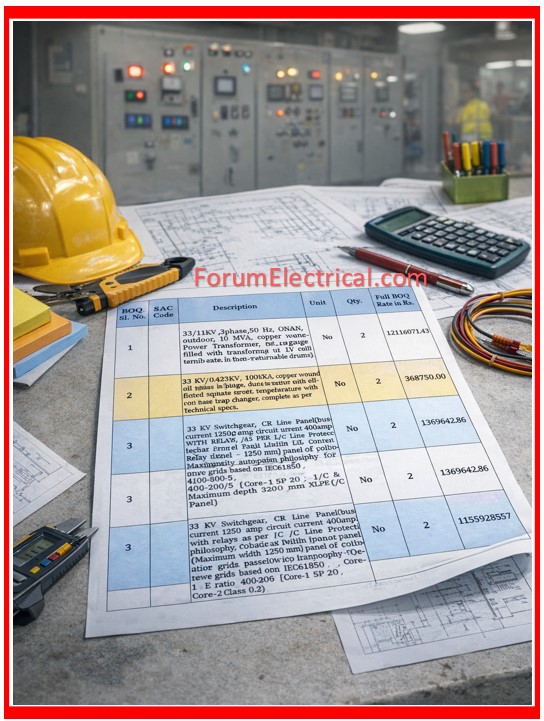
A well prepared BOQ covers all the installation elements required for the electrical system.
Power System Equipment
- Transformers (Power & Distribution),
- Switchgear (HT/LT),
- Bus ducts &
- Capacitor banks.
Cable and Wiring
- Electrical power cables,
- Electrical control cables &
- Instrument cables.
Lighting and Power Distribution
- Lighting fixtures,
- Distribution boards (DB/EDB) &
- Switches & sockets.
Earthing and Lightning Protection
- Earthing electrodes,
- Copper earth conductors &
- Lightning arresters (& surge arresters).
Cable Management System
- Cable trays,
- Cable ladders &
- Conduits.
Installation Accessories
- Cable glands,
- Lugs,
- Ferrules &
- Termination kits.
This detailed listing ensures no components are overlooked during procurement.
Advantages of Accurate Electrical Estimation & BOQ
Accurate estimation and BOQ (Bill of Quantities) preparation provide several different advantages for the project stakeholders.
Financial Control
Financial control used to prevent the unexpected cost overruns during project execution.
Accurate Tendering
Accurate tendering helps the contractors to submit competitive and realistic bids.
Efficient Procurement
Efficient procurement ensures the correct material quantities that are ordered.
Project Planning
Project planning provides a very detailed and clear roadmap for installation and scheduling.
Client Transparency
Client transparency allows clients to understand exactly what they are paying for.
Standards Applicable in Electrical Project Estimation
Electrical estimation and design must comply with the recognized/approved international standards.
- IEC 60364: Electrical Installations of Buildings
- NEC (National Electrical Code)
- IEEE Standards for Electrical Systems
- IS Standards (Indian Standards) for installation practices
Following these standards ensures safety, reliability and regulatory compliance.
Practical Tips for Engineers Preparing BOQ
Engineers working in estimation must adopt systematic procedures.
Some useful tips (recommended) include:
- Always cross check quantities with drawings,
- Maintain a standard BOQ template,
- Use estimation software (or) spreadsheets,
- Consult vendor catalogs for equipment pricing,
- Include contingency allowances and
- Update material prices regularly.
These practical procedures significantly improve the estimation accuracy.
Conclusion
Electrical project estimation and BOQ (Bill of Quantity) preparation are essential engineering skills that are used to connect technical design and financial planning.
A well prepared estimate ensures that projects are completed on time within the budget and without any material shortages.
It also allows contractors to submit competitive bids and helps project managers plan execution effectively.
Engineers who master estimation and BOQ preparation become valuable professionals capable of handling both technical design and the project financial management.

