
Corrective Maintenance (CM) is one of the important procedures in maintaining the reliability and safety of medium voltage (MV) electrical systems.
A Vacuum Circuit Breaker (VCB) is one of the most important protection devices used in the medium voltage switchgear which is typically ranging from 3.3 kV to 36 kV.
- What is Corrective Maintenance in Circuit Breakers?
- Overview of Vacuum Circuit Breaker (VCB)
- Main Components of VCB
- Corrective Maintenance Inspection: Case Study
- Issues Identified during Inspection
- 1). Solenoid Coil Burning & Damage
- 2). Mechanical Wear in Moving Parts & Springs
- 3). Dust & Carbon Deposits in Mechanism
- Safety Measures taken during Inspection
- Corrective Actions
- Importance of Corrective Maintenance in VCB
- Purpose of Preventive and Corrective Maintenance
- Conclusion
When faults (or) abnormalities are detected during the routine inspections (or) equipment operation, corrective maintenance becomes necessary to identify the root cause and restore the equipment to a safe operating condition.
This post explains a real corrective maintenance inspection of a Vacuum Circuit Breaker, the issues identified, actions taken and the importance of proper safety procedures.
What is Corrective Maintenance in Circuit Breakers?
Corrective Maintenance (CM) refers to maintenance performed after a fault (or) abnormal condition (or) failure is detected in an electrical equipment.
The primary objective is to identify the cause of the failure and repair (or) replace the faulty components.
In the case of Vacuum Circuit Breakers (VCB) corrective maintenance may be required due to:
- Operating mechanism failure,
- Coil burnout,
- Mechanical wear,
- Contact failure,
- Control circuit problems and
- Insulation deterioration.
Unlike preventive maintenance which is scheduled periodically, corrective maintenance is performed when a defect is found during operation (or) inspection.
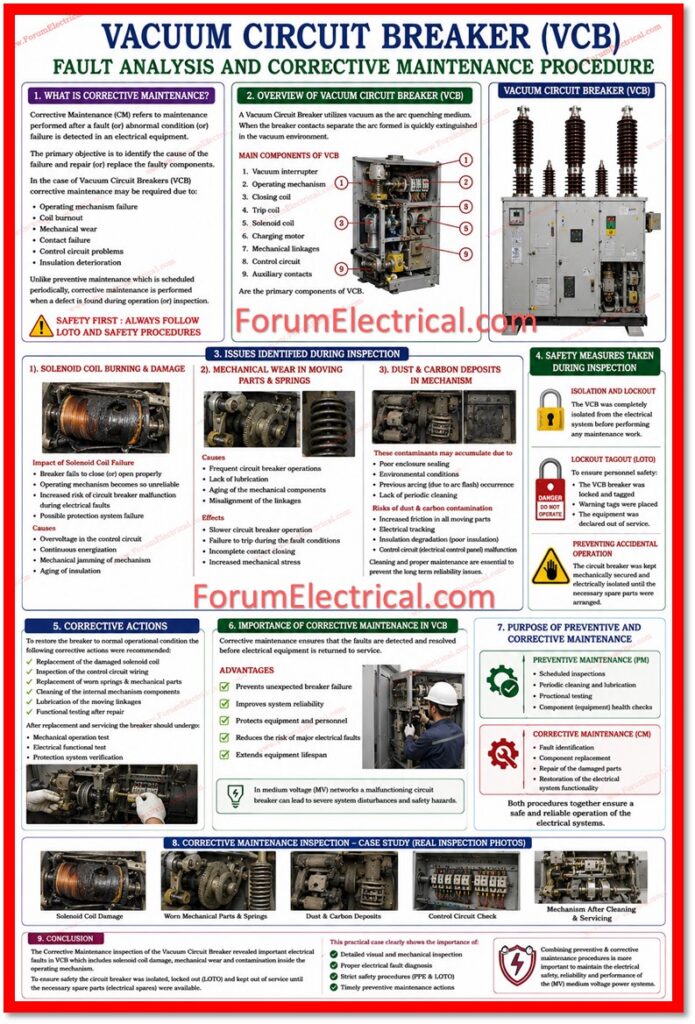
Overview of Vacuum Circuit Breaker (VCB)
A Vacuum Circuit Breaker utilizes vacuum as the arc quenching medium.
When the breaker contacts separate the arc formed is quickly extinguished in the vacuum environment.
Main Components of VCB
- Vacuum interrupter,
- Operating mechanism,
- Closing coil,
- Trip coil,
- Solenoid coil,
- Charging motor,
- Mechanical linkages,
- Control circuit and
- Auxiliary contacts
Are the primary components of VCB.
The operating mechanism is responsible for opening and closing the circuit breaker and any damage to its components can prevent proper breaker operation.
Corrective Maintenance Inspection: Case Study
During a corrective maintenance inspection of a vacuum circuit breaker a detailed internal inspection of the operating mechanism was carried out.
The breaker had shown abnormal operation conditions leading to further severe faults analysis.

Issues Identified during Inspection
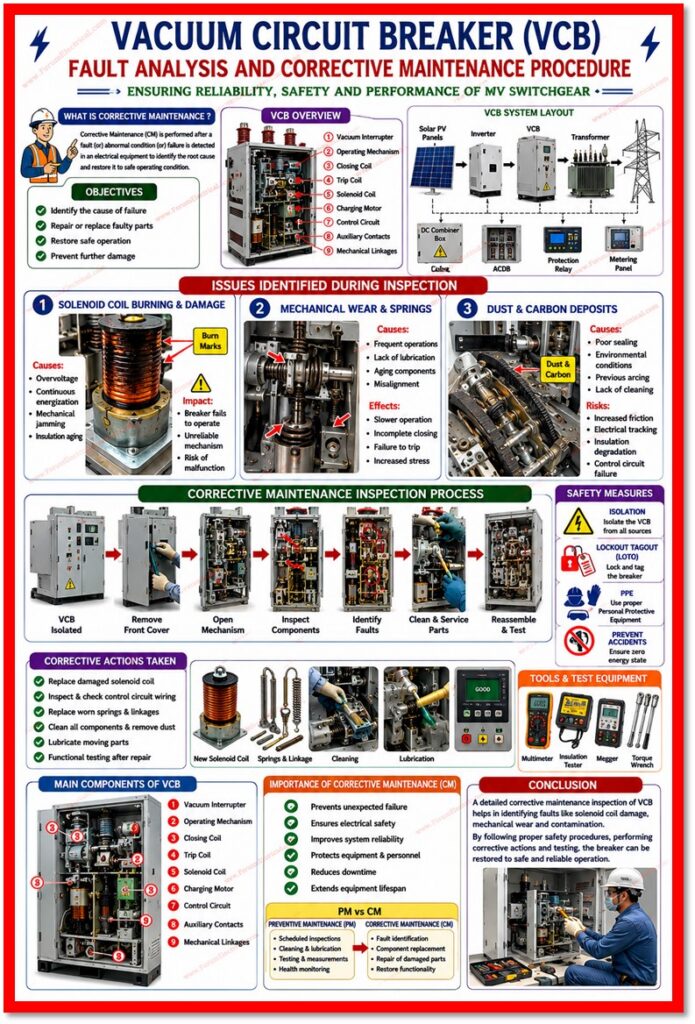
1). Solenoid Coil Burning & Damage
One of the major faults identified was burning and damage in the solenoid coil.
Impact of Solenoid Coil Failure
- Breaker fails to close (or) open properly,
- Operating mechanism becomes so unreliable,
- Increased risk of circuit breaker malfunction during electrical faults and
- Possible protection system failure.
Burn marks and insulation damage were observed on the coil winding that indicates thermal stress and electrical overheating.
Causes
Possible causes include:
- Overvoltage in the control circuit,
- Continuous energization,
- Mechanical jamming of mechanism and
- Aging of insulation
2). Mechanical Wear in Moving Parts & Springs
Mechanical inspection visualizes the significant wear in some of the moving components & springs of the operating mechanism.
Causes
Common causes of mechanical wear include:
- Frequent circuit breaker operations,
- Lack of lubrication,
- Aging of the mechanical components and
- Misalignment of the linkages
Effects
The effects of mechanical wear are:
- Slower circuit breaker operation,
- Failure to trip during the fault conditions,
- Incomplete contact closing and
- Increased mechanical stress.
The operating speed of vacuum circuit breakers (VCB) is important for fault clearing, any mechanical deterioration needs to be fixed immediately.
3). Dust & Carbon Deposits in Mechanism
Dust and carbon traces found inside the vacuum circuit breaker (VCB) mechanism were another important observation made during the mechanical inspection.

These contaminants may accumulate due to
- Poor enclosure sealing,
- Environmental conditions,
- Previous arcing (due to arc flash) occurrence and
- Lack of periodic(timing) cleaning
Risks of dust & carbon contamination are
- Increased friction in all moving parts,
- Electrical tracking,
- Insulation degradation (poor insulation) and
- Control circuit (electrical control panel) malfunction.
Cleaning and proper maintenance are essential to prevent the long term reliability issues.
Safety Measures taken during Inspection
Since the circuit breaker had visible damage and operational concerns strict safety procedures were followed.
Isolation and Lockout
The VCB was completely isolated from the electrical system before performing any maintenance work.
Lockout Tagout (LOTO)
To ensure personnel safety:
- The VCB breaker was locked and tagged,
- The equipment was declared out of service.
Preventing Accidental Operation
The circuit breaker was kept mechanically secured and electrically isolated until the necessary spare parts were arranged.
Corrective Actions
To restore the breaker to normal operational condition the following corrective actions were recommended:
- Replacement of the damaged solenoid coil,
- Inspection of the control circuit wiring,
- Replacement of worn springs & mechanical parts,
- Cleaning of the internal mechanism components,
- Lubrication of the moving linkages and
- Functional testing after repair.
After replacement and servicing the breaker should undergo:
- Mechanical operation test,
- Electrical functional test,
- Protection system verification.
Importance of Corrective Maintenance in VCB
Corrective maintenance ensures that the faults are detected and resolved before electrical equipment is returned to service.

Advantages
- Prevents unexpected breaker failure,
- Improves system reliability,
- Protects equipment and personnel,
- Reduces the risk of major electrical faults and
- Extends equipment lifespan.
In medium voltage (MV) networks a malfunctioning circuit breaker can lead to severe system disturbances and safety hazards.
Purpose of Preventive and Corrective Maintenance
Electrical maintenance procedures typically to combine:
Preventive Maintenance (PM)
- Scheduled inspections,
- Periodic cleaning and lubrication,
- Functional testing and
- Component (equipment) health checks.
Corrective Maintenance (CM)
- Fault identification,
- Component replacement,
- Repair of the damaged parts and
- Restoration of the electrical system functionality.
Both procedures together ensure a safe and reliable operation of the electrical systems.
Conclusion
The Corrective Maintenance inspection of the Vacuum Circuit Breaker revealed important electrical faults in VCB which includes solenoid coil damage, mechanical wear and contamination inside the operating mechanism.
To ensure safety the circuit breaker was isolated, locked out (LOTO) and kept out of service until the necessary spare parts (electrical spares) were available.
This practical case clearly shows the importance of:
- Detailed visual and mechanical inspection,
- Proper electrical fault diagnosis,
- Strict safety procedures (PPE & LOTO) and
- Timely preventive maintenance actions.
Combining preventive & corrective maintenance procedures is more important to maintain the electrical safety, reliability and performance of the (MV) medium voltage power systems.

, identifying solenoid coil damage, mechanical wear and safety procedures.)