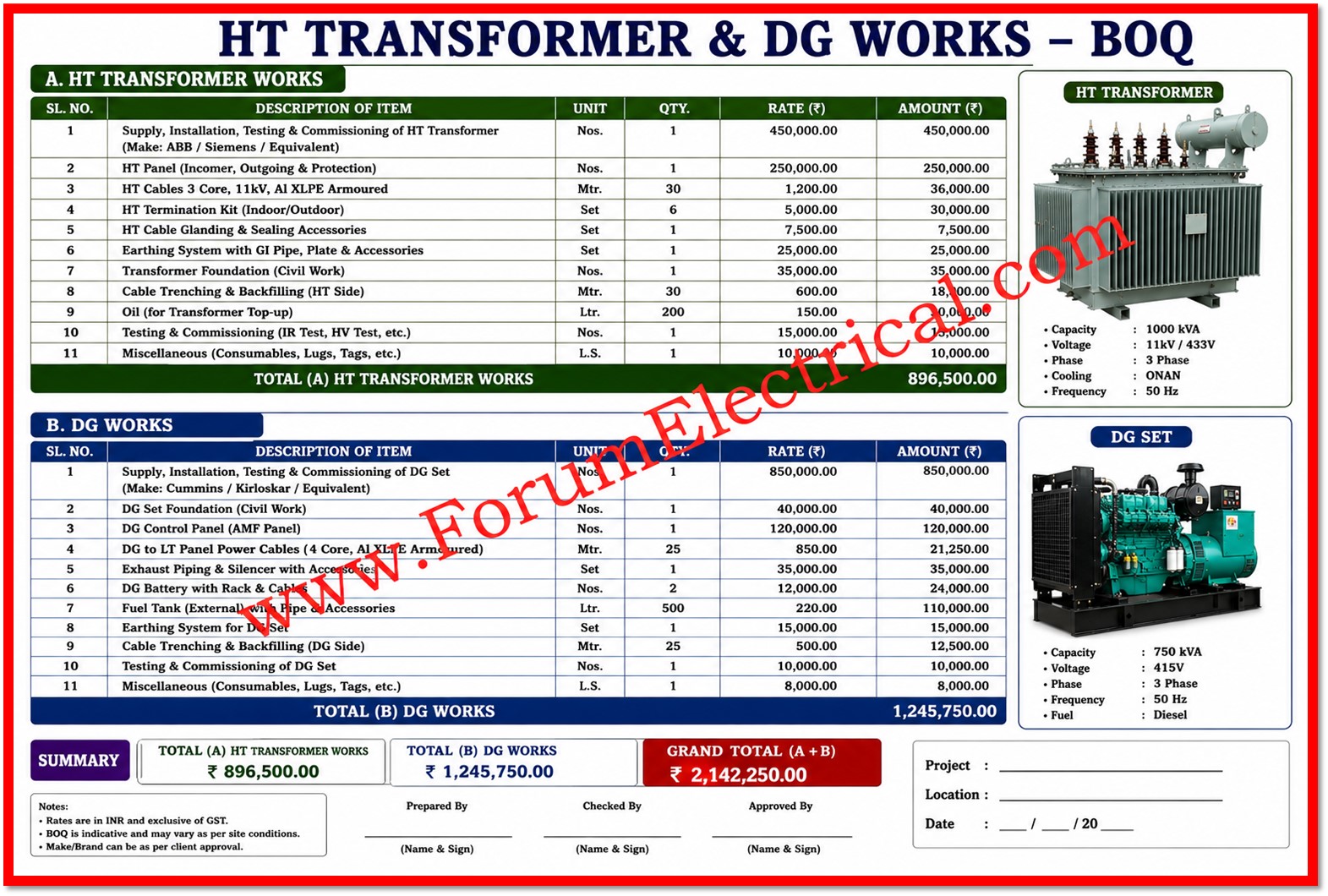
A Bill of Quantities (BOQ) defines, quantifies & prices every component of work for an HT electrical installation.
This BOQ covers the 11 kV power intake, distribution transformers and diesel generator (DG) sets which is the core of any substation.
It serves as the binding technical and commercial checklist between client, consultant & contractor.
All components should be read alongside the project single line diagram (SLD), drawings and applicable IS/IEC standards.
General Conditions
Every BOQ equipment covers supply, installation, testing and commissioning unless they are stated otherwise.
Key conditions include:
- Civil works (cable trenches, transformer plinth, DG foundation) are excluded and covered under the civil package.
- Transformers require ISMC base frames, wheel stoppers & minimum 3 mm anti vibration rubber pads under each wheel.
- All protection relays should be Numerical type with BMS/SCADA compatibility (Modbus/DNP3).
- All CTs in VCBs should be dual-core (one core for metering, one for protection).
- DC batteries for their panels & relays should be made Sealed Maintenance Free (SMF) type.
- All rates are all with inclusive of GST, transport, insurance, tools and contractor overheads.
- All fabricated steelwork receives 2 coats primer & 2 coats enamel paint, shade as approved.
Section I: 11 kV HT Panel Works
Single & Four-Module Outdoor Panels
The HT panel is the first intake point from the utility supply.
It houses Vacuum Circuit Breakers (VCBs) rated at 630 A / 18.3 kA / 350 MVA with Horizontal Draw-out mechanism for safe maintenance without de-energising adjacent sections.
A 1-module panel suits a single feeder and a 4-module panel (1 incomer + 3 outgoing VCBs of 400 A each) serves as the multiple transformer feeders.
Metering Cubicle & Battery Charger
The outdoor metering cubicle (IP65, 2 mm CRCA steel) houses the DISCOM Tri-Vector revenue meter and should comply accurately with local DISCOM norms.
Each panel also requires a dedicated SMF battery bank & charger to power relays & trip coils during AC supply failure.
Section II: 11 kV HT Cable Works
- XLPE insulated,
- Aluminium conductor,
- Armoured cables (95 and 120 sq.mm, 3-core, 11 kv)
carry power from the HT panel to transformers.
XLPE is designated for its improved thermal stability & moisture resistance.
Cables laid underground require sand bedding, mechanical protection and concrete route markers at direction changes per IS:1255.
Multi-core copper control cables (24-core and 12-core, 2.5 sq.mm, YFY type) handle protection relay and interlock wiring.
Heat-shrink termination and straight-through joint kits (Raychem/3M/approved equivalent) should be installed by certified jointers.
Section III: Transformer Works
Oil-Cooled (ONAN) Transformer
Steps down reduce the voltage from 11 kV to 433 V.
Standard accessories include
- Conservator,
- Buchholz relay (detects internal faults via gas),
- OTI,
- WTI,
- Pressure relief device,
- Silica gel breather and
- Drain valve.
Vector group Dyn11, impedance 4.5%, compliant with IS:2026.
Dry-Type (CRHE/VPI) Transformer
Used indoors where oil fire risk is unacceptable.
Requires PT100 winding temperature sensors and anti-condensation heaters.
Before energisation transformer oil (for oil-type units) should be tested per IS:335 for dielectric strength, moisture content and tan delta which results submitted as bound test report.
Section IV: LT Panel & Bus Duct
The Main Distribution Board (MDB) at 415 V, 3Ph, 4W receives power from the transformer secondary.
It houses the
- ACB/MCCB incomer,
- Outgoing feeders,
- Energy metering,
- APFC capacitor bank and
- SPDs per IS:8623.
A sandwich (or) air insulated bus duct provides the low impedance, high current connect between transformer LT terminals and the MDB incomer that is preferred over cables above 1600 A for lower voltage drop & easier inspection.
Section V: Diesel Generator Set Works
The DG set (CPCB-II compliant acoustic enclosed) provides standby power on grid failure.
The package includes the
- Engine-alternator unit,
- Integrated 990-litre fuel tank,
- Anti-vibration base mounts,
- Amf control panel,
- Battery-charger for cranking and
- Residential-grade silencer.
The AMF panel auto-starts the DG within 10–15 seconds of primary failure with interlocks preventing simultaneous grid and DG connection.
The insulated MS exhaust pipe routes flue gases outside the building; an HSD fuel line with solenoid valve, flow meter & fuel filter connects the storage tank to the engine.
A dedicated earthing system per IS:3043 is mandatory for the DG neutral and frame.
Section VI: Earthing & Lightning Protection
Maintenance-free chemical earth electrodes with CI inspection chambers are installed at each equipment point.
Earth resistance should not exceed 1 Ω (ohm) for HT and 5 Ω (ohms) for LT equipment per IS:3043.
A 50×6 mm HDG GI flat ring earth mat buried at 600 mm depth interconnects all pits and bonds all major equipment.
ZnO lightning arresters (9 kV rated) on each 11 kV phase protect the transformer from surge overvoltages.
Type-1/Type-2 SPDs at the MDB clamp transient surges reaching the LT system.
Section VII: Cable Tray & Conduit
Hot-dip galvanised (HDG) perforated cable trays support & organise all HT and LT cables.
HDG coating provides a superior corrosion protection in humid environments and perforations ensure ventilation for heat dissipation.
Tray width is sized by cable fill calculations. MS/GI channel supports are spaced per manufacturer load tables (typically 1200–1500 mm).
Rigid GI conduit protects cables at exposed locations and through fire-rated wall/floor penetrations which should be sealed with approved fire-stopping compound.
Section VIII: Testing, Commissioning & Statutory Approvals
Testing covers
- Insulation Resistance (5 kV DC Megger),
- HV withstand,
- CT ratio/polarity,
- Relay setting verification,
- Transformer ratio and
- Vector group tests,
- Earthing resistance,
- AMF logic and
- DG load-bank trial.
All results are submitted in a bound test report.
No HT installation shall be energised without a Safety Certificate from the Chief Electrical Inspector (CEI) to Government (CEIG) that includes preparation of electrical drawings, CEIG inspection liaison & obtaining Form ‘C’ is the contractor responsibility.
Multistoried Building Act electrical clearance and DISCOM power sanction documentation assistance are also included in scope.
Exclusions & Inclusions
Excluded from Contractor Scope
- DISCOM grid connection cost & deposit/service charges,
- Floor distribution panels, sub-mains & final circuit wiring,
- UPS, EPABX, BMS, CCTV and security systems,
- Facade, landscape and the external feature lighting,
- Civil works: trenches, transformer plinth, DG foundation,
- Temporary construction power supply and
- Fire suppression systems for LT panels and kitchen electrical works.
Included in Contractor Scope
- HT panels, transformers, DG set: full supply, installation, T&C,
- All HT/LT cables, termination kits & cable tray systems,
- Complete earthing ring mat, earth pits, LAs & SPDs,
- CEIG approval, Safety Certificate & Multistoried Building Act clearance,
- Cables up to PHE, fire fighting & HSD panel incomers and
- All test reports and O&M documentation in bound volumes.

