
IT Cybersecurity
Information Technology (IT) comprises systems used to create, process, store and exchange information.
Typical assets include
- Laptops,
- Workstations,
- Servers,
- Databases,
- Cloud services,
- Email,
- Enterprise resource planning (ERP) systems,
- Identity platforms and
- Corporate networks.
IT cybersecurity protects information and the services that support business functions against unauthorized access, alteration, disclosure, destruction and interruption.
The integrity and availability (CIA) model is a useful way to describe IT security objectives.
Confidentiality limits information access to authorized users and systems.
Integrity protects information from unauthorized (or) improper modification.
Availability makes that data and systems are accessible when needed.
The importance of each objective depends on the system: a payroll database may emphasize confidentiality while a customer facing service may place high importance on availability.
Common IT threats include
- Phishing,
- Credential theft,
- Business-email compromise,
- Ransomware,
- Exploitation of unpatched software,
- Misconfigured cloud resources,
- Insider misuse and
- Data exfiltration.
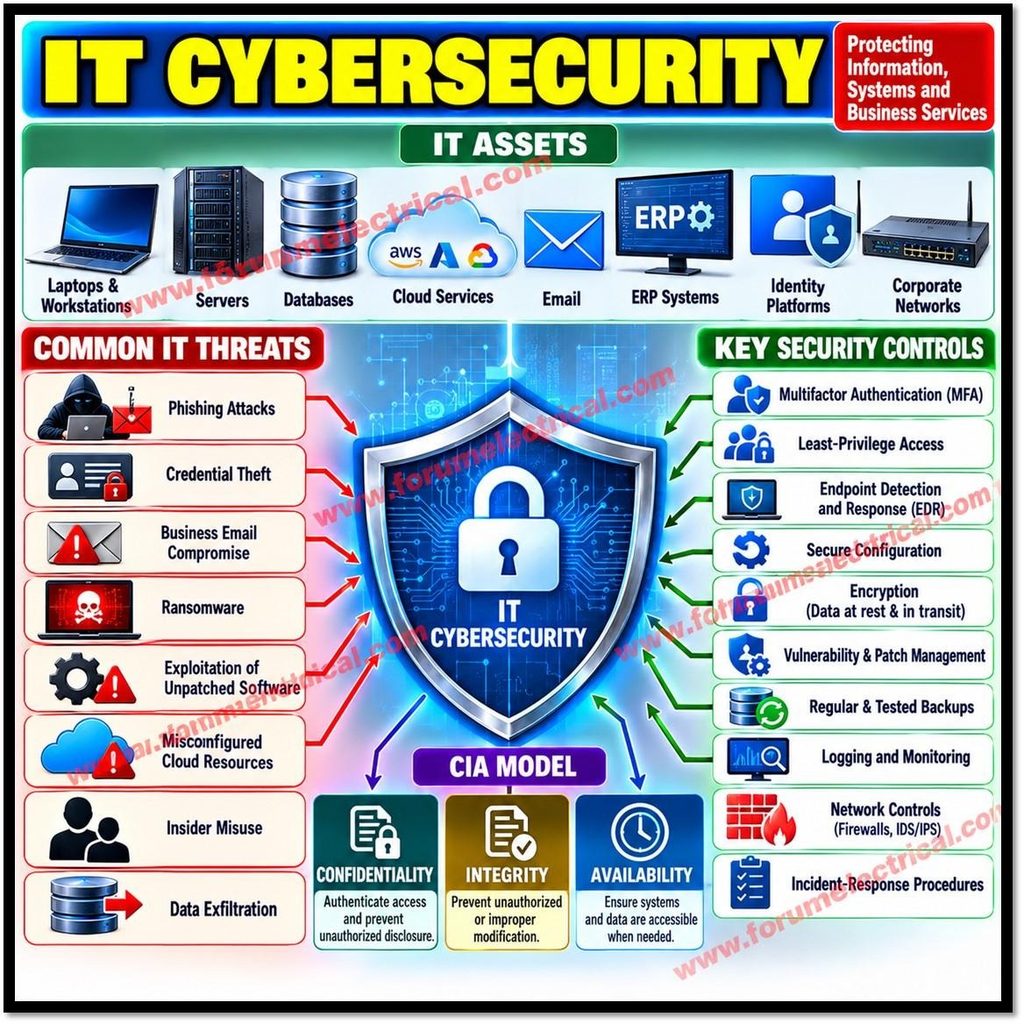
Typical controls include multifactor authentication (MFA), least-privilege access, endpoint detection & response, secure configuration, encryption, vulnerability and patch management, tested backups, logging, network controls and incident-response procedures.
OT Cybersecurity
Operational Technology (OT) consists of programmable systems and devices that monitor (or) directly influence physical equipment, industrial processes and infrastructure.
Examples
- Programmable Logic Controllers (PLCs),
- Supervisory Control and Data Acquisition (SCADA) systems,
- Distributed Control Systems (DCS),
- Human-Machine Interfaces (HMIs),
- Remote Terminal Units (RTUs),
- Industrial sensors and actuators,
- Safety instrumented systems (SIS),
- Drives,
- Protection relays and
- Building (or) Utility control systems.
OT cybersecurity used to avoid unauthorized access (or) changes that could disrupt control, compromise process data, degrade equipment (or) affect personnel, the environment and production.
Availability and predictable, reliable operation are often important.
Process integrity is also important because commands, setpoints, controller logic and sensor values must remain correct.
Safety is a central concern although safety is not simply another cybersecurity property: it is a system-level outcome managed through engineering, functional-safety practices and risk assessment.
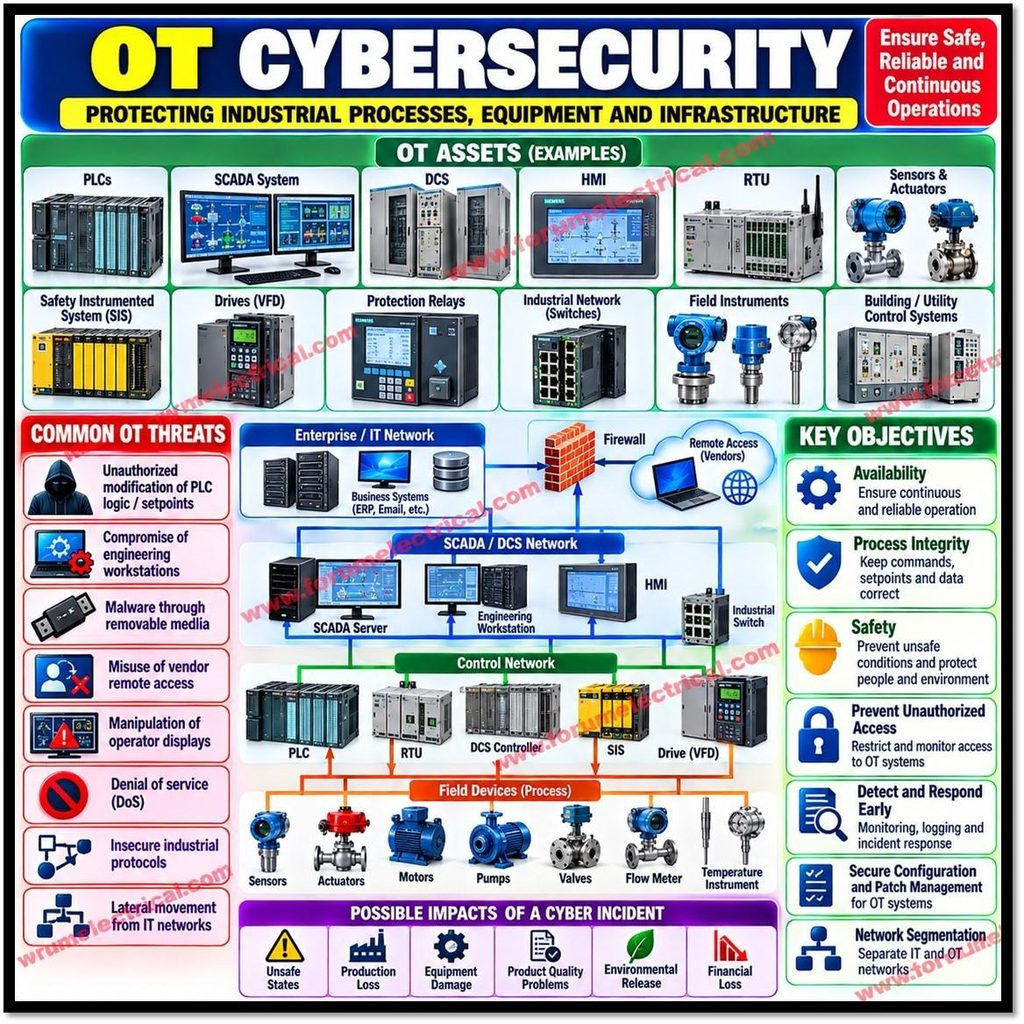
Threats include unauthorized modification of PLC logic (or) setpoints, compromise of engineering workstations, misuse of vendor remote access, malware entering through removable media, manipulation of operator displays, denial of service, insecure industrial protocols and lateral movement from connected enterprise networks.
A cyber incident can lead to unsafe states, product-quality problems, equipment damage, environmental release (or) prolonged production loss, depending on the process & safeguards.
IT and OT: Key Technical Differences
| Dimension | IT Cybersecurity | OT Cybersecurity |
| Primary assets | Data, applications, endpoints, servers and cloud services | Controllers, HMIs, sensors, actuators, control networks and industrial processes |
| Main objectives | Confidentiality, integrity and availability, prioritized by business need | Safe and reliable operation, availability, process integrity and controlled change |
| Impact of failure | Data exposure, fraud, service outage and business disruption | Production interruption, equipment damage, unsafe conditions or environmental impact |
| Change and patching | Often managed through scheduled enterprise patch cycles | Requires compatibility testing, outage planning, vendor coordination and process-risk review |
| Monitoring | Endpoint, identity, network and cloud telemetry | Passive network monitoring and process-aware monitoring where appropriate |
| Typical lifetime | Technology may be refreshed relatively frequently | Assets can remain in service for many years due to validation, cost and availability needs |
| Protocols and devices | Common enterprise protocols and general-purpose systems | Industrial protocols and specialized devices, sometimes with limited security features |
IT systems also support critical services and OT environments vary widely.
Security decisions should be based on asset function, threat exposure, process consequence & recovery requirements rather than on labels alone.
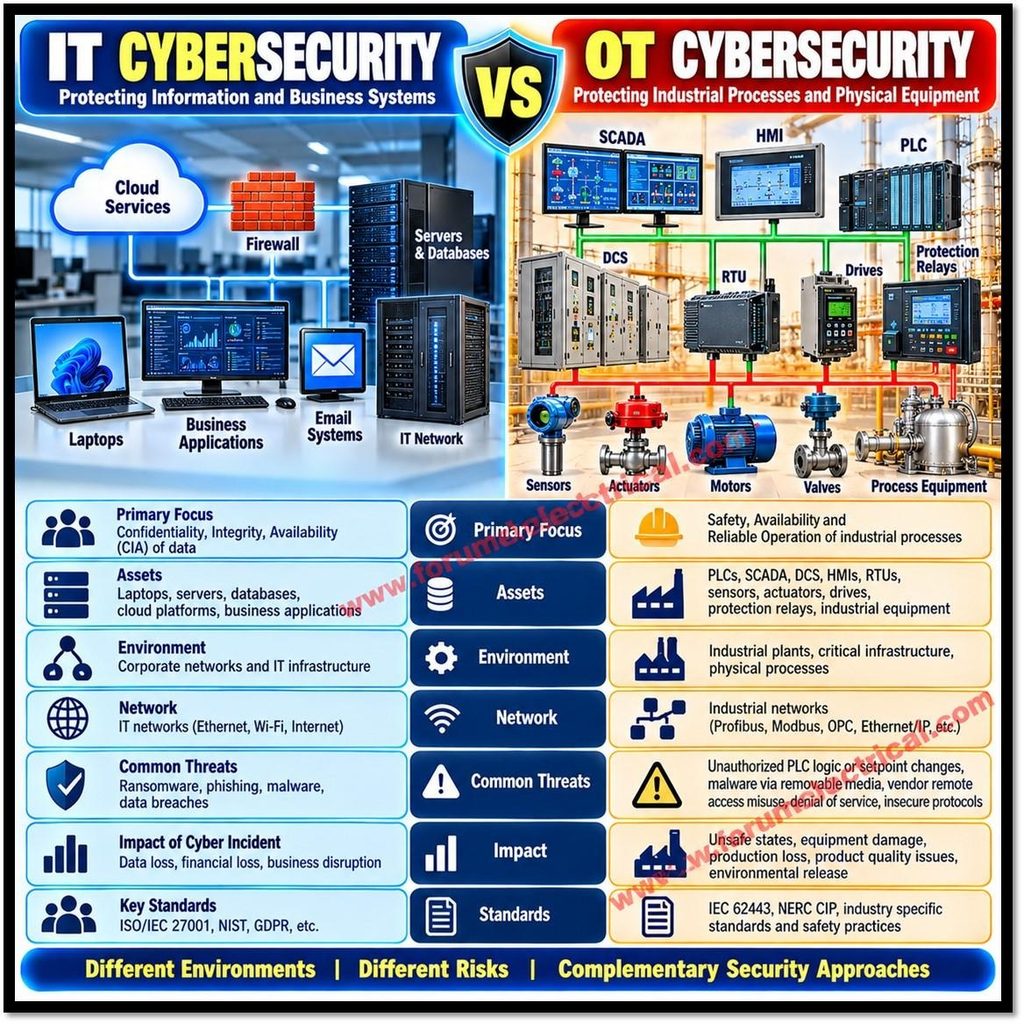
Why IT Security practices need OT Adaptation?
A control that is routine in an office network can have unintended consequences in an industrial control system.
An active vulnerability scan may overload a legacy controller or disrupt a fragile device.
Installing a patch (or) rebooting an HMI, historian or engineering workstation can interrupt visibility or control.
Endpoint agents may be unsupported on vendor-certified systems.
For these reasons, organizations should inventory assets, verify vendor guidance, assess operational and safety impact, test changes in a representative environment where feasible, schedule approved maintenance windows and maintain a rollback plan.
This does not mean OT should remain unpatched (or) unmonitored.
It means remediation should be risk-based and coordinated with operations and engineering.
IT/OT Convergence and Common Attack Paths
Common drivers include
- Production reporting,
- Remote maintenance,
- Centralized identity,
- Cloud analytics,
- Historians,
- Manufacturing execution systems (MES) and
- Predictive maintenance.
Connectivity can improve visibility and efficiency but it can also create paths for attackers if trust boundaries are weak.
Example
For example, a phishing incident may compromise an enterprise account; an attacker could then attempt to abuse remote-access tools (or) a poorly segmented connection to reach an engineering workstation.
If access controls and monitoring are inadequate, the attacker may try to alter control logic (or) disrupt operations.
This is a possible attack path, not an inevitable result of IT compromise.
Strong segmentation, authentication, authorization, monitoring and tested response procedures can interrupt the chain.
Practical OT and IT/OT Security Controls
Asset Inventory & Ownership
Maintain an accurate list of IT & OT assets, software versions, communication paths, criticality, owners & support status.
Network Segmentation
Permit only required communications & explicitly manage conduits across zones.
Remote Access
Use approved gateways, MFA where technically feasible, time limited authorization, individual accounts, session logging and controlled vendor access.
Avoid direct, unmanaged internet exposure of the controllers.
Least Privilege
Limit engineering & operator permissions to job requirements.
Separate routine operation from programming (or) administrative privileges and review accounts regularly.
Secure Configuration
Remove (or) disable unnecessary services, change default credentials, protect configuration files & maintain approved controller logic and device backups.
Monitoring and Detection
Collect relevant logs and use OT-aware preferably passive monitoring where active probing could affect devices.
Establish baselines & alert on unexpected connections, logic changes and unusual remote sessions.
Resilience and Recovery
Keep offline (or) otherwise protected backups of controller programs, HMI configurations, network diagrams & essential system images.
Test restoration procedures and define safe manual (or) degraded operating modes.
Incident Response
Create joint IT, OT, engineering, safety & operations playbooks.
Define who can isolate a network when process shutdown may be necessary, how evidence is preserved & how safe operation is restored.
Standards
NIST SP 800-82 – Guide to Operational Technology (OT) Security describes OT architectures, threats, vulnerabilities and recommended safeguards.
Implementation Priorities
- Identify essential processes and the assets whose compromise could affect safety, environment, production or essential services.
- Map IT/OT connections and remove undocumented or unnecessary communication paths.
- Agree on change windows, testing, rollback and emergency procedures with operations and engineering.
- Exercise incident response and recovery using scenarios that include loss of visibility, loss of control and suspected controller compromise.
Conclusion
IT cybersecurity primarily protects information and business services; OT cybersecurity protects the systems and processes that interact with the physical world.
Both require confidentiality, integrity and availability, but their relative priorities and acceptable risks can differ substantially.
Effective IT/OT security combines sound technical controls with process knowledge, disciplined change management, resilient recovery and collaboration among cybersecurity, IT, engineering, safety & operations teams.

