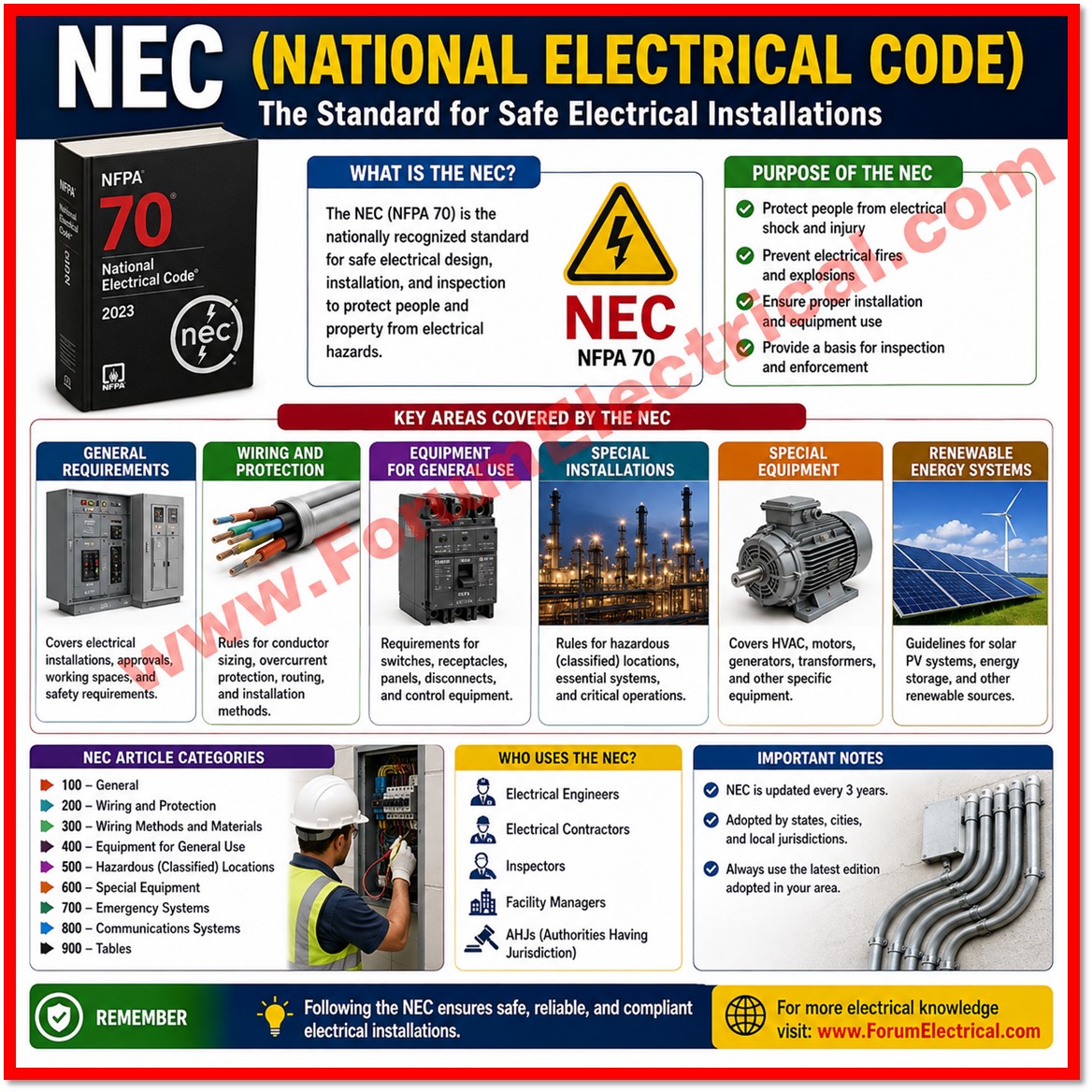
The National Electrical Code (NEC), formally designated NFPA 70, is the most widely referenced electrical safety standard in the world that is published and maintained by the National Fire Protection Association (NFPA), the NEC establishes the minimum requirements necessary for the safe design, installation, inspection and maintenance of electrical wiring and equipment.
Although the Code originates in the United States, its technical principles have been adopted, adapted (or) referenced by regulatory bodies, utilities and engineering firms in numerous countries making it a global benchmark for electrical safety practice.
The NEC is revised on a three-year cycle through a consensus-based process involving code-making panels composed of engineers, electricians, inspectors, manufacturers and safety professionals.
This continuous revision cycle ensures the Code keeps pace with evolving technologies such as renewable energy systems, energy storage and electric mobility.
Purpose of the NEC
The overarching purpose of the NEC is the practical safeguarding of persons and property from hazards arising from the use of electricity.
It achieves this through a comprehensive set of enforceable requirements rather than through design guidance alone.
The principal objectives of the Code include:
- Ensuring safe electrical installations across residential, commercial and industrial occupancies.
- Preventing electrical fires, electric shock and arc flash hazards through mandatory protective measures.
- Standardizing electrical installation practices so that work performed by different contractors remains consistent and inspectable.
- Protecting personnel, equipment, and buildings from damage caused by faults, overloads and short circuits.
- Promoting reliable and efficient electrical systems that support long term operational performance.
Key Areas Covered by the NEC
The NEC is organized into chapters and articles that collectively address nearly every aspect of electrical system design and installation.
Major technical areas covered include:
- Wiring methods and materials, including conduit, cable tray, and raceway systems.
- Grounding and bonding of systems, equipment, and structures.
- Overcurrent protection, including fuses, circuit breakers and coordination studies.
- Cable and conductor sizing based on ampacity, temperature rating and installation conditions.
- Switchgear, switchboards and distribution panelboards.
- Transformers and generators, including ventilation and protection requirements.
- Motors and motor control circuits, including branch circuit and overload protection.
- Emergency and standby power systems for critical facilities.
- Hazardous (classified) locations where flammable gases, vapors or dust may be present.
- Solar photovoltaic (PV) systems, including array wiring and rapid shutdown.
- Battery Energy Storage Systems (BESS) and their integration with the grid.
- Electric Vehicle (EV) charging systems and associated infrastructure.
Importance of the NEC in Electrical Engineering
For practicing electrical engineers, the NEC functions as both a design reference and a compliance benchmark.
Its importance extends across the full lifecycle of an electrical installation:
- It improves electrical safety during both the installation phase and subsequent maintenance activities.
- It minimizes the risk of electrical accidents, equipment failures and unplanned outages.
- It ensures proper selection of cables, breakers and other protective devices based on calculated loads and fault conditions.
- It enhances the reliability and operational lifespan of electrical installations through sound engineering practice.
NEC Requirements for Solar Power Plants
With the rapid growth of renewable energy, the NEC has developed detailed provisions specifically addressing photovoltaic (PV) systems primarily under Article 690.
These requirements are essential for engineers designing utility-scale and rooftop solar installations, and they cover the complete electrical path from the PV module to the point of interconnection:
- DC and AC cable installation methods suited to outdoor and rooftop environments.
- PV module wiring, including series and parallel string configurations.
- Grounding and bonding of solar arrays, racking systems and combiner boxes.
- Disconnecting means and isolation devices for maintenance and emergency shutdown.
- Overcurrent protection sized for PV source and output circuits.
- Inverter installation requirements, including clearances and interconnection provisions.
- Equipment labeling and warning signage to alert personnel to multiple power sources.
- Rapid shutdown requirements that de-energize conductors within a specified boundary during emergencies.
- Battery energy storage integration addressed jointly with Article 706 where PV systems include storage.
Advantages of following NEC
Adherence to the NEC delivers measurable benefits throughout the life of an electrical system.
These benefits extend beyond regulatory compliance to encompass operational and financial advantages:
- Increased electrical safety for occupants, operators and maintenance personnel.
- Reduced risk of fire and electric shock resulting from improper installation.
- Improved system reliability through standardized design and protection practices.
- Easier inspection and maintenance due to consistent documentation and labeling requirements.
- Better regulatory compliance that is reducing the likelihood of costly rework or project delays.
- Protection of personnel and equipment investment over the operational life of the facility.
Commonly referenced NEC Articles
The following table summarizes the NEC articles most frequently referenced by engineers, contractors and inspectors across conventional and renewable energy projects:
| Article | Title | Scope / Focus |
|---|---|---|
| Article 110 | Requirements for Electrical Installations | General installation requirements, working space and equipment approval |
| Article 250 | Grounding and Bonding | System and equipment grounding, bonding of enclosures and conductors |
| Article 310 | Conductors for General Wiring | Conductor ampacity, sizing and insulation types |
| Article 408 | Switchboards and Panelboards | Construction, clearance and overcurrent protection of panels |
| Article 430 | Motors, Motor Circuits, and Controllers | Motor branch circuit protection, disconnects, and controllers |
| Article 450 | Transformers | Installation, overcurrent protection, and ventilation of transformers |
| Article 690 | Solar Photovoltaic (PV) Systems | PV source and output circuits, disconnects, grounding and rapid shutdown |
| Article 706 | Energy Storage Systems | Battery Energy Storage System (BESS) installation and protection |
| Article 625 | Electric Vehicle Power Transfer System | EV charging equipment, cords and ventilation requirements |
Conclusion
The National Electrical Code stands as a globally respected electrical safety standard, offering practical, enforceable requirements for the design and installation of electrical systems.
While developed within the United States regulatory framework, its technical rigor has led to widespread international recognition.
Engineers, contractors and inspectors working on industrial facilities, substations, renewable energy projects, and commercial buildings routinely reference the NEC to improve safety, ensure reliability and demonstrate compliance with recognized engineering practice.
As electrical systems continue to evolve with the integration of solar power, battery storage and electric vehicle infrastructure, the NECs periodic revision cycle ensures it remains a relevant and authoritative reference for the electrical engineering profession.

, including its purpose, electrical safety requirements, wiring rules, equipment standards, and key NEC articles for safe, reliable and code-compliant electrical installations.)