1). What is a Hydroelectric Power Plant?
A hydroelectric power plant uses turbines to turn stored water into mechanical energy, which is subsequently converted to electrical power through generators.
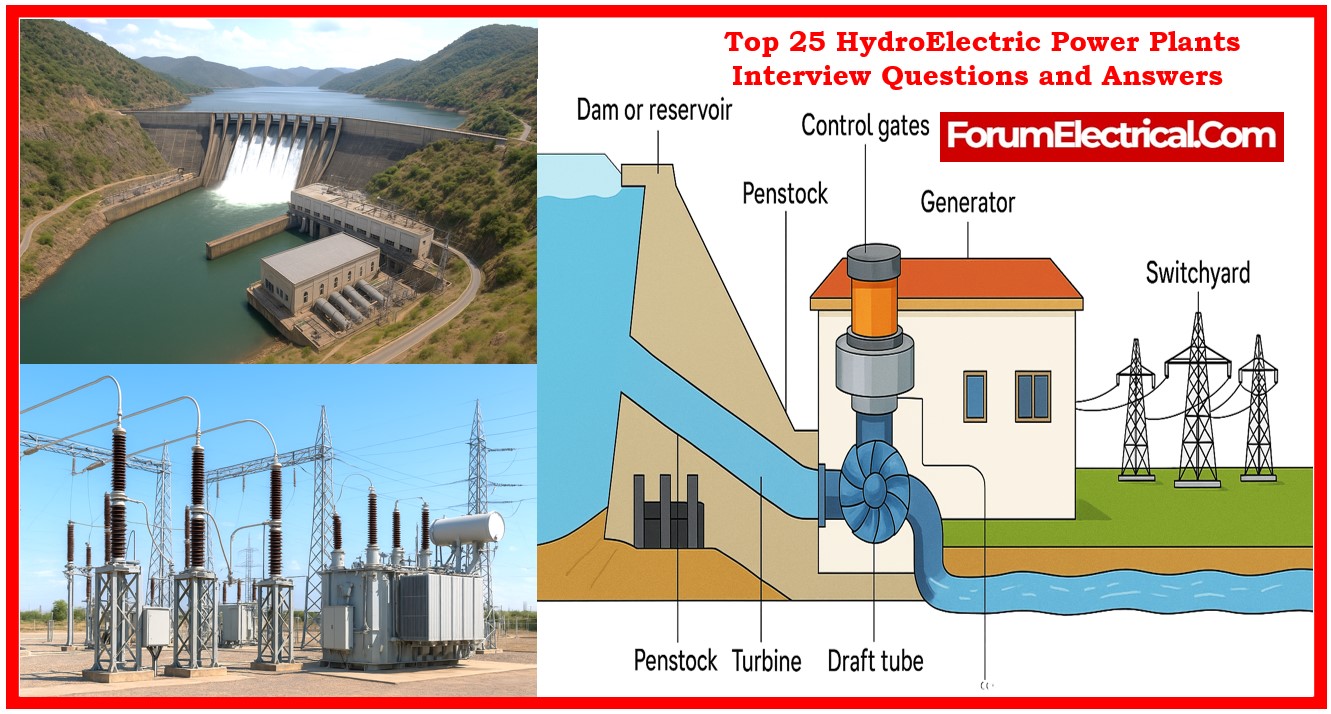
2). What are the Major Components of a Hydroelectric Power Plant?
The major components of a hydroelectric power plant are:
- Dams (or) Reservoirs,
- Penstock,
- Turbine,
- Generator,
- Control gates,
- Powerhouse &
- Switchyard
3). How does a Hydropower Plant generate Electricity?
Water from a height runs via the penstock, spinning a turbine attached to a generator.
The revolving generator uses electromagnetic induction to transform mechanical energy into electrical energy.
4). What are the different types of hydropower plants?
The different types of hydropower plants are:
- Storage (reservoir-based),
- Run-of-river &
- Pumped storage.
5). What is a Penstock?
A penstock is a huge pipe (or) conduit that transports high-pressure water from the reservoir to the turbine.
6). What types of Turbines are used in Hydro Power Plants?
The types of turbines used in hydro power plants are:
- Pelton’s wheel (High Head),
- Francis turbine (Medium Head) &
- Kaplan turbines (Low Head).
7). What is the purpose of a Draft Tube in hydroelectric turbines?
The purpose of a draft tube in hydroelectric turbines is to improves efficiency by recovering kinetic energy from the turbine’s discharge water & reducing its exit velocity.
8). What is the difference between a Dam and a Barrage?
| Dam | Barrage |
| A high structure that stores water in order to generate hydraulic head. | A barrage is a low structure with moveable gates for controlling water flow. |
9). What is meant by “Head” in hydro power?
The term “head” refers to the difference in height between the water source & turbine.
A larger head indicates more potential energy.
10). What is Cavitation in Turbines & how do you avoid it?
Cavitation occurs when vapor bubbles collapse, causing damage to turbine blades.
It is avoided by keeping pressure above vapor pressure and utilizing properly built draft tubes.
11). What is the Efficiency of Hydroelectric Power Plants?
Efficiency refers to the ratio of electrical energy production to hydraulic energy input.
Modern plants may have efficiencies that exceed 90%.
12). What are the Environmental Implications of Hydroelectric Power?
The environmental implications of hydroelectric power are:
- Flooding in ecosystems,
- Fish migration disturbance,
- Water quality changes &
- Methane emission from the reservoirs.
13). What are the Advantages of Hydropower?
The advantages of hydropower are:
- Renewable,
- Low operating costs,
- Long lifespan and
- Load balancing improves grid stability.
14). Describe a Pumped Storage Hydroelectric System
Pumped storage hydroelectric system are the system that pumps water to an upper reservoir when low demand & releases it to create power during high demand.
15). Define Spillway
A spillway prevents overtopping during floods by allowing controlled water overflow from a dam.
16). What types of Maintenance are necessary in Hydropower Plants?
The types of maintenance necessary in hydropower plants are:
- Inspecting turbine blades,
- Check the generator windings,
- Clean the penstock and valves,
- Calibration of control systems
17). What is a Surge Tank? How does it work?
A surge tank protects the penstock by absorbing abrupt pressure changes (water hammer) when load changes.
18). How is Voltage Controlled in a Hydropower Plant?
Automatic Voltage Regulators (AVRs) change excitation to regulate the output voltage.
19). What types of Protection Systems are employed in Hydropower Plants?
The types of protection systems are employed in hydropower plants are:
- Overcurrent Protection,
- Differential Protection,
- Earth-Fault Protection &
- Temperature Monitoring for the rotor & stator.
20). What are Tailrace & Forebay in a hydroelectric system?
Tailrace
A channel that transports water after it passes past the turbine.
Forebay
Reservoir before the penstock.
21). What is the Life Expectancy of a hydroelectric power plant?
Hydro plants can last up to 50-100 years with proper maintenance.
22). How do hydroelectric generators start and coordinate with the grid?
The turbine is started by control gates. Once the rated speed and voltage have been reached, the generator is synced utilizing a synchronizing panel.
23). What are SCADA systems utilized for in hydropower plants?
SCADA systems in hydro plants enable
- Remote Monitoring,
- Control of Gates,
- Turbines,
- Alarms and
- Data Logging.
24). Why are Transformers used in hydropower plants?
Transformers convert generating voltage (11-33 kV) to transmission levels (132/220/400 kV) for effective power distribution.
25). What is the typical power rating of hydroelectric plants?
The typical power rating of hydroelectric plants are:
- Small (<10 MW)
- Medium: 10 to 100 MW.
- Large: >100 MW (Ex: Bhakra, Tehri & Sardar Sarovar, India)

