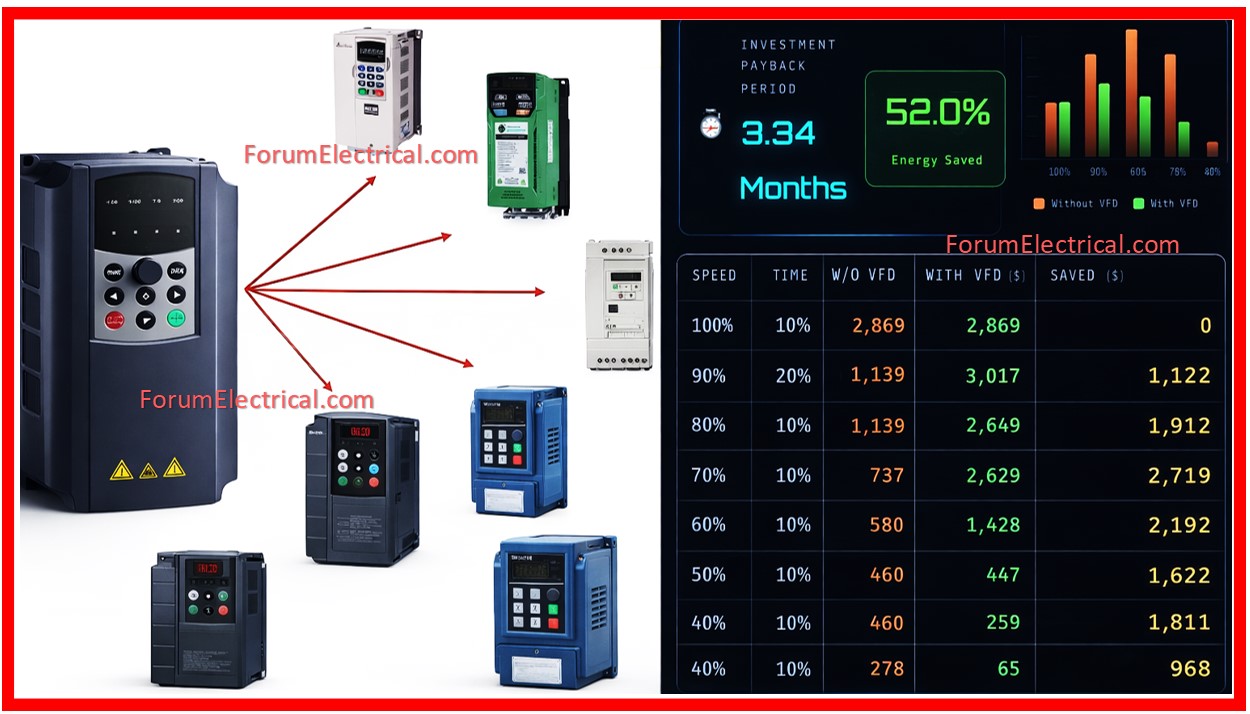
Calculator
Electric motors utilized in pumps and fans consume a significant portion of industrial electrical energy.
to see results
| Speed | % Time | W/o VFD ($) | With VFD ($) | Saved ($) |
|---|
Click here for more Electrical Calculators
Many of these motors run continuously at full speed even when the process requires lower flow (or) pressure.
This results in unnecessary energy consumption and increased operational costs.
A Variable Frequency Drive (VFD) solves this problem by adjusting the motor speed according to the process requirement.
By controlling the frequency supplied to the motor VFDs reduce energy usage dramatically especially in centrifugal loads such as pumps and fans.
The VFD Energy Savings Calculator helps engineers, technicians and plant managers to estimate:
- Annual energy consumption,
- Annual electricity cost,
- Energy savings after installing a VFD and
- Payback period for the VFD investment.
What is a VFD Energy Savings Calculator?
A VFD Energy Savings Calculator is an engineering tool utilized to estimate how much electrical energy can be saved by installing a Variable Frequency Drive on a motor driven system.
It calculates:
- Power consumption without VFD,
- Power consumption with VFD,
- Annual operating cost,
- Total energy savings and
- Investment payback period.
This tool is widely utilized in industries such as:
- Water treatment plants,
- HVAC systems,
- Chemical plants,
- Oil & gas facilities and
- Manufacturing industries.
Why use a VFD in Motor Applications?
Installing a VFD provides several operational and energy advantages.
1). Energy Savings
VFDs reduce the motor speed during the low demand which is significantly decreases the power consumption.
2). Reduced Mechanical Stress
Soft starting avoids the sudden current surges and also mechanical shocks.
3). Improved Process Control
Accurate control of speed that improves the system efficiency and generate product quality.
4). Lower Maintenance Cost
Reduced stress on the mechanical components which increases the equipment life.
5). Power Factor Improvement
VFDs maintain a better power factor (PF) when compared to direct online starting (DOL starter).
Key Inputs Parameters
The calculator requires many motors, operational and cost parameters.
1). Speed Distribution
This part represents the percentage (%) of time the motor operates at the different speeds.
Typical speed levels utilized in the calculator:
- 100%
- 90%
- 80%
- 70%
- 60%
- 50%
- 40%
- 30%
- 20%
- 10%
The total percentage of the operating hours must equal 100%.
Example
- 100% speed – 10% of time
- 90% speed – 20% of time
- 80% speed – 25% of time
This helps estimate the realistic motor operation.
2). Motor Parameters
These parameters define the motors electrical characteristics.
Required inputs include:
- Motor power (HP),
- Motor efficiency (%),
- Input voltage (V),
- Frequency (Hz),
- Full load current (A) and
- Motor speed (RPM).
Full Load Power Formula
The calculator determines full load input power using:
Power (kW) = HP X 0.7457/Efficiency
Where
HP – Motor horsepower
0.7457 – Conversion factor to kW
Efficiency – Motor efficiency
3). Cost Parameters
These values are used to find the annual operating cost and savings.
Inputs include:
- VFD purchase cost,
- Electricity tariff ($/kWh),
- Operating hours per day and
- Operating days per week.
Annual Operating Hours
Annual Hours = Hours per Day x Days per Week x 52
Example
24 x 7 x 52 = 8760 hours per year
Power consumption follows the Affinity Laws.
Speed vs Flow
Flow ∝ Speed
Speed vs Pressure
Pressure ∝ Speed2
Speed vs Power
Power ∝ Speed3
This explains even a small reduction in speed results in large energy savings.
How VFD Energy Savings Calculator works?
The calculator performs the following step by step calculations.
Step-1: Full Load Power Calculation
Motor full load (FLP) power is determined from motor HP and efficiency.
Step-2: Annual Energy without VFD
Energywithout = Full Load Power x Annual Hours
Step-3: Annual Energy with VFD
Power at which each speed level is calculated using the cube law:
Power = Full Load Power x (Speed/100)3
Step-4: Annual Cost Calculation
The annual cost is calculated as
Annual Cost = Energy x Electricity Rate
Step-5: Annual Savings
The annual savings is calculated as
Savings = Costwithout – Costwith
Payback Period Calculation
The calculator also determines the payback period for installing a VFD.
Payback Formula
Payback Period (Profit) = VFD Cost/Annual Savings
The result is usually expressed in months.
The VFD Energy Savings Calculator is a powerful engineering tool for calculating the economic and energy advantages of installing Variable Frequency Drives in motor driven systems.
For industries planning to reduce electricity consumption and improve efficiency VFDs provides one of the most cost effective energy optimization solutions.

