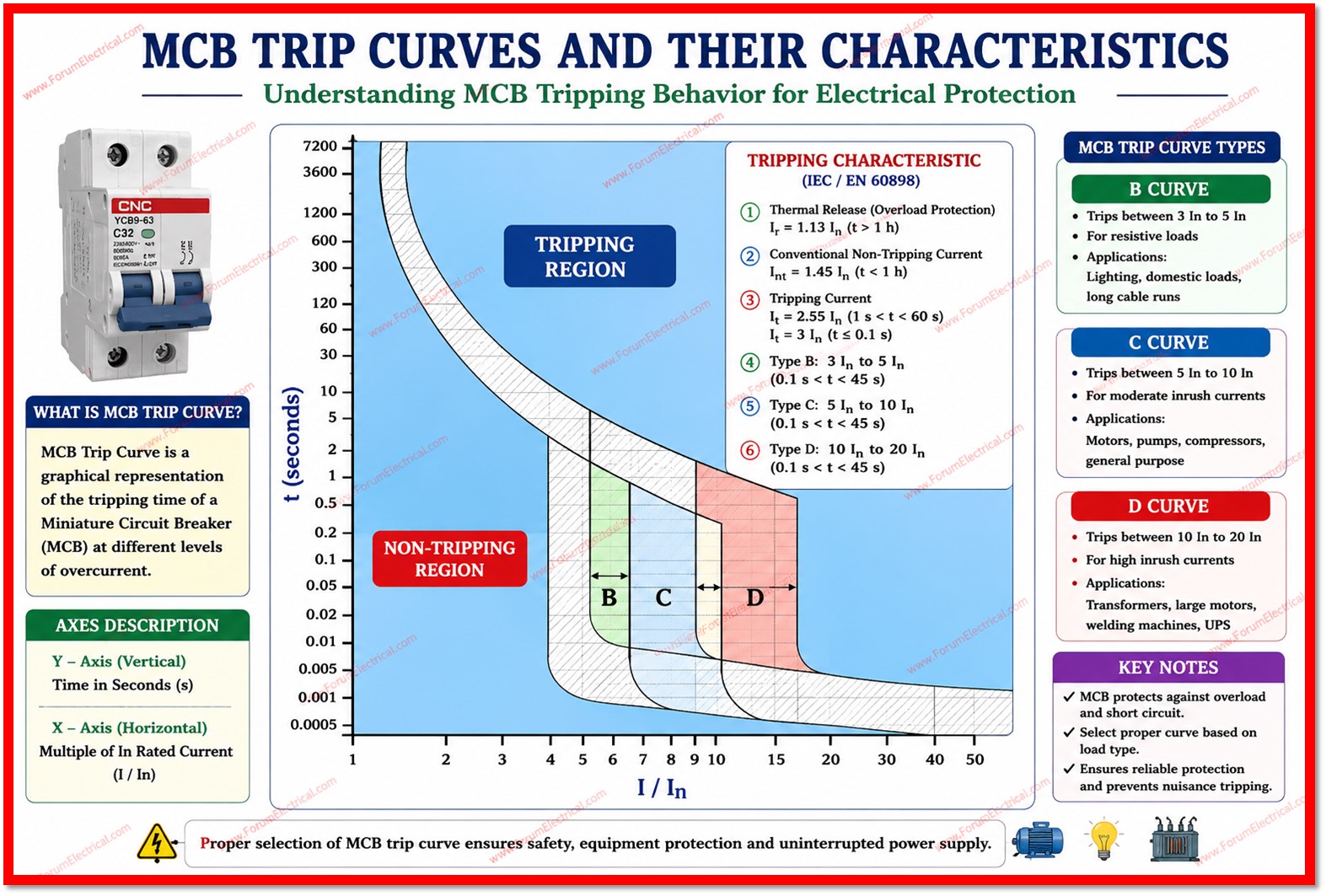
What is a Trip Curve?
A trip curve also called a current time graph is a graphical illustration of a circuit breakers response.
- What is a Trip Curve?
- How do you read a Trip Curve?
- Why is it necessary to have different tripping curves?
- MCB Trip Curve
- Type B Characteristic Curves
- Type C Characteristic Curves
- Type D Characteristic Curves
- Type K Characteristic Curves
- Type Z Characteristic Curves
- MCB Trip Curve Types Table
- Comparison of MCB Curves
- Typical Instantaneous Tripping Ranges
- Selection Rule
- How to select MCB curve?
- Which MCB trips faster?
- For Acti 9 MCB, what does the B, C and D curve mean?
It illustrates the present relationship between the tripping time of the protection device.
How do you read a Trip Curve?
The horizontal X-axis shows the multiples of the current via the circuit breaker.
The Y-axis shows the circuit breakers tripping time on a logarithmic scale.
The thermal area depicts the reaction of the bimetallic contact trip unit to overcurrent.
The curve indicates that the circuit breakers tripping time decreases as the current increases.
The first curve in the graph represents the response of the thermal trip unit.
The magnetic region demonstrates the solenoid’s sensitivity to fault current which could be a short circuit current.
A circuit breaker has no fixed tripping period and we cannot forecast a specific tripping point. It is because environmental circumstances, such as temperature have an impact on tripping.
Why is it necessary to have different tripping curves?
Circuit breakers are utilized to instantly trip the power supply in case of an overcurrent.
However, it must not move too quickly or unnecessarily causing complications.
Overcurrent can occur under normal circumstances such as the inrush current of a motor.
Inrush current is the large current consumption that occurs when a motor starts causing voltage drops in the main line.
The circuit breaker must be able to control the inrush current and provide some time before tripping.
As a result, the circuit breaker used should not trip too quickly causing a nuisance nor should it trip late causing harm.
This is when the circuit breakers trip characteristics come into effect.
The tripping curve describes how quickly a circuit breaker will trip at a given current.
The various tripping curves divide circuit breakers into groups with each category utilized for a certain type of load.
It is important to select a circuit breaker that gives adequate overcurrent protection.
MCB Trip Curve
The trip curve is a schematic representation of circuit protection devices.
- Fuse,
- MCB,
- MCCB,
- Supplementary protectors,
- Motor protection circuit breakers,
- Overload relays,
- Electronic fuses &
- Air circuit breakers
are all types of circuit protection devices.
The diagram below shows the trip curve of an MCB.
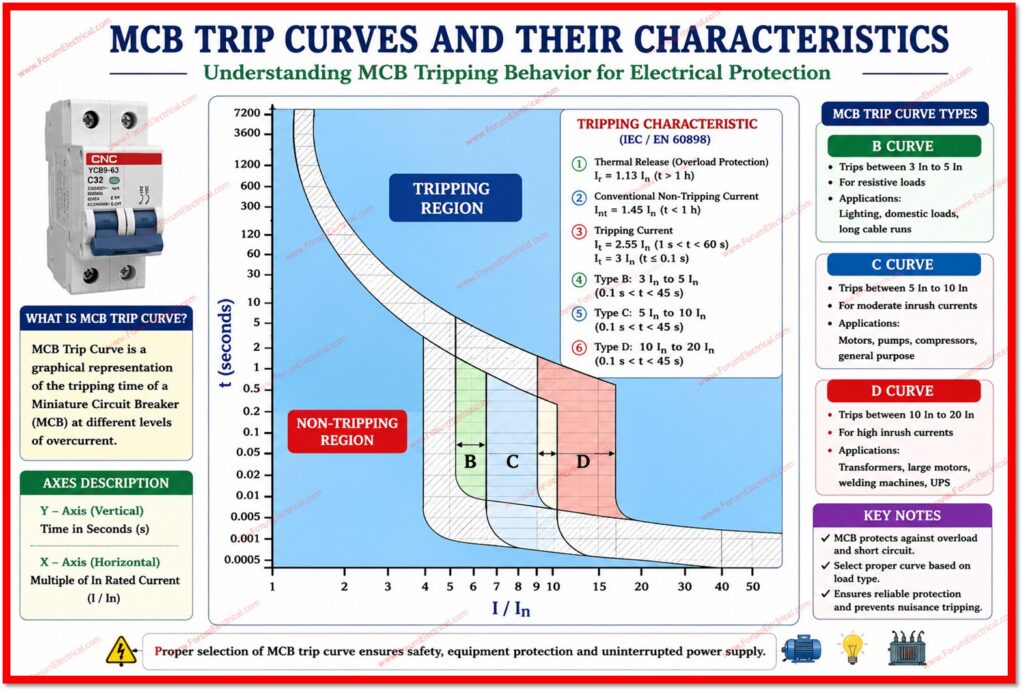
The horizontal X-axis represents multiples of current flowing through the micro circuit breaker. The Y-axis, on a logarithmic scale, shows the time it takes for the small circuit breakers to trip.
The characteristic curve shows the correlation between current & tripping time.

The MCB has 5 types of characteristic curves:
1). Type B,
2). Type C,
3). Type D,
4). Type K and
5). Type Z Characteristic Curves.
They are listed below.
Type B, C or D are classified according to the breakdown current rating at which an electromagnetic operation occurs providing short-term protection in opposition to short circuits.
The trip curve is a graph that relates the outgoing current and the tripping time (amp-sec Curve) to make sure of maximum equipment safety & performance while preventing unintentional trips.
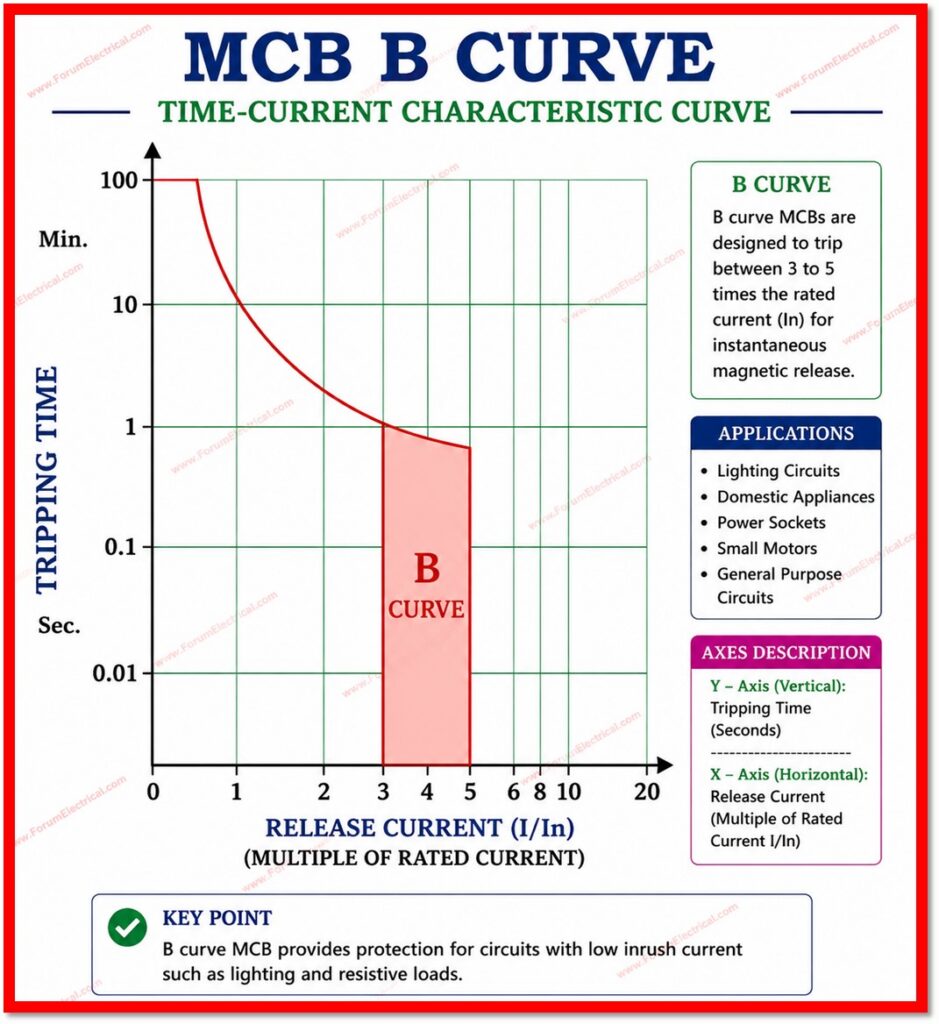
Type B Characteristic Curves
3 to 5 times in the magnetic trip for utilization in domestic operations where maximum sensitivity is necessary and there is small devices that demands a large start-up current.
When the loads are resistive and if there is no inrush current use B curve MCBs.
Type C Characteristic Curves
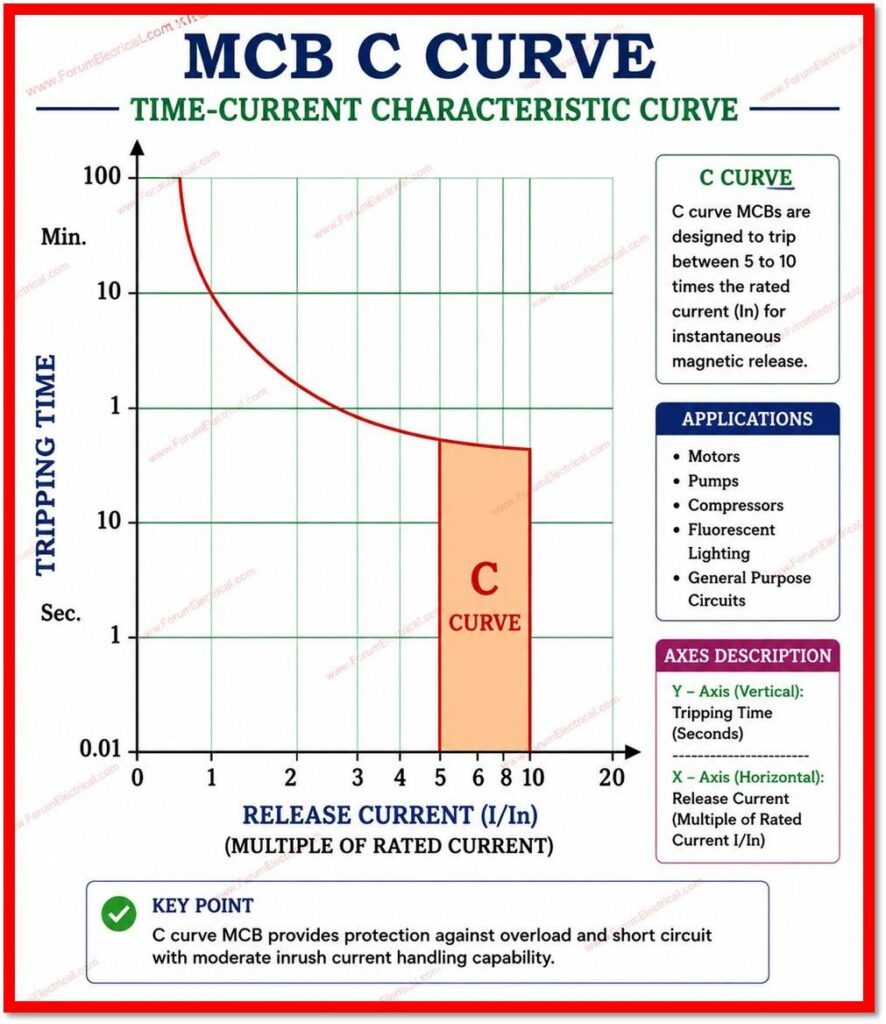
For commercial & industrial applications Type C devices are the norm. These devices are intended to trip when the current exceeds 5-10 times the rated current which is 50-100A for a 10A electrical device.
C curve MCBs must be utilized when loads have negligible inrush current at initiation. The optimal application involves a small transformer load.
Type D Characteristic Curves
Type D devices have more limited uses mainly in industrial use where significant inrush currents are expected,
- Large sized battery charging systems,
- Winding motors,
- Power transformers,
- X-ray equipment and some discharge lighting sources.
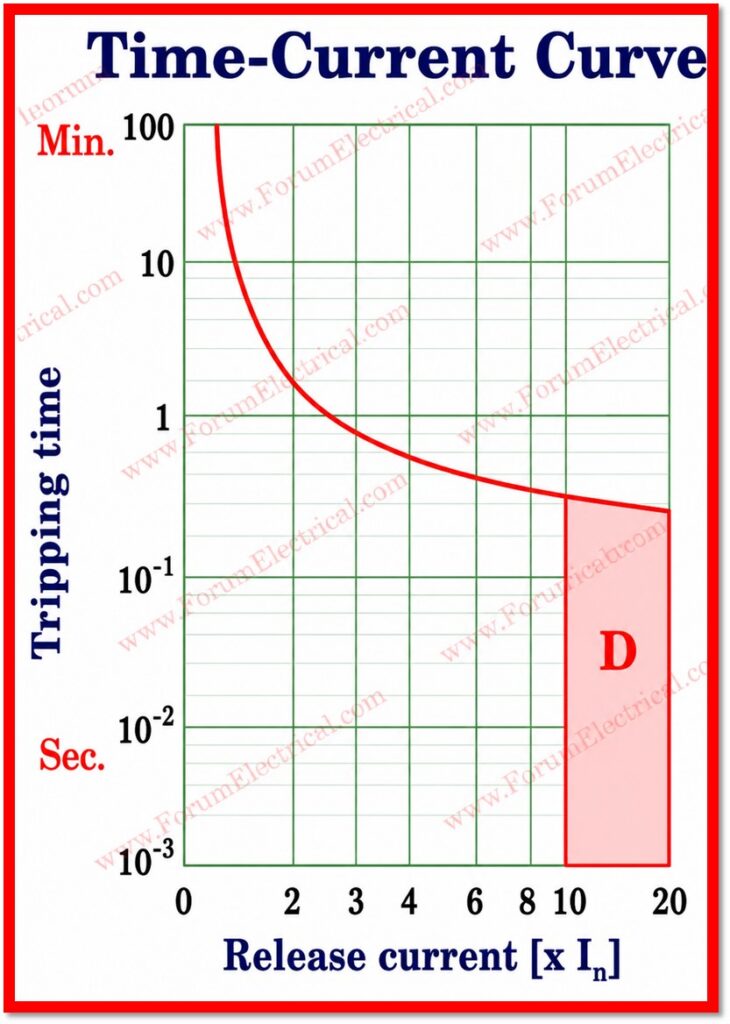
Type D devices are designed to trip 10-20 times per second, i.e., 100-200A / 20A electrical devices.
Normal connection ratings indicate the amount of time a cable may be utilized continuously under specific installation conditions.
Wires can withstand strong currents for a limited time and without becoming damaged.
Type K Characteristic Curves
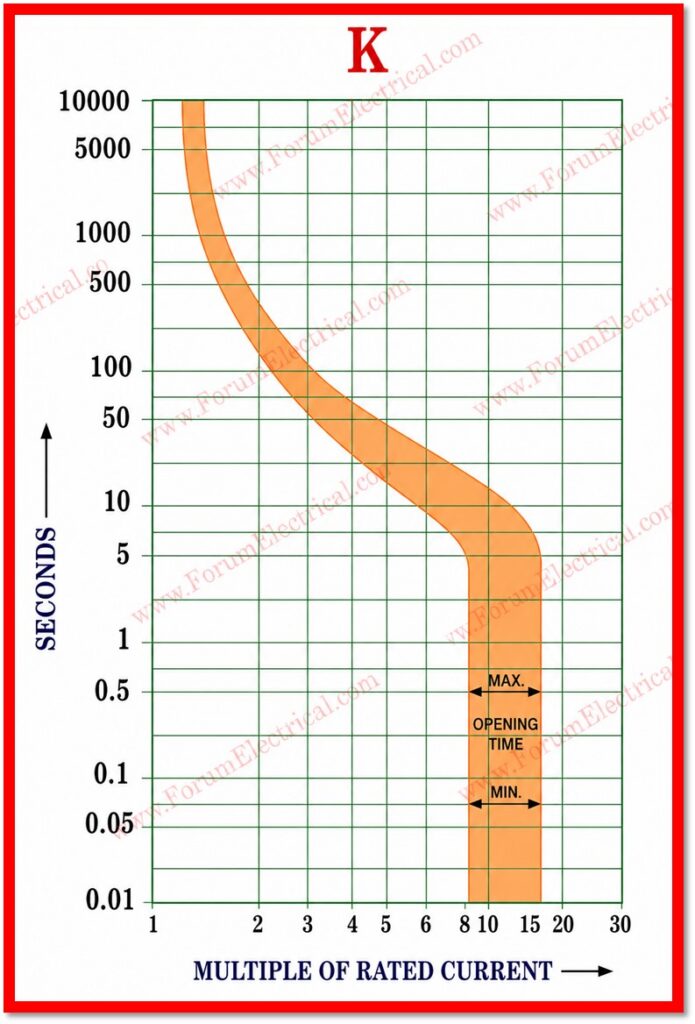
The K curve MCB is intended for motor applications in which amperage climbs fast during “start-up.”
Curves can pass through the temporary inrush of current, reducing nuisance tripping while ensuring circuit safety.
In less than 0.01 seconds (< 0.01) the magnetic element of the K curve breaks a short circuit at ten times the rated current.
At ten times the rated current, the K curve tripping bandwidth varies by 0.01 second.
Type Z Characteristic Curves
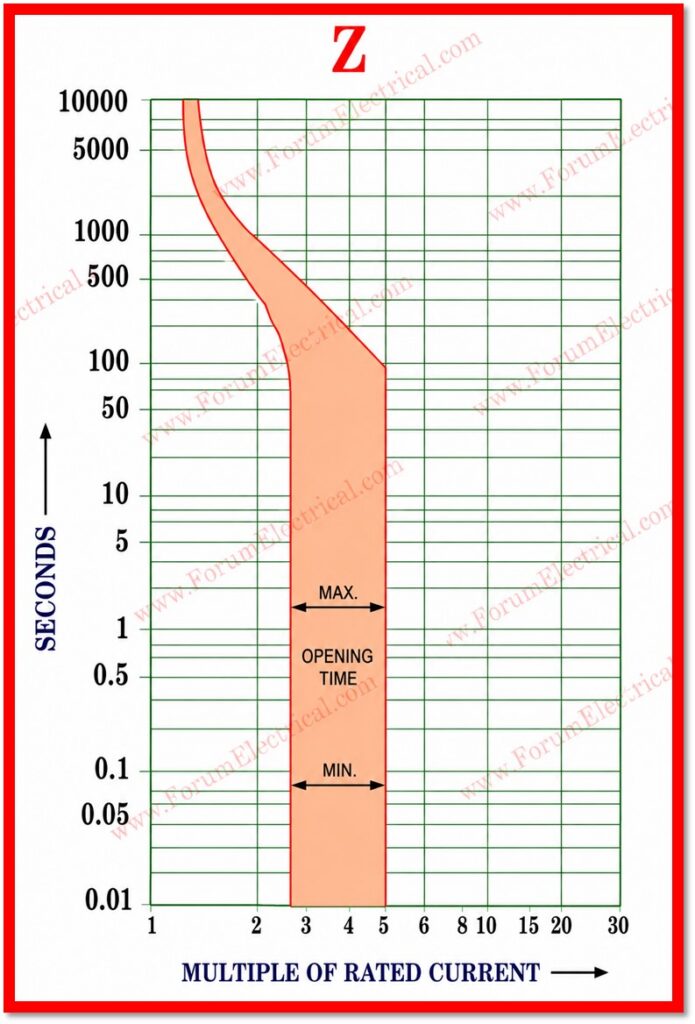
When the current via an MCB with the type Z trip characteristics exceeds 2 to 3 times the rated current it trips immediately.
These MCBs are particularly sensitive to short circuits & are used to protect highly sensitive electrical devices such as semiconductors.
Low short circuit trip settings are necessary for Z type MCBs.
MCB Trip Curve Types Table
| MCB Trip Curve Type | Instantaneous Magnetic Trip Range | Typical Application | Load Type | Key Characteristics |
| Type B | 3 to 5 x In | Residential installations, lighting circuits, heating loads & domestic appliances | Resistive loads with little (or) no inrush current | High sensitivity, trips quickly on a small fault currents & ideal for domestic use where maximum protection is required. |
| Type C | 5 to 10 x In | Commercial buildings, small motors, pumps, transformers & HVAC systems | Moderate inductive loads with a moderate inrush current | Most commonly used MCB curve, balances nuisance trip prevention and fault protection. |
| Type D | 10 to 20 x In | Large motors, transformers, battery chargers, welding machines, X-ray equipment, discharge lighting | High inrush current loads | Designed to withstand high starting currents without nuisance tripping while providing short-circuit protection. |
| Type K | 8 to 12 x In | Motor control circuits, compressors, industrial machinery, inductive loads | Motor and highly inductive loads | Specially designed for motor starting currents. Provides enhanced overload protection while tolerating temporary inrush currents. |
| Type Z | 2 to 3 x In | Electronic circuits, semiconductor devices, PLCs, sensitive instrumentation | Highly sensitive electronic loads | Extremely sensitive short-circuit protection. Trips very quickly at low fault currents to protect delicate equipment. |
Comparison of MCB Curves
| Curve Type | Sensitivity | Inrush Current Tolerance | Common Use |
| Z Curve | Very High | Very Low | Sensitive electronics and semiconductors |
| B Curve | High | Low | Residential and lighting circuits |
| C Curve | Medium | Medium | Commercial and general-purpose circuits |
| K Curve | Medium-Low | High | Motors and inductive loads |
| D Curve | Low | Very High | Heavy industrial equipment and transformers |
Typical Instantaneous Tripping Ranges
| MCB Curve | Trip Range |
| Z Curve | 2–3 × In |
| B Curve | 3–5 × In |
| C Curve | 5–10 × In |
| K Curve | 8–12 × In |
| D Curve | 10–20 × In |
Selection Rule
Z Curve → Sensitive electronics.
B Curve → Domestic/resistive loads.
C Curve → General commercial and industrial loads.
K Curve → Motors and inductive equipment.
D Curve → Heavy inrush current equipment and transformers.
How to select MCB curve?
B-Curve: Suitable for domestic & light commercial uses such as heaters & lighting. Trips range from 3 to 5 times of rated current.
C-curve: Suitable for commercial & industrial applications that is requiring low-level surges.
D-Curve: Suitable for circuits with a strong inrush currents such as motors & transformers.
Which MCB trips faster?
The Type B MCB trips faster than Type C & Type D MCBs for the same fault current level.
MCB Trip Characteristics
Type B MCB: Trips at 3 – 5 times of the rated current (fastest).
Type C MCB: Trips at 5 – 10 times of the rated current.
Type D MCB: Trips at 10 – 20 times of the rated current (slowest).
Fastest Trip: Type B MCB
Used for residential circuits, lighting loads and low inrush current applications.
Example: A 10A Type B MCB can trip instantly at 30–50A while a 10 A Type C MCB may need a current of 50 – 100A to trip instantly.
For Acti 9 MCB, what does the B, C and D curve mean?
The MCB trips 3 to 5 times the entire load current according to the B curve. It is mostly utilized in home settings with resistive loads, including as lighting fixtures and low-surge domestic appliances.
The MCB trips 5 to 10 times the full load current when it has a C curve. It is utilized in commercial and industrial settings where there is a larger risk of short circuit currents such as fluorescent lighting and mostly inductive loads.
The MCB trips 10 to14 times the full load current according to the D curve. It is utilized in situations where inrush currents may be quite high such as in X-ray machines.

, their tripping characteristics, current ranges, applications, and protection functions.)