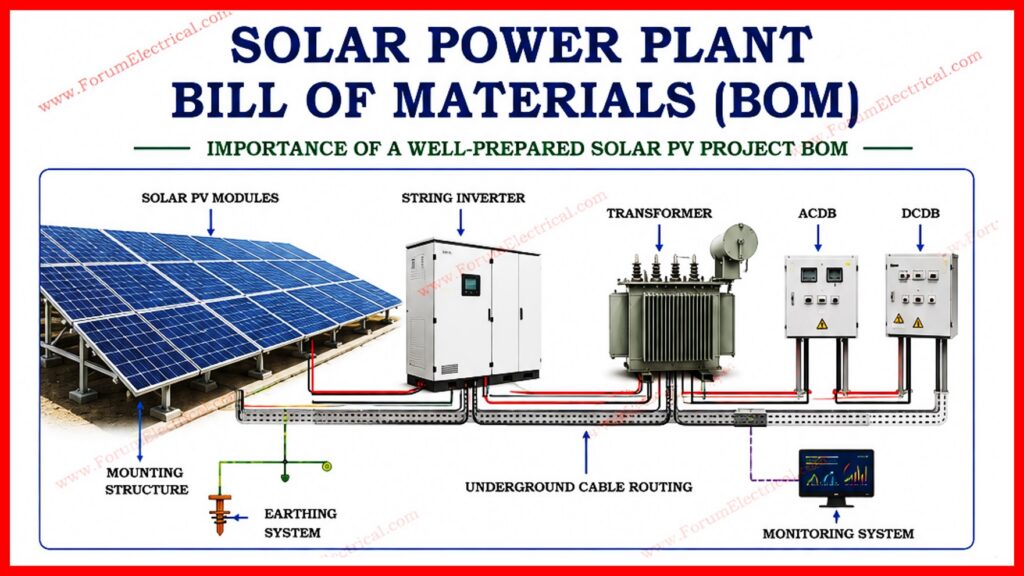
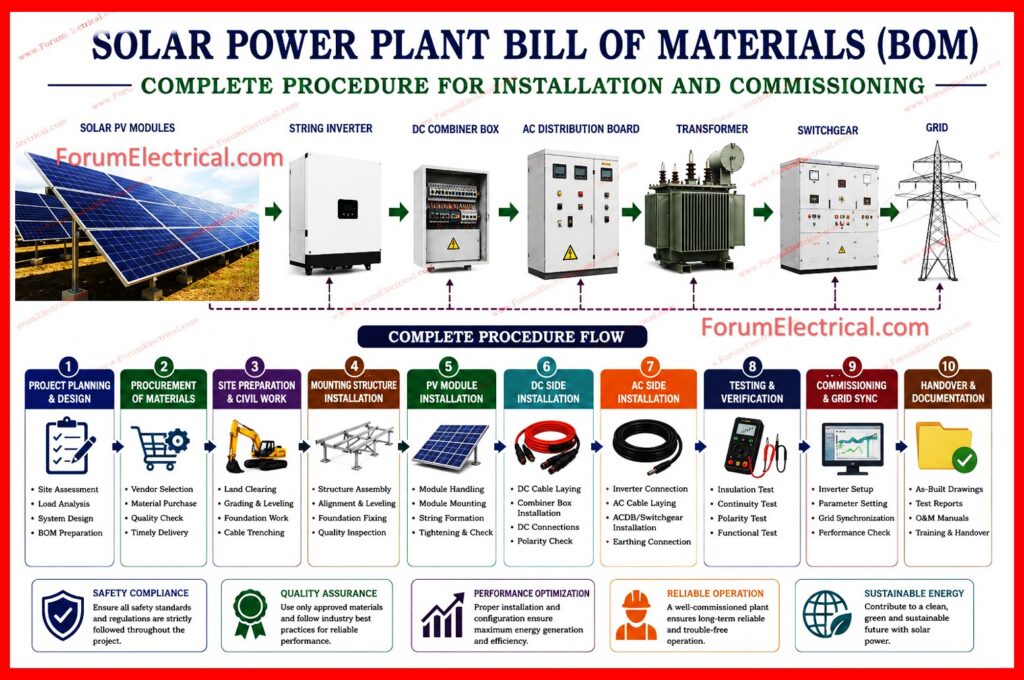
A Bill of Materials (BOM) for a Solar Power Plant is a detailed comprehensive list of all components, materials and accessories that is needed for the successful installation, testing, commissioning & operation of a solar photovoltaic (PV) system.
- What is a Solar Power Plant BOM?
- Components of a Solar Power Plant BOM
- Solar PV Modules
- Solar Inverters
- Module Mounting Structure
- DC Side Equipment
- AC Side Equipment
- Transformers
- Switchgear and Protection Equipment
- Earthing Materials BOM
- Earthing Electrode
- Earth Enhancement Compound
- GI Strip
- Copper Strip (or) Copper Wire
- Earth Pit Chamber
- Test Link and Accessories
- Earth Pit Identification Tags
- Lightning Protection Materials
- Lightning Arrestor Mast
- Air Terminals
- Down Conductors
- GI (or) Copper Strip
- Test Joints
- Earth Electrodes
- Monitoring and Communication Materials
- SCADA Server
- Network Switches
- Fiber Optic Cable
- Ethernet Cable
- Data Logger
- Remote Monitoring Software
- Additional Materials Required
- Typical Major Equipment Cost Distribution
- Solar Plant BOM Customization
- Checklist
- Conclusion
The BOM varies depending on the project size whether it is a
- Residential rooftop system,
- Commercial installation or
- Utility-scale solar power plant.
However, the major components remain similar across most grid-connected solar PV projects.
What is a Solar Power Plant BOM?
A Solar Power Plant BOM serves as a detailed procurement and planning document that helps project developers, engineers, contractors and procurement teams identify all required materials before the construction starts.
A well prepared BOM helps in:
- Accurate project cost estimation,
- Procurement planning (PP),
- Inventory management,
- Installation scheduling,
- Quality control and
- Project execution and commissioning.
Components of a Solar Power Plant BOM
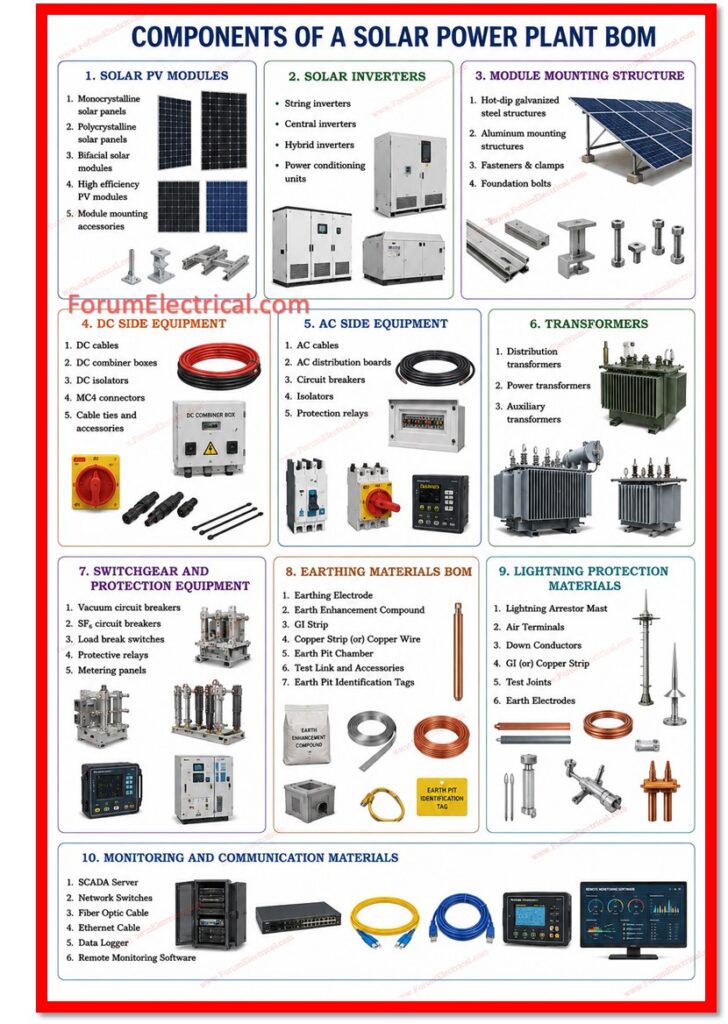
Solar PV Modules
The solar modules are the primary electrical power generating components of the plant.
The typical specifications include
- Monocrystalline solar panels,
- Polycrystalline solar panels,
- Bifacial solar modules,
- High efficiency PV modules and
- Module mounting accessories.
Solar Inverters
Solar inverters used to convert DC power generated by the solar panels into AC power suitable for the power grid connection.
Types of inverters include
- String inverters,
- Central inverters,
- Hybrid inverters and
- Power conditioning units.
Module Mounting Structure
The mounting structure supports the solar panels & ensures a proper tilt and orientation.
Common materials include
- Hot-dip galvanized steel structures,
- Aluminum mounting structures,
- Fasteners & clamps and
- Foundation bolts.
DC Side Equipment
DC side components (equipments) ensure safe collection & transmission of solar power from the panels to inverters.
Typical equipments include
- DC cables,
- DC combiner boxes,
- DC isolators,
- MC4 connectors and
- Cable ties and accessories.
AC Side Equipment
AC side equipment connects the inverter output to the electrical network.
Typical components (equipments) include:
- AC cables,
- AC distribution boards,
- Circuit breakers,
- Isolators and
- Protection relays.
Transformers
Transformers step up voltage levels for an efficient power transmission.
Common transformer types include:
- Distribution transformers,
- Power transformers and
- Auxiliary transformers.
Switchgear and Protection Equipment
Switchgear provides protection, control and isolation of electrical systems.
Typical equipment includes:
- Vacuum circuit breakers,
- SF6 circuit breakers,
- Load break switches,
- Protective relays and
- Metering panels.
Earthing Materials BOM
Proper earthing is essential for personnel safety and equipment protection.
Earthing Electrode
Copper bonded (or) galvanized iron earthing electrodes are utilized to provide a low resistance path to ground.
Earth Enhancement Compound
It is used to improve soil conductivity and maintain low earth resistance.
GI Strip
GI Strip is typically 50 mm x 6 mm galvanized iron strips are utilzed for earthing grid connections.
Copper Strip (or) Copper Wire
Copper Strip (or) Copper Wire is used for equipment & system grounding where higher conductivity is required.
Earth Pit Chamber
Earth pit chamber provides access for inspection, testing and maintenance of earth pits.
Test Link and Accessories
Test link and accessories are used for measuring and verifying earth resistance values.
Earth Pit Identification Tags
Earth pit identification tags helps to identify individual earth pits for maintenance and inspection purposes.
Lightning Protection Materials
Lightning protection systems safeguard solar plants from the direct lightning strikes and surge damage.
Lightning Arrestor Mast
Lightning arrestor mast provides protection by intercepting lightning strikes.
Air Terminals
Air terminals installed at the elevated points to capture the lightning discharges.
Down Conductors
Down Conductors safely conduct lightning current to the grounding system.
GI (or) Copper Strip
GI (or) Copper Strip is used as the grounding conductor for the lightning protection system.
Test Joints
Test joints allow periodic inspection and testing of the lightning protection conductors.
Earth Electrodes
Earth electrodes provide effective dissipation of lightning current into the ground.
Monitoring and Communication Materials
Modern solar plants use the advanced monitoring systems for performance tracking and fault analysis.
SCADA Server
SCADA Server collects, stores and analyzes plant operational data.
Network Switches
Network switches provide communication between monitoring devices and servers.
Fiber Optic Cable
Fiber optic cable utilized for high-speed, long-distance communication.
Ethernet Cable
Ethernet cable provides local network connectivity between equipment.
Data Logger
Data logger records performance of the parameters and operating data.
Remote Monitoring Software
Remote monitoring software allows operators to monitor plant performance from remote locations.
Additional Materials Required
1). Civil Works Materials,
2). Concrete foundations,
3). RCC structures,
4). Cable trenches,
5). Drainage systems,
6). Internal roads,
7). Cable Management System (CMS),
8). Cable trays,
9). Cable ladders,
10). Cable ducts,
11). Cable markers,
12). Safety Equipment,
13). Fire extinguishers,
14). Safety signboards,
15). Warning labels and
16). Personal protective equipment (PPE).
Typical Major Equipment Cost Distribution
The percentage contribution of the major equipment to the overall solar plant cost generally follows the pattern below as
| Component | Typical Cost Share |
|---|---|
| Solar Modules | 50% to 60% |
| Inverters | 8% to 12% |
| Mounting Structure | 10% to 15% |
| Cables and Electrical BOS | 5% to 10% |
| Transformers and Switchgear | 5% to 10% |
| Civil Works | 3% to 8% |
| SCADA and Monitoring | 1% to 3% |
| Earthing and Lightning Protection | 1% to 3% |
Solar Plant BOM Customization
The Bill of Materials (BOM) can be customized based on plant capacity, design requirements and project location.
The common solar project sizes includes
1). 1 MW (1 MegaWatt) Solar Power Plant,
2). 5 MW (5 MegaWatt) Solar Power Plant,
3). 10 MW (10 MegaWatt) Solar Power Plant,
4). 25 MW (25 MegaWatt) Solar Power Plant,
5). 50 MW (50 MegaWatt) Solar Power Plant and
6). Utility-Scale Solar Farms.
Each project requires detailed
- Quantity calculations,
- Equipment ratings,
- Cable sizing,
- Protection coordination,
- Earthing design and
- Monitoring requirements.
Checklist
Conclusion
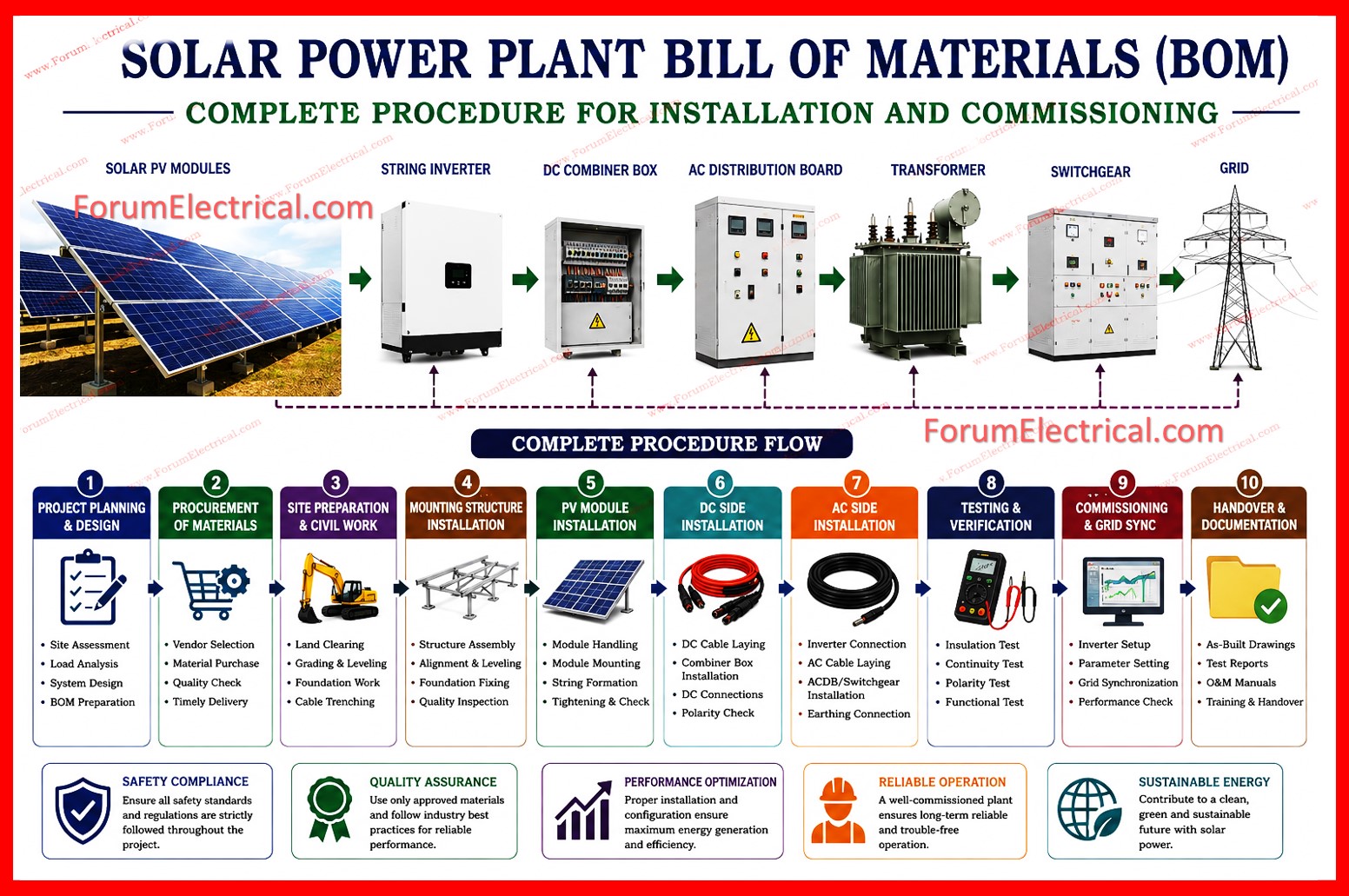
A Solar Power Plant Bill of Materials (BOM) is the foundation of successful project planning and execution.
It provides a complete inventory of all equipments (components), materials and accessories required for installation, testing, commissioning & long term operation.
Proper BOM preparation helps to reduce project delays, improve procurement efficiency, optimize the costs & ensure a reliable plant performance throughout its lifecycle.

 including solar modules, inverters, transformers, earthing, lightning protection, SCADA systems and cost distribution for utility-scale solar projects.)