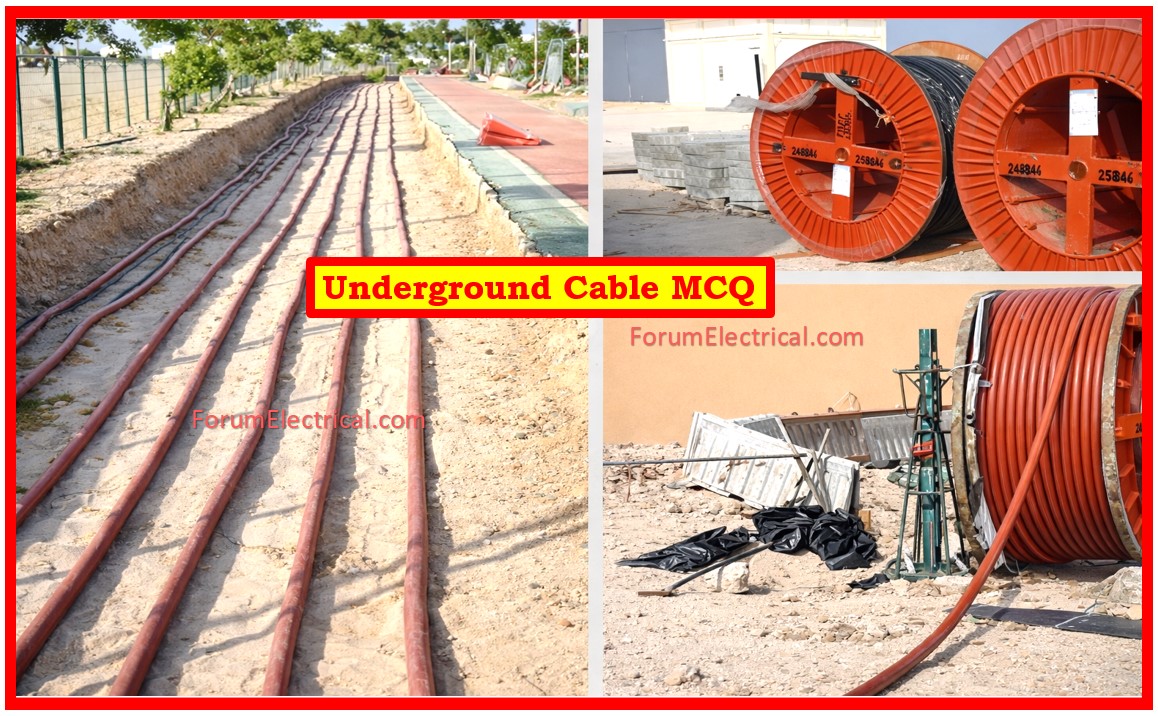
Underground Cables MCQ

0
257
Underground Cables MCQ

Underground cables are insulated conductors installed beneath the ground for safe and reliable transmission and distribution of electrical power.
They consist of a conductor, insulation, protective layers, armouring, and outer sheath, ensuring protection against moisture, mechanical damage and environmental conditions.
These cables are widely used in urban areas, substations, and industrial zones due to their safety, aesthetics and reduced fault occurrence.

These MCQ questions on underground cables are carefully prepared to help you understand key concepts such as cable construction, insulation materials, voltage ratings, advantages, disadvantages and fault characteristics.
This section is highly useful for electrical engineering students, diploma holders, competitive exams and technical interviews.

Underground Cable MCQ

Underground Cable MCQ

An underground cable is an electrical cable installed below the ground surface to transmit or distribute power safely and reliably.

It consists of a conductor (usually copper or aluminum), surrounded by insulation, protective bedding, armouring and an outer sheath to protect against moisture, mechanical damage, and environmental conditions.

Underground cables are widely used in urban areas, substations and industrial plants where overhead lines are impractical or unsafe. They provide better reliability, improved safety and enhanced aesthetics, but are generally more expensive and harder to maintain compared to overhead lines.

1 / 25

Category: Underground Cable

Material with high insulation but absorbs moisture

2 / 25

Category: Underground Cable

Least temperature resistance insulation

3 / 25

Category: Underground Cable

IE Rule for earthed terminal

4 / 25

Category: Underground Cable

Ratio of max to min dielectric stress

5 / 25

Category: Underground Cable

Insulation resistance of cable

6 / 25

Category: Underground Cable

Maximum potential gradient occurs in

7 / 25

Category: Underground Cable

Minimum aluminium cable size for lightning circuits

8 / 25

Category: Underground Cable

Insulation resistance for 100 km cable

9 / 25

Category: Underground Cable

Inter sheaths in cables are used to

10 / 25

Category: Underground Cable

Impregnated paper is used in

11 / 25

Category: Underground Cable

Main drawback of underground system

12 / 25

Category: Underground Cable

Attenuation & propagation constants apply to

13 / 25

Category: Underground Cable

Transmitted voltage wave at junction

14 / 25

Category: Underground Cable

For LV applications (<1 kV), cables used are

15 / 25

Category: Underground Cable

Loading of a cable is done to:

A) Increase inductance
B) Increase leakage resistance
C) Decrease leakage resistance
D) Achieve distortionless condition

16 / 25

Category: Underground Cable

ACSR conductor with 25 aluminium & 7 steel strands is

17 / 25

Category: Underground Cable

Least number of faults occur in

18 / 25

Category: Underground Cable

Best system for 60 km underground transmission:

19 / 25

Category: Underground Cable

Power distribution by cable is generally adopted for

20 / 25

Category: Underground Cable

Leakage resistance of 50 km cable = 1 MΩ. For 100 km cable

21 / 25

Category: Underground Cable

Capacitance between any two cores of a 3-core cable is 3 μF. Capacitance per phase is

22 / 25

Category: Underground Cable

Air pockets in HV cables have _____ permittivity and _____ electric field

23 / 25

Category: Underground Cable

In terms of cost, overhead transmission line is better than underground transmission line in

24 / 25

Category: Underground Cable

Property of absorbing moisture from the atmosphere is

25 / 25

Category: Underground Cable

The material commonly used for sheaths of underground cable is

Your score is

The average score is 25%

0%