
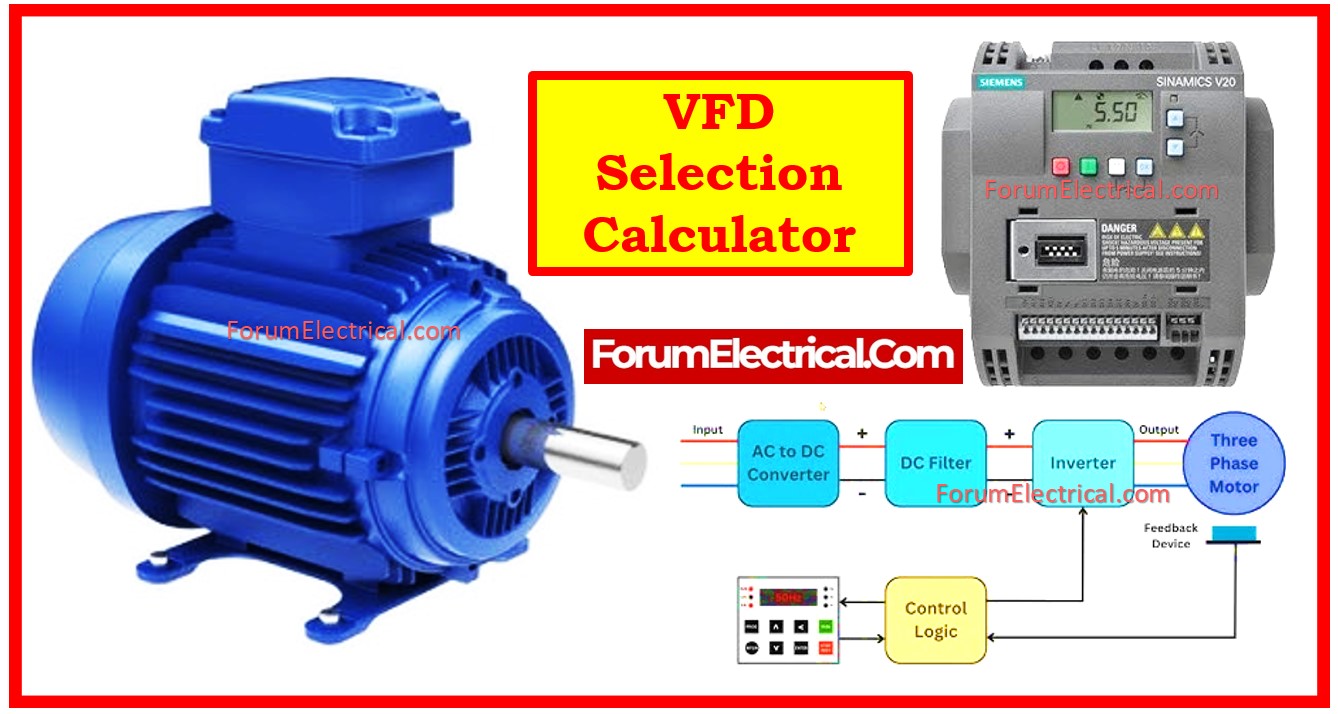
Calculator
VFD SELECTION CALCULATOR
NEMA MG-1 | NEC | IEC Compliant
Click here for more Electrical Calculators
A Variable Frequency Drive commonly known as a VFD is an essential electrical device used in modern industrial applications to control the speed and torque of three phase (3 phase) AC electric motors.
VFDs have changed the motor control by providing energy efficiency, accurate speed regulation and extended equipment lifespan.
If you are working in HVAC systems, conveyor belts, pump applications (or) fan systems, understanding proper VFD selection is essential for the optimal performance and compliance with the electrical standards.
VFD Selection Calculator
The VFD Selection Calculator is a professional online calculator tool designed to assist the electrical engineers, technicians and project managers to determine the correct VFD specifications for their motor applications.
This calculator adheres to
• NEMA MG-1,
• NEC (National Electrical Code) and
• IEC standards
ensuring your installations meet all the regulatory requirements.
By inputting your motors nameplate data you can instantly able to calculate the
• VFD power rating,
• Output current requirements,
• Conductor ampacity and
• Proper overcurrent protection device sizing.
Key Parameters
1). Motor Power (kW)
Motor power represents the rated mechanical power output of your electric motor measured in kilowatts (kW).
This is the fundamental specification found on the motors nameplate.
Example
The 15 kW motor is capable of delivering 15000 watts of mechanical power under rated operating conditions.
When selecting a VFD you must ensure it is able to handle at least the full power rating of your motor often with additional capacity for service factors and safety margins.
This parameter is important because the undersizing of the VFD can result in inadequate motor control and also potential equipment failure.
2). Voltage (V)
Voltage is the electrical potential difference supplied to the motor system typically measured in volts.
Common Industrial Voltages: 230V, 415V, 440V, 480V and 600V.
The voltage rating must exactly match your industry's electrical supply to ensure compatibility.
VFDs designed for one voltage level cannot be used safely on a different voltage without proper specifications.
The voltage you select affects the VFDs input and output current ratings as well as the conductor sizes required for the safe installation.
Always verify your facility's electrical supply voltage before selecting your VFD.
3). Power Factor (0-1.0)
Power factor is a measure of how efficiently the motor uses electrical power ranging from 0 to 1.0.
A power factor of 1.0 represents the perfect efficiency where all supplied power is converted to useful work.
Typical AC motors have a power factor between 0.75 and 0.95.
A lower power factor indicates that more reactive power is being drawn from the electrical system increasing the line losses & the utility costs.
When calculating the VFD requirements, the power factor is essential because it determines how much current the motor will draw.
Most three phase industrial motors operate at an approximately 0.85 power factor though this varies based on the motor design and load conditions.
4). Efficiency (0-1.0)
Motor efficiency represents the percentage of input electrical power that is converted to useful mechanical output expressed as a decimal between 0 & 1.0.
Higher efficiency motors waste very less energy as heat and are more economical to operate long-term.
Standard industrial motors typically achieve 85-95% efficiency depending on motor size and design class.
Premium efficiency motors can reach upto 96-97%.
When selecting a VFD, efficiency directly impacts the input current calculation.
A more efficient motor requires very less input current for the same power output.
Modern motors are increasingly designed for higher efficiency to reduce the operational costs and environmental impact.
5). Service Factor (1.0-1.15)
Service factor (SF) is a multiplier applied to the motor ratings to account for the variations in supply voltage, frequency & temperature that motors are used typically to encounter in real world installations.
The NEMA standard defines the service factors typically ranging from 1.0 to 1.15.
A service factor (SF) of 1.15 means that the motor is safely able to handle 15% above of its rated power without any damage under any normal conditions.
When calculating the VFD capacity applying the service factor (SF) ensures your drive can manage temporary overloads and operating variations.
Using a service factor (SF) of 1.15 is standard practice in professional installations to provide safety on equipment and extend equipment life.
6). Safety Margin (%)
The safety margin (SM) is an additional percentage of capacity added to your calculations beyond the standard requirements.
Safety margins typically range from 15% to 30% with 25% being common in the professional applications
A 25% safety margin means if your calculated VFD output current is 100A you would select a VFD that is rated for 125A.
Applying the appropriate safety margins is essential for the system reliability and prevents nuisance tripping of the overcurrent protection devices.
Conservative margin selection is used to ensure your system remains stable under worst conditions.
7). OCPD Rating (A)
OCPD - Overcurrent Protection Device
that includes circuit breakers and fuses that are designed to protect electrical circuits from excessive current.
The OCPD rating measured in amperes (A) determines the maximum current that can flow via the circuit before the protective device activates.
Proper OCPD sizing is essential because it must be large enough to allow normal motor operation but small enough to provide the protection against faults.
NEC Article 430 gives detailed requirements for the OCPD sizing based on the motor current and protection device type.
The OCPD rating is also used to determine the required conductor and equipment grounding conductor (EGC) wire sizes.
8). Overcurrent Device Type
Choosing between circuit breakers and fuses affects coordination and protection characteristics of the electrical system.
Circuit breakers provide automatic reusable protection and disconnection capability making them convenient for applications with frequent operations.
Fuses
Fuses are used to provide one time protection & should be replaced after the activation.
Circuit Breakers
Circuit breakers are more common in modern installations due to convenience and reduced downtime.
However fuses provide superior current limitation in some applications.
Results
Motor Input Current
This calculated value is used to represent the current that flows from industry electrical supply to the VFD input.
It depends on the motors power rating, voltage, power factor & efficiency.
Understanding this value assists you to verify that your industry's electrical service has an adequate capacity.
VFD Output Current
The VFD output current is the current the drive supplies to the motor which is calculated with service factor (SF) & safety margin applied.
This value determines the VFDs minimum current rating to safely operate your motor under all conditions.
VFD Power Rating
VFD power rating is the power handling capacity that is needed from your VFD in kilowatts (kW).
Selecting a VFD with at least this power rating ensures the adequate motor control and performance.
It is calculated from the voltage, power factor, output current & efficiency.
NEC Compliance Verification
The calculator provides important compliance information required by the National Electrical Code including minimum conductor ampacity (125% of calculated input current) and equipment grounding conductor wire size based on OCPD rating per NEC Table 250.122.
The VFD Selection Calculator provides estimates based on the standard electrical formulas and assumptions.