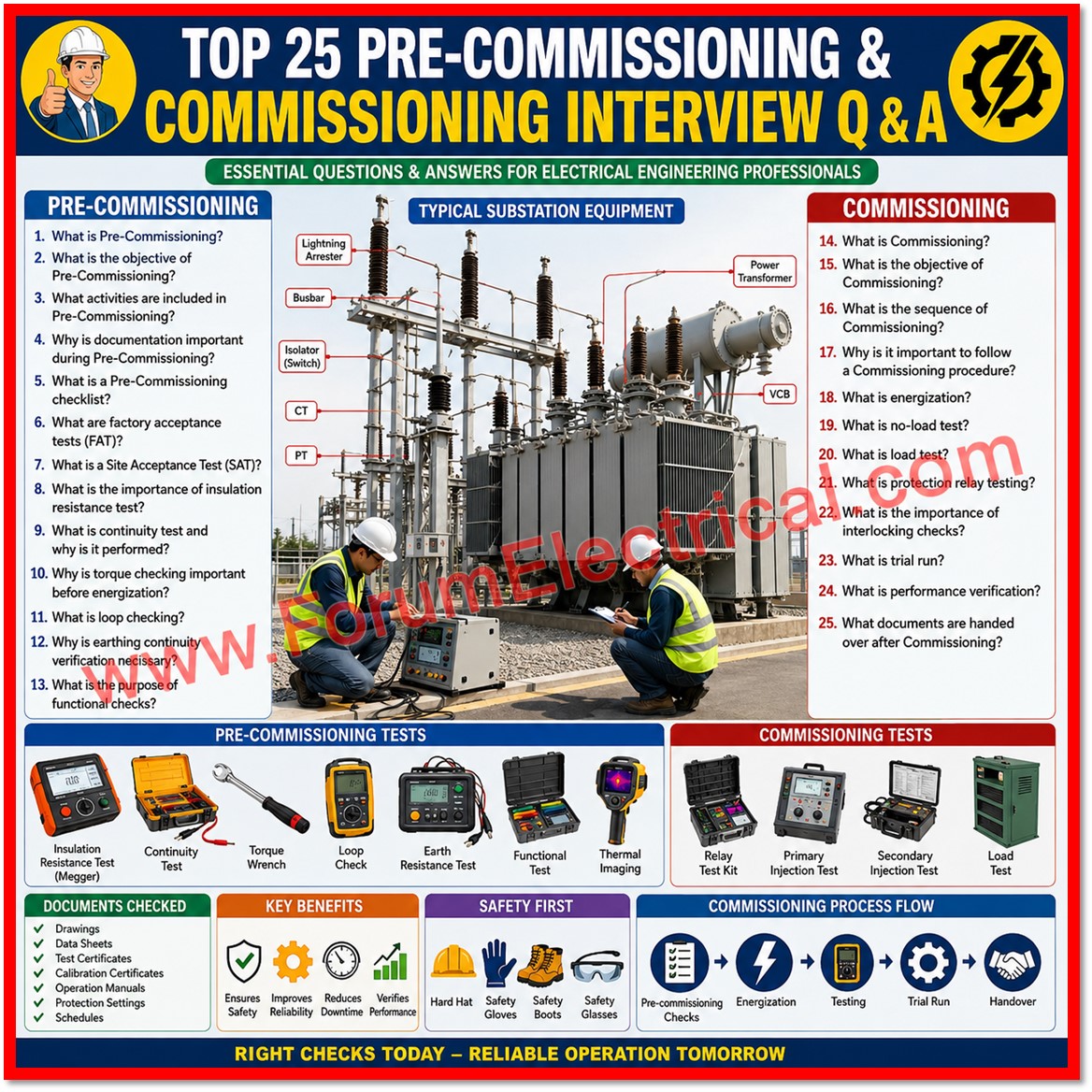
1). What is Pre-Commissioning?
Pre-commissioning is the procedure of inspecting, checking and testing equipment prior to energization to confirm that it is correctly installed, safe, complete & ready for commissioning.
2). What is Commissioning?
Commissioning is the procedure of energizing and functionally testing equipment and systems to confirm whether they operate correctly under their intended operating conditions.
3). What is the key difference between pre-commissioning and commissioning?
| Pre-Commissioning | Commissioning |
| Pre-commissioning verifies installation quality, completeness and readiness for energization | Commissioning verifies the functional and operational performance of the equipment after or during controlled energization. |
4). What tests are performed during pre-commissioning?
Typical tests include
- Visual inspection,
- Continuity testing,
- Insulation resistance testing,
- Earthing verification,
- Torque checks,
- Mechanical operation checks,
- Cable identification,
- Control-circuit verification &
- Equipment-specific tests.
5). Why is Insulation Resistance Testing important?
Insulation Resistance Testing verifies the condition of electrical insulation and used to identify
- Insulation deterioration,
- Moisture, contamination,
- Improper connections or physical damage before energization.
6). Why is Earthing verification important?
Earthing verification is important to ensures that exposed conductive parts have an effective path to earth and that fault current can flow through the intended protection path allowing protective devices to operate correctly.
7). What is Protection Relay Testing?
Protection relay testing verifies that a relay operates according to its approved settings, logic & required operating characteristics when an abnormal electrical conditions are simulated.
8). What is an Electrical Interlock?
An electrical interlock prevents unsafe (or) incorrect switching operations by ensuring that certain equipment (or) contactors cannot operate simultaneously or under prohibited conditions.
9). What should you do if an MV cable has low insulation resistance?
Do not energize the cable.
Analyze the cause, inspect the cable, joints and terminations, check for moisture (or) damage, rectify the problem, repeat the required tests and document the results.
10). What should be checked before energizing an MV transformer?
Check transformer earthing, insulation resistance, winding & cable connections, bushings, oil level and condition, oil leakage, tap position, phase identification, lightning arresters, protection systems, control circuits & all required test records.
11). Can equipment be energized with outstanding punch-list items?
Only if the outstanding items are formally reviewed & that are confirmed to be non-safety-essential and do not affect safe operation.
Required authorization must be obtained before energization.
Safety-critical defects must be rectified first.
12). What is the most important consideration during commissioning?
Safety is the first priority.
The approved procedure, isolation requirements, permits, PPE, protection systems and authorization requirements should be followed before energization (or) functional testing.
13). What is a Pre-Commissioning Checklist?
A pre-commissioning checklist is a controlled document used to verify that installation, inspection, testing, documentation and safety requirements have been completed before equipment is energized.
14). What is a Commissioning Checklist?
A commissioning checklist used to records the functional and operational checks required to demonstrate that equipment performs correctly which is under its intended operating conditions.
15). What is a Continuity Test?
A continuity test is used to verify that an electrical conductor (or) circuit provides a continuous electrical path with no unintended open circuit (or) high resistance connection.
16). Why are cable terminations inspected before energization?
Cable terminations are inspected to verify correct phase identification, proper lug installation, correct crimping, adequate insulation, proper gland installation, correct torque and absence of damage (or) contamination.
17). Why is Torque Verification important?
Correct torque ensures that electrical and mechanical connections have the required or necessary contact pressure.
Under torquing can cause high resistance connections and overheating while over torquing can damage terminals and bolts (or) equipment.
18). What is a Functional Test?
A functional test verifies that equipment, control circuits, interlocks, alarms, indications and associated systems perform their intended functions according to the approved design and operating sequence.
19). What is a Trip Test?
A trip test verifies that the appropriate protection or control system initiates the required circuit-breaker (or) equipment trip when the specified trip condition occurs.
20). What is Secondary Injection Testing?
Secondary injection testing involves injecting controlled electrical signals into a protection relays input circuits to verify relay pickup values, timing, logic, outputs and associated trip functions without applying primary system fault current.
21). What is Primary Injection Testing?
Primary injection testing involves applying a controlled high current through the primary circuit of equipment such as CTs, circuit breakers (or) protection systems to verify the complete current path and associated protection operation.
22). What checks are performed on a Circuit Breaker during commissioning?
Typical checks include
- Visual inspection,
- Mechanical operation,
- Contact resistance,
- Insulation resistance,
- Control-circuit verification,
- Trip and close operation,
- Auxiliary contacts,
- Interlocks,
- Protection trip functions and timing tests where applicable.
23). What is a punch list in commissioning?
A punch list is a controlled list of incomplete, defective or outstanding items identified during inspection, testing (or) commissioning that should be addressed before final handover (or) an approved operational milestone.
24). Why is Phase Sequence verification necessary?
Phase sequence verification confirms that the three-phase supply is connected in the correct sequence.
It is particularly important for rotating equipment because an incorrect sequence can cause a motor to rotate in the wrong direction.
25). What documents are required for commissioning?
Depending on the project, documents may include approved drawings, equipment datasheets, manufacturer’s manuals, inspection and test plans, pre-commissioning checklists, test reports, calibration certificates, relay setting sheets, cable schedules, protection schemes, punch lists and approved commissioning procedures.

