Calculator
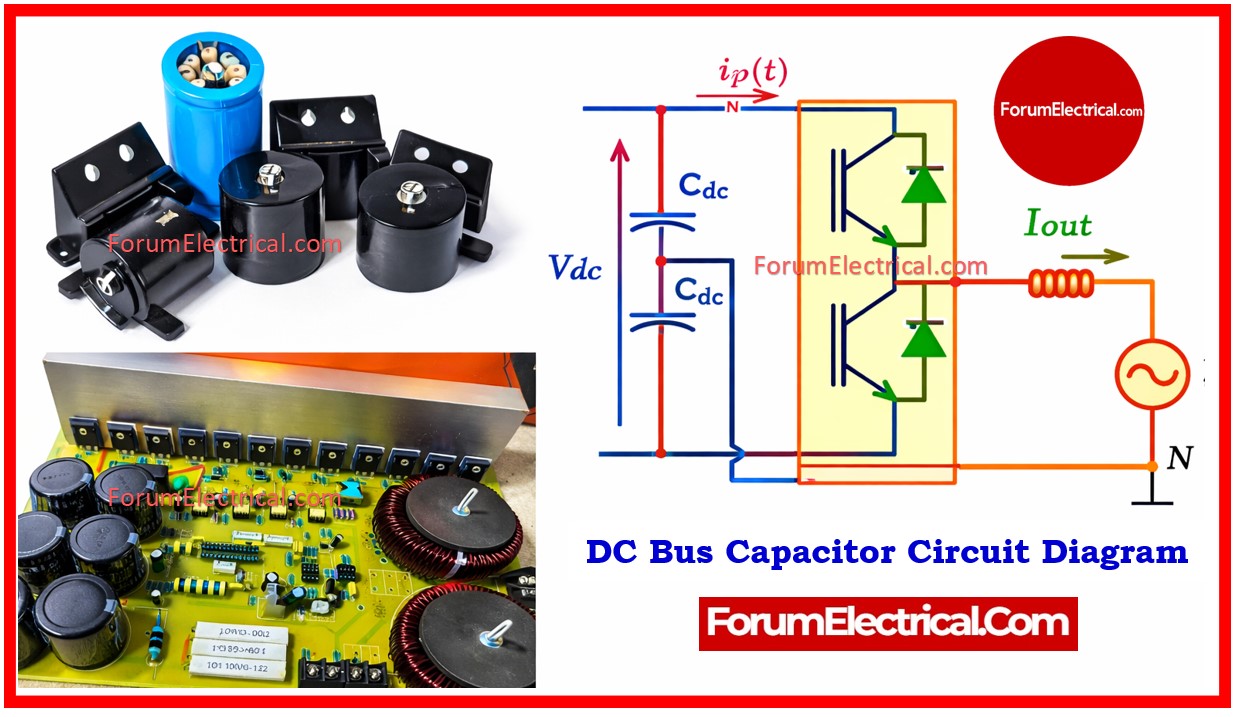
In variable speed drives (VSDs), inverters and industrial power conversion systems, the DC bus capacitor bank is one of the most essential components.
(Phase to Phase RMS)
(Hot Spot – Ambient)
(Auto: Full=6×F, Half=1×F)
(Auto: √2 × VRMS)
(Auto: UMAX – Vripple)
Click here for more Electrical Calculators
It stores energy, smooths rectified DC voltage and supplies pulsed current to the inverter switches and decouples the rectifier from the inverter load.
Sizing this bank incorrectly leads to excessive voltage ripple, premature capacitor failure, inverter trips and in some severe cases leads to catastrophic bus overvoltage.
This post accompanies the DC Bus Capacitor Calculator tool and provides a thorough understanding of every parameter, formula and result it used to be calculated.
Engineers working on industrial drives, UPS systems, solar inverters and motor controllers (or) any AC-DC-AC conversion system will find this reference essential.
| Design Basis This calculator is designed around a 415V AC (3-phase), 50Hz, full wave (6-pulse) rectifier system with a 620V DC bus aiming 6.6% of full load capacity. All formulas apply equally to other system voltages and frequencies by adjusting the input parameters. |
Why DC Bus Capacitor Bank is Important?
After a 3-phase full-wave rectifier converts AC to DC and the output is not a perfectly flat DC voltage as it contains ripple at a frequency that is a multiple of the supply frequency.
For a full wave 3 phase rectifier, this ripple frequency is 6 times the input frequency (6 × 50 Hz = 300 Hz).
The capacitor bank serves 4 important functions:
- Supplies instantaneous current to the inverter during load transients without the DC bus voltage collapsing.
- Reduces the peak-to-peak voltage ripple on the DC bus to an acceptable level which is protecting the inverter and load.
- Isolates the inverters high frequency switching currents from the rectifier and the AC supply.
- In UPS and essential systems the capacitor bank provides a brief period of the continued operation during AC supply interruptions.
An undersized capacitor bank will cause excessive ripple voltage which stresses all bus connected components.
An oversized bank wastes cost and space increases inrush current on the startup and may cause resonance issues with the upstream line inductance.
System Overview
Reference System Parameters
The calculator uses the following reference design point.
All fields are user-configurable
Example values:
| Parameter | Value |
|---|---|
| AC Input Voltage (VRMS) | 415 V (line-to-line) |
| Input Frequency | 50 Hz |
| Rectifier Type | Full-Wave (6-pulse) |
| DC Bus Voltage (approx.) | 620 V DC (≈ √2 × 415 × √(4/3)) |
| Inverter Rating | 61,380 W (6.6% of full load basis) |
| Ripple Voltage Allowed | 50 V pk-pk |
| Capacitor Branches | 10 parallel branches |
| PWM Frequency | 7,000 Hz |
What is 6.6% Full Load at 620V?
In large industrial drive systems, capacitor banks are often sized for a fraction of the total drive rating during initial commissioning, test runs (or) when operating in energy saving mode.
The 6.6% figure represents the inverter load as a proportion of the maximum rated capacity of the bus which is a common conservative starting point for thermal and sizing verification.
At 620V DC and 6.6% load the inverter rating works out to approximately 61.38 kW.
The calculator scales all current and power calculations from this operating point.
Input Parameters
Before using the calculator, engineers should gather the following information from the drive
- Specification sheet,
- Capacitor datasheet and
- Thermal analysis.
Enter each value in the corresponding field of the calculator.
| Parameter | Symbol | Unit | Description |
|---|---|---|---|
| Input AC Voltage (Phase-Phase) | VRMS | Volt | Line-to-line RMS voltage from the AC supply |
| Input Frequency | Fin | Hz | Supply frequency (typically 50 or 60 Hz) |
| Rectifier Type | — | — | Full-wave (6 x F) or half-wave (1 x F) topology |
| Ripple Voltage Allowed | Vripple | Volt | Acceptable peak-to-peak DC bus ripple |
| Inverter Rating | Pinv | Watt | Total load power drawn from the DC bus |
| Number of Cap Branches | Nbr | — | Parallel capacitor strings in the bank |
| PWM Frequency | FPWM | Hz | Switching frequency of the inverter stage |
| ESR at Ripple Freq | ESRdc | Ω | Capacitor ESR at the fundamental ripple frequency |
| ESR at PWM Freq | ESRpwm | Ω | Capacitor ESR at the inverter switching frequency |
| Thermal Resistance | Rth | °C/W | Combined capacitor + heatsink thermal resistance |
| Max Temp Rise (ΔT) | ΔT | °C | Hot-spot minus ambient temperature limit |
Auto Calculation
3 fields are calculated automatically as you type.
You do not required to enter them manually:
1). Ripple Frequency (Fdc)
For a full wave rectifier, Fdc = 6 × Fin = 300 Hz.
For half-wave, Fdc = Fin.
2). Peak Ripple Voltage (UMAX)
This is the peak of the rectified DC equal to VRMS × √2.
For 415V AC UMAX ≈ 586.8V.
3). Minimum Bus Voltage (UMIN)
The bottom of the ripple envelope,
UMIN = UMAX − Vripple.
For 50V ripple UMIN ≈ 536.8V.
Capacitor Sizing Calculations
Required Capacitance
The fundamental sizing equation comes from the charge balance on the DC bus.
During one ripple cycle, the capacitor should supply charge equal to the load current times the discharge period:
| Formula C = IL / (Vripple × Fdc) Where IL = Pinv / UMAX is the DC load current (Amperes) Vripple is the allowed ripple in Volts, and Fdc is the ripple frequency in Hz. The result C is in Farads; the calculator displays it in milli-Farads (mF). |
The calculator distributes this across the number of parallel branches.
Charge and Discharge Timing
The capacitor is charged from the rectifier during the time interval when the instantaneous rectifier output exceeds the bus voltage and it discharges into the load during the remaining interval.
Charge Time (Tc)
Tc = arccos(UMIN / UMAX) / (2π × Fdc)
This represents the angular portion of each half cycle during which the rectifier conducts into the bus.
Discharge Time (Tdc)
Tdc = (1/Fdc) − Tc
The remaining time in each cycle during which the capacitor alone supplies the load.
These timing values are utilized to accurately compute the RMS ripple currents which used to directly determine the thermal stress on the capacitor.
Peak and RMS Currents
Capacitor lifetime is primarily limited by RMS ripple current heating.
The calculator calculates:
Peak Charging Current
Icpeak = CperBranch × Vripple / Tc
This is the instantaneous peak current each capacitor branch sees from the rectifier.
RMS Charging Current
Icrms = √(Icpeak² × Tc × Fdc)
The time averaged RMS heating contribution from the charging pulse.
Peak Discharge Current
Idcpeak = Pinv / (UMIN × Nbranches)
The peak current demanded from each branch to supply the load.
RMS Discharge Current
Idcrms = Idcpeak × √(Tdc × Fdc)
The RMS heating from the discharge interval.
Total RMS per Branch
Irms = √(Icrms² + Idcrms²)
Combined ripple current from both intervals and this is the value to compare against the capacitors rated ripple current.
Total Bank Current
Ibank = Irms × Nbranches
The total current flowing through all the capacitor branches combined.
| Points to Remember The Total RMS per Branch must not exceed the capacitor manufacturers rated ripple current at the given temperature and frequency. Exceeding this limit causes thermal runaway and premature failure. Derate as required by the datasheet. |
Thermal Analysis and Power Loss
Even a correctly sized capacitor (by capacitance) will fail early if it overheats.
Power loss in the capacitor comes from 2 sources:
- Fundamental ripple current at the rectifier frequency and
- High-frequency ripple current from inverter pwm switching.
ESR and Power Loss
Equivalent Series Resistance (ESR) is a frequency-dependent parasitic resistance inherent in all electrolytic capacitors.
It causes I²R heating whenever ripple current flows.
Capacitor datasheets provide ESR values at multiple frequencies which always use the value at the actual ripple frequency.
Power Loss at Fdc (PDC)
PDC = Ibank² × ESRdc
It is the heat generated by the 300 Hz fundamental ripple current.
Power Loss at FPWM (PPWM)
PPWM = IL² × ESRpwm
It is the heat generated by inverter switching current at the PWM frequency (e.g. 7 kHz).
Total Power Loss
Ptotal = PDC + PPWM
Thermal Resistance and Allowable Power
The maximum power the capacitor can safely dissipate is determined by its thermal path to ambient:
| Formula Pcap = ΔT / Rth Where ΔT is the allowed temperature rise (hot-spot temperature – maximum ambient which is typically 75°C − 55°C = 20°C) and Rth is the combined thermal resistance of the capacitor + any fitted heat sink in °C/W. For the reference system: Pcap = 20 / 1.6 = 12.5 W per capacitor. |
Necessary Power Loss Reduction
If
Ptotal > Pcap
the capacitor cannot safely handle the ripple current.
The calculator quantifies how much power loss should be reduced:
Required Reduction (Pred)
Pred = Ptotal − Pcap
Fundamental Ripple Component to Reduce
Pfund = Pred − PPWM
Since PPWM is usually small, most of the reduction must come from reducing the fundamental ripple current which is achieved by adding a DC bus choke (inductor).
| Design Strategy If Pred > 0 The capacitor will overheat at the specified operating point. The solution is to add a DC bus choke in series with the rectifier output. The choke limits the peak charging current and reduces the fundamental ripple current through the capacitor bank which directly reducing PDC. |
DC Bus Choke Sizing
A DC bus choke (also called a DC link inductor / DC reactor) is connected in series between the rectifier output and the capacitor bank.
It limits the rate of rise of capacitor charging current and reduces the amplitude of the fundamental ripple current component.
Choke Voltage and Remaining Ripple
V1rms (Choke Voltage RMS)
V1rms = √(Pfund × ESRdc)
This is the RMS voltage the choke should develop across itself at the fundamental frequency to achieve the required power loss reduction.
Vpk-pk
Vpk-pk = V1rms × 2√2
The peak-to-peak voltage across the choke.
Remaining Ripple Current (Irem)
After the choke is fitted
Irem = √(Pcap / ESRdc) x Nbranches
This is the maximum residual fundamental ripple current the capacitor bank can tolerate at the thermal limit.
Inductance Calculation
| Formula L (µH) = V1rms / (Irem × 2π × Fdc) × 10⁶ This gives the minimum inductance required to reduce the fundamental ripple current to a thermally safe level. The result is in micro-Henries (µH). |
Choke Specification
The DC bus choke shiould be specified with 3 key parameters derived from the calculator:
| Specification | Symbol | Significance |
|---|---|---|
| Inductance (L) | L (µH) | Minimum inductance to reduce ripple to safe level |
| DC Current Rating | ADC | Must equal or exceed the continuous load current IL |
| Ripple Current Rating | Aripple | Must handle the residual ripple current at 360 Hz continuously |
Output Reference Table
The following table summarises every output that the calculator generates with its formula and unit
| Output | Symbol | Formula / Basis |
|---|---|---|
| Ripple Frequency | Fdc | Fdc = Fin × multiplier (6 for full-wave, 1 for half-wave) |
| Peak Ripple Voltage | UMAX | UMAX = VRMS × √2 |
| Minimum Bus Voltage | UMIN | UMIN = UMAX − Vripple |
| Capacitance Required | C (mF) | C = IL / (Vripple × Fdc) |
| Charge Time | Tc | Tc = arccos(UMIN/UMAX) / (2π × Fdc) |
| Discharge Time | Tdc | Tdc = (1/Fdc) − Tc |
| Peak Charging Current | Ic peak | Ic peak = C × ΔV / Tc |
| RMS Charging Current | Ic rms | Ic rms = √(Ic peak² × Tc × Fdc) |
| Peak Discharge Current | Idc peak | Idc peak = Pinv / (UMIN × N) |
| RMS Discharge Current | Idc rms | Idc rms = Idc peak × √(Tdc × Fdc) |
| Total RMS per Branch | Irms | Irms = √(Ic rms² + Idc rms²) |
| Total Bank Current | Ibank | Ibank = Irms × Nbranches |
| Load Current | IL | IL = Pinv / UMAX |
| Power Loss at Fdc | PDC | PDC = Ibank² × ESRdc |
| Power Loss at FPWM | PPWM | PPWM = IL² × ESRpwm |
| Total Power Loss | Ptotal | Ptotal = PDC + PPWM |
| Max Allowable Cap Loss | Pcap | Pcap = ΔT / Rth |
| Required Loss Reduction | Pred | Pred = Ptotal − Pcap |
| Inductance (Choke) | L (µH) | L = V1rms / (Irem × 2π × Fdc) × 10⁶ |
How to use the Calculator?
Step-1: Gather your system data which is AC supply voltage (VRMS), frequency, inverter rated power and rectifier topology from the equipment datasheet.
Step-2: Enter Input AC Voltage (VRMS) which is line-to-line RMS value (eg: 415V).
Step-3: Enter Input Frequency (Fin) that is typically 50 Hz (Europe/Asia/Africa) (or) 60 Hz (Americas).
Step-4: Select Rectifier Type which may be Full Wave (6-pulse) for standard 3 phase drives (or) Half Wave for single phase systems.
Step-5: The 3 orange auto computed fields (Fdc, UMAX, UMIN) will update instantly as you type.
Step-6: Enter Ripple Voltage (Vripple) that is the maximum allowable DC bus ripple. Typical values is 1 – 2% of UMAX. For 620V bus, 6–12V is tight; 50V is moderate.
Step-7: Enter Inverter Rating (Pinv) in Watts and the total connected load at the operating point being analysed.
Step-8: Enter number of the capacitor branches and the number of parallel capacitor strings in the bank.
Step-9: Enter PWM Frequency (FPWM) that is the inverter switching frequency from the drive parameters.
Step-10: Enter ESR values which is used to obtain from the capacitor manufacturers datasheet at Fdc and FPWM.
Step-11: Enter thermal resistance (Rth) that is from the capacitor datasheet combined with any heat sink value.
Step-1w: Enter max temperature rise (ΔT) that is typically (hot spot rating – maximum ambient temperature).
Step-12: Click calculate. All results appear with accuracy.
Step-13: Check Is & Pred (required power loss reduction) if it is positive and ok the capacitor will overheat and proceed to the choke sizing section results.
Step-14: Record the choke specification summary that is L (µH), ADC (A) and Aripple (A) for procurement (or) design.
Terms
| Term | Definition |
|---|---|
| DC Bus | The intermediate DC voltage rail between the rectifier and inverter in a VSD (or) power converter. |
| ESR | Equivalent Series Resistance and frequency dependent parasitic resistance of a capacitor causing I²R losses. |
| Ripple Current | The AC component of current flowing through the DC bus capacitor, caused by rectifier charging pulses and inverter load pulses. |
| Ripple Voltage (Vripp) | In DC bus voltage there will be peak to peak voltage (Vpk-pk) variation due to the capacitor charging/discharging cycles. |
| Rectifier | Power electronic circuit that converts AC to DC. Full-wave 3-phase bridge produces 6 pulses per cycle. |
| Inverter | Circuit that converts DC back to variable-frequency AC for motor or load control. |
| UMAX / UMIN | Peak and minimum values of the DC bus voltage ripple envelope. |
| Thermal Resistance (Rts) | Opposition to heat flow in °C per Watt. Lower Rth means better cooling. |
| DC Bus Choke | Series inductor in the DC link that limits current rate-of-rise and reduces ripple current amplitude. |
| PWM | Pulse Width Modulation and the technique used by inverters to synthesise AC output from the DC bus voltage. |
| Holdup Time | Duration the DC bus capacitor can supply the load current after AC supply loss. |
| VSD | Variable Speed Drive — complete assembly of rectifier, DC bus and inverter for motor control. |
Frequently Asked Questions
1). Why is the ripple frequency 300 Hz for a 50 Hz supply?
A 3-phase full-wave (6-pulse) bridge rectifier produces 6 current pulses per AC cycle.
Each pulse charges the DC bus so the ripple repeats 6 times per second per Hz of supply = 6 × 50 = 300 Hz.
A half-wave single-phase rectifier produces one pulse per cycle, so ripple frequency = supply frequency.
2). How accurate is the capacitance formula?
The formula
C = IL / (Vripple × Fdc)
is a first-order approximation based on the charge balance.
For engineering design work apply a 10-20% margin and verify with simulation (e.g: PSIM, PLECS / LTspice) for the final value.
Also account for the capacitance tolerance (±20% for electrolytics) and ageing derating.
3). Can I use this calculator for single-phase systems?
Yes. Select ‘Half Wave’ as the rectifier type. The multiplier changes to 1 and so Fdc = Fin = 50 Hz.
All other calculations remain valid.
Note that single phase full-wave rectifiers are also 2-pulse and so set the multiplier accordingly (Fdc = 2 × Fin = 100 Hz)

