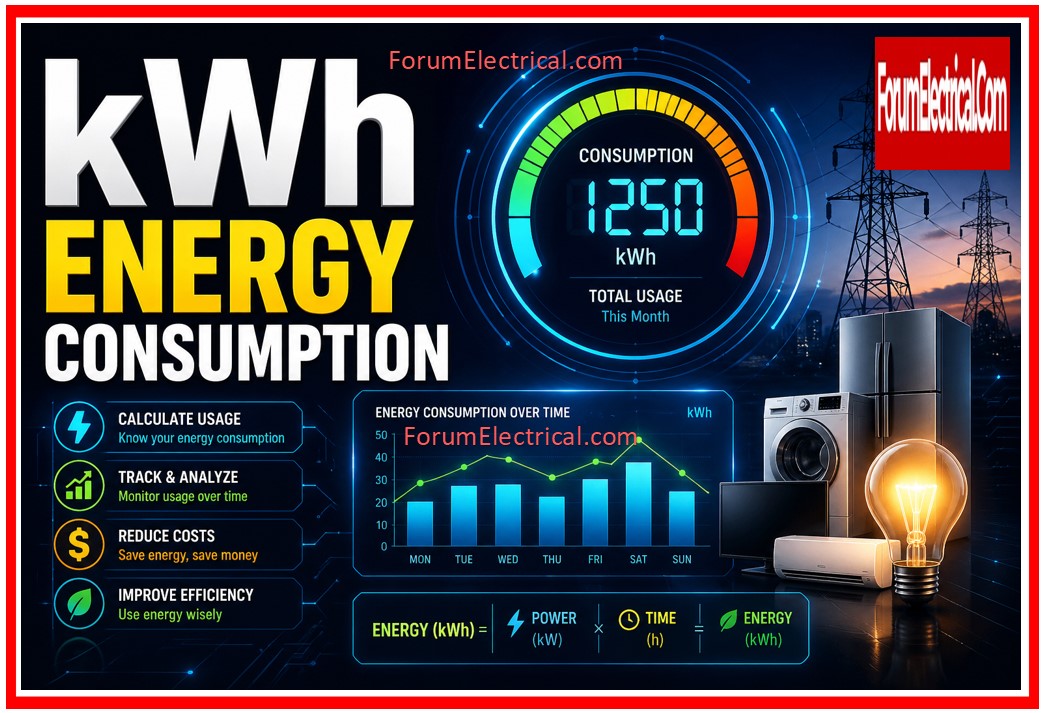
The kWh Energy Consumption Calculator is a online calculator tool designed to help homeowners, engineers, facility managers and energy professionals accurately estimate electrical energy usage and associated costs for any device (or) appliance.
Calculator
⚡ kWh Energy Consumption Calculator
Calculate daily, monthly, and annual energy consumption and costs
Energy Parameters
- Click here for more Electrical Calculators
You can also follow us on Facebook and Linkedin to receive daily updates.
By entering a few basic parameters, users can instantly determine daily, monthly and annual energy consumption, electricity costs, and carbon dioxide (CO₂) emissions.
Purpose
Energy costs are a significant part of household & industrial budgets.
Understanding how much power an individual devices consume empowers users to make informed decisions about the energy efficiency, budgeting and environmental impact.
Key Features
- Calculates daily, monthly & annual energy consumption in kWh.
- Estimates the electricity costs at user defined tariff rates.
- Accounts for the device efficiency and power factor.
- Calculates CO₂ emissions based on the global average powergrid emission factors.
- Responsive for a design suitable for desktop and mobile use.
- Instant results with no page reload is required.
How Calculator Works?
The calculator uses a simple energy formula derived from the electrical engineering principles.
The core equation is:
Energy (kWh) = [Power (W) x Efficiency (%) x Power Factor] ÷ 100 ÷ 1000 x Hours
This effective power is then multiplied by time periods to generate daily, monthly and annual values. Costs and emissions are derived from the resulting kWh values.
Terms
| Term | Definition |
|---|---|
| kWh (Kilowatt-Hour) | A unit of energy equal to 1000 watts of power consumed for one hour. The standard billing unit used by electricity utilities worldwide. |
| Watt (W) | The SI unit of power. It represents the rate at which energy is consumed or produced. |
| Power Factor (PF) | The ratio of real power (watts) (W) to apparent power (volt-amperes) (VA). Power factor indicates how the electrical power is being converted into an useful work effectively. |
| Efficiency (η) | The ratio of useful output energy to the total input energy that is expressed as a percentage (%). A higher efficiency means less energy wasted as heat. |
| CO₂ Emission Factor | The mass of CO₂ emitted per unit of electricity generated, expressed in kg/kWh. Varies depends on the energy merge of the electricity grid. |
| Apparent Power (VA) | The total power supplied to a circuit including both the real power and reactive power. Relevant for sizing the electrical infrastructure. |
| Real Power (W) | The actual power consumed by a load is to perform work. This is also called active power. |
| Load Factor | The ratio of average load to peak load over a given period of time. Utilized in energy management and tariff calculations. |
Input Parameters
The calculator use to accepts 6 input parameters.
Understanding the each one ensures accurate results.
| Parameter | Unit | Description | Default |
|---|---|---|---|
| Power Rating | Watts (W) | The rated power consumption of the device as stated on its label (or) specification sheet. | 0 |
| Daily Operating Hours | Hours/Day | How many hours per day the device runs. Partial hours are accepted (e.g., 1.5 for 90 minutes). | 0 |
| Days Per Month | Days | Number of days per month the device is in use. Typically 30 for continuous use. | 0 |
| Electricity Cost | Currency/kWh | The rate charged by your utility provider per kilowatt-hour. Check your electricity bill for this figure. | 0 |
| Device Efficiency | % | The operational efficiency of the device. A 90% efficient motor uses 10% more power than its rated output. | 100 |
| Power Factor | 0–1 | The ratio of real power to apparent power. Relevant for inductive loads such as motors and compressors. | 1.0 |
The power rating is usually found on:
- The nameplate (or) label affixed to the device.
- The product specification sheet (or) user manual.
- The manufacturers website under the technical specifications.
- The device’s packaging (or) box.
If only voltage (V) and current (A) are listed calculate power using:
P = V x I
for DC or single phase AC with unity power factor.
Understanding Power Factor
Power factor (PF) is a dimensionless number across 0 and 1 that helps to represents how efficiently electrical power is being used.
A PF of 1.0 (unity) means all power drawn from the supply is utilized productively.
Common power factor values:
- Resistive loads (heaters, incandescent bulbs): PF = 1.0
- Fluorescent lighting: PF ≈ 0.85 – 0.95
- Induction motors (lightly loaded): PF ≈ 0.70 – 0.85
- Induction motors (fully loaded): PF ≈ 0.85 – 0.95
Device Efficiency
Efficiency is the difference between input power and useful output power.
For example: 1000 W motor rated at 90% efficiency requires 1111 W of input power that is to deliver 1000 W of mechanical output.
Enter the efficiency percentage (e.g., 90 for 90%).
Leave at 100 if the efficiency losses are already included in the rated power.
Output Results
Upon clicking the Calculate button the calculator displays 8 result outputs covering consumption, costs and environmental impact.
| Result | Unit | Formula |
|---|---|---|
| Daily Consumption | kWh | Effective Power (kW) x Daily Hours |
| Monthly Consumption | kWh | Daily Consumption x Days Per Month |
| Annual Consumption | kWh | Monthly Consumption x 12 |
| Daily Cost | Currency | Daily Consumption x Cost Per kWh |
| Monthly Cost | Currency | Monthly Consumption x Cost Per kWh |
| Annual Cost | Currency | Annual Consumption x Cost Per kWh |
| Daily CO₂ Emissions | kg CO₂ | Daily Consumption x 0.92 kg/kWh |
| Annual CO₂ Emissions | kg CO₂ | Annual Consumption x 0.92 kg/kWh |
CO₂ Emission Factor
The calculator uses a global average CO₂ emission factor of 0.92 kg per kWh. This number is based on the International Energy Agency (IEA) global average for electricity generation which blends fossil fuel, nuclear and renewable sources.
Actual emissions vary by country and region:
- Countries with high renewable penetration (e.g., Norway, Iceland): significantly lower than 0.92 kg/kWh
- Countries heavily reliant on coal (e.g., some developing nations): may exceed 0.92 kg/kWh
- India average: approximately 0.82 kg/kWh (varies by state)
- United States average: approximately 0.39 kg/kWh
Solved Examples
Example 1: Air Conditioner
| Parameter | Value |
|---|---|
| Power Rating | 1500 W |
| Daily Operating Hours | 8 hours |
| Days Per Month | 30 days |
| Electricity Cost | ₹8 per kWh |
| Efficiency | 95% |
| Power Factor | 0.9 |
Effective Power = 1500 x 0.95 x 0.9 / 100 = 1.2825 kW
- Daily Consumption: 1.2825 x 8 = 10.26 kWh
- Monthly Consumption: 10.26 x 30 = 307.8 kWh
- Monthly Cost: 307.8 x ₹8 = ₹2,462.40
- Annual CO₂ Emissions: 307.8 x 12 x 0.92 = 3398.11 kg
Example 2: LED Bulb
| Parameter | Value |
|---|---|
| Power Rating | 10 W |
| Daily Operating Hours | 6 hours |
| Days Per Month | 30 days |
| Electricity Cost | ₹7 per kWh |
| Efficiency | 100% |
| Power Factor | 1.0 |
Effective Power = 10 W = 0.01 kW
- Daily Consumption: 0.01 x 6 = 0.06 kWh
- Monthly Consumption: 0.06 x 30 = 1.8 kWh
- Monthly Cost: 1.8 x ₹7 = ₹12.60
- Annual CO₂ Emissions: 1.8 x 12 x 0.92 = 19.87 kg

