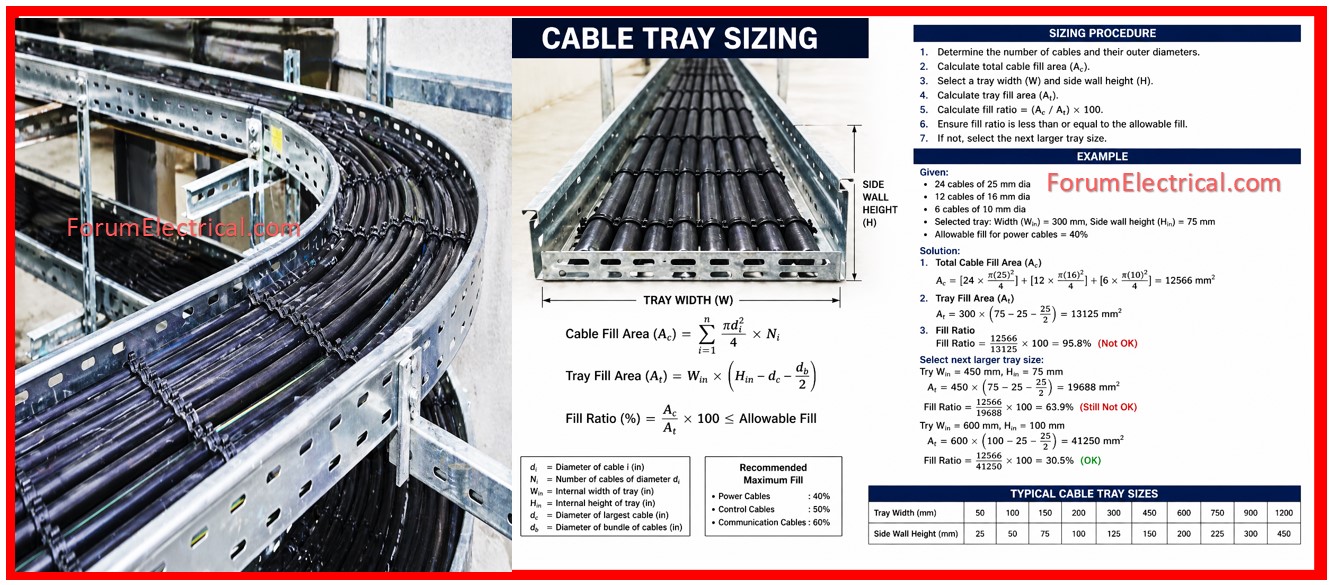
The Cable Tray Sizing Calculator is an electrical calculator tool designed to determine the correct cable tray dimensions for electrical installations.
Calculator
Cable Tray Sizing Calculator
Accurate fill ratio analysis and tray sizing per NEC, IEC 60364, and BS 7671 standards. Enter your cable schedule below to get started.
Related Electrical Calculators
ELECTRICAL CONVERTERS
ELECTRICAL MACHINES CALCULATORS
TRANSFORMER CALCULATORS
POWER SYSTEMS CALCULATORS
BATTERY CALCULATORS
ELECTRICAL ENGINEERING EXCEL CALCULATORS
UNIT CONVERTERS
Click here for more Electrical Calculators
You can also follow us on Facebook and Linkedin to receive daily updates.
It performs accurate fill ratio analysis in accordance with internationally recognized electrical standards
- NEC NFPA 70,
- IEC 60364 and
- BS 7671
ensuring that cable installations remain safe, thermally sound and compliant with code requirements.
Why is Cable Tray Sizing Important?
Incorrect cable tray sizing is one of the most common causes of
- Thermal degradation,
- Premature insulation failure and
- Non-compliance during site inspections.
Overcrowded trays restrict air circulation that cause mutual heating between cables and make future cable additions practically impossible without costly rework.
Undersized trays also create mechanical stress on cable sheaths that is particularly at bends and supports.
A correctly sized tray with appropriate fill margin and safety headroom used to deliver the following advantages:
- Thermal safety: cables remain within the rated operating temperatures
- Regulatory compliance: meets NEC, IEC and BS inspection requirements
- Future-proofing: spare capacity accommodates planned and unplanned additions
- Reduced installation cost: correct sizing avoids costly rework and replacements
- Improved accessibility: adequate spacing simplifies fault finding and cable replacement
Input Parameters
The calculator requires 2 categories of input:
- Tray configuration parameters and
- Cable schedule.
Each parameter is described in detail below.
Tray Parameters
Tray Type
Select the physical construction type of the cable tray.
The tray type determines the default maximum fill ratio & affects thermal dissipation characteristics.
- Ladder Tray: open construction with side rails and rungs; best thermal dissipation; 40% NEC fill
- Perforated Bottom: solid sides with punched base and moderate ventilation and 50% NEC fill
- Solid Bottom: no ventilation openings which is used for mechanical protection; 40% NEC fill
- Wire Mesh — open welded wire construction; good ventilation; common in data centres
- Channel / Raceway — enclosed or semi-enclosed; smallest capacity; used for small cable counts
Tray Width
The internal usable width of the tray is millimeters(mm).
Standard widths range from 100 mm (4″) to 900 mm (36″).
The calculator uses this value to compute the tray cross-sectional area.
Always verify the internal usable width from the industry datasheet as external dimensions may differ.
Tray Depth
The internal usable depth of the tray is millimeters(mm).
Standard depths range from 50 mm (2″) to 200 mm (8″).
Greater depth increases cross sectional area but also increases tray weight and structural support requirements.
Common practice limits fill depth to 75 – 80% of physical depth to allow cable management and future additions.
Voltage Class
The voltage class of the cables determines segregation requirements.
Mixing voltage classes in a single tray is generally prohibited (or) requires physical barriers.
Select the appropriate class for the cable group being sized.
- LV – Low Voltage (1000 V AC or less): standard power, control and data circuits
- MV – Medium Voltage (1 kV to 35 kV): distribution feeders and transformer secondary circuits
- HV – High Voltage (above 35 kV): transmission-level circuits which requires specialist design
Fill & Safety Settings
Maximum Allowable Fill (%)
This is the maximum percentage of the tray cross-sectional area that may be occupied by cable cross-sections.
Default values per tray type and standard are shown.
Safety / Expansion Margin (%)
An additional reserve percentage applied on top of the maximum fill limit.
The recommended value is 20%, reserving (1/5th) of the available fill capacity for future cable additions without requiring tray replacement.
This margin is applied when the calculator generates its recommended tray specification that is ensuring the recommended tray has demonstrable spare capacity.
Installation Derating Factor
The derating factor adjusts the effective cable outer diameter to account for installation conditions that increase the physical space cables occupy (or) the thermal load they generate.
A factor above 1.0 effectively increases the calculated cable area, producing a more conservative (larger) result.
| Factor | Installation Condition | Design Impact |
|---|---|---|
| × 1.0 | Horizontal straight run: ideal conditions | No adjustment required |
| × 1.1 | Horizontal bend (or) elbow: moderate restriction | Allows 10% extra for cable OD compression |
| × 1.2 | Vertical or inclined run: gravity effects apply | Accounts for sag and cable management stress |
| × 1.3 | Outdoor (or) high humidity environment | Larger OD due to UV rated (or) armoured sheaths |
Cable Schedule
The cable schedule is the core input of the calculator.
For each cable type installed in the tray enter:
- Cable Description / Type – a text label identifying the cable (e.g. 4Cx16mm² XLPE Power Cable)
- Outer Diameter (OD) in millimetres – the overall external diameter of the cable obtained from the cable manufacturer’s datasheet. This is the essential dimension for fill calculation.
- Quantity – the number of cables of that type and size running in the tray
Note: Always use the manufacturer’s published overall diameter, not a nominal (or) calculated value. Cable OD can vary significantly between manufacturers for the same conductor size and insulation type.
Multiple cable types can be added using the Add Cable button.
Cables can be removed individually without affecting other entries.
Pre-populated sample entries are provided to demonstrate the required input format.
Fill Ratio Reference
The following table shows the maximum allowable fill ratios by tray type across all 3 supported standards.
These are the default values used by the calculator.
Engineers may apply more conservative values at their discretion.
| Tray Type | NEC NFPA 70 | IEC 60364 | BS 7671 |
|---|---|---|---|
| Ladder Tray | 40% | 45% | 45% |
| Perforated Bottom | 50% | 45% | 45% |
| Solid Bottom | 40% | 40% | 40% |
| Wire Mesh | 50% | 45% | 45% |
| Channel / Raceway | 40% | 40% | 40% |
Important Note: Fill ratio is defined as the sum of individual cable cross sectional areas divided by the total interior cross sectional area of the tray.
Cable cross-section = π x (OD/2)²
Calculation
The calculator follows a simple methodology based on the selected standard.
The following steps describe the complete calculation sequence.
Cable Cross-Sectional Area
For each cable entry, the cross-sectional area is computed using the circular area formula:
Cable Area = π x (OD ÷ 2)² x Quantity x Derating Factor
All individual cable areas are summed to produce the Total Cable Area.
This represents the appropriate cross sectional footprint of all the cables in the tray.
Tray Cross-Section & Usable Area
The Tray Cross-Section is calculated as
Tray Cross-Section (TCS) = Tray Width x Tray Depth
The usable area (maximum fill) is
Usable Area = Tray Cross Section x Max Fill Percentage
Fill Ratio
The Fill Ratio is the percentage (%) of the tray cross section occupied by cables:
Fill Ratio (%) = (Total Cable Area ÷ Tray Cross-Section) x 100
Standard Tray Sizing Reference
The table attached below provides a quick reference to standard cable tray sizes, their cross-sectional areas & typical applications.
Use this as the starting point when selecting tray size before running the detailed calculation.
| Width | Depth | Cross-Section (mm²) | Typical Application |
|---|---|---|---|
| 100 mm (4″) | 50 mm | 5000 mm² | Instrument / signal cables, small data runs |
| 150 mm (6″) | 75 mm | 11250 mm² | Control cables, communication wiring |
| 200 mm (8″) | 100 mm | 20000 mm² | Mixed LV power & control, medium density |
| 300 mm (12″) | 100 mm | 30000 mm² | Standard power distribution – most common |
| 450 mm (18″) | 150 mm | 67500 mm² | Heavy-duty power feeders, large cable counts |
| 600 mm (24″) | 150 mm | 90000 mm² | Main distribution, MV/HV segregated runs |
| 750 mm (30″) | 200 mm | 150000 mm² | Sub-station feeders, large industrial plants |
| 900 mm (36″) | 200 mm | 180000 mm² | Maximum size – utility / power plant grade |
Why does the calculator multiply cable area by the derating factor?
The derating factor accounts for real-world installation conditions that increase the effective space a cable occupies in the tray.
For Example: In a horizontal bend the cables are compressed together on the inner radius which is reducing the effective usable area.
Multiplying by the factor gives a conservative cable area that reflects these conditions.

