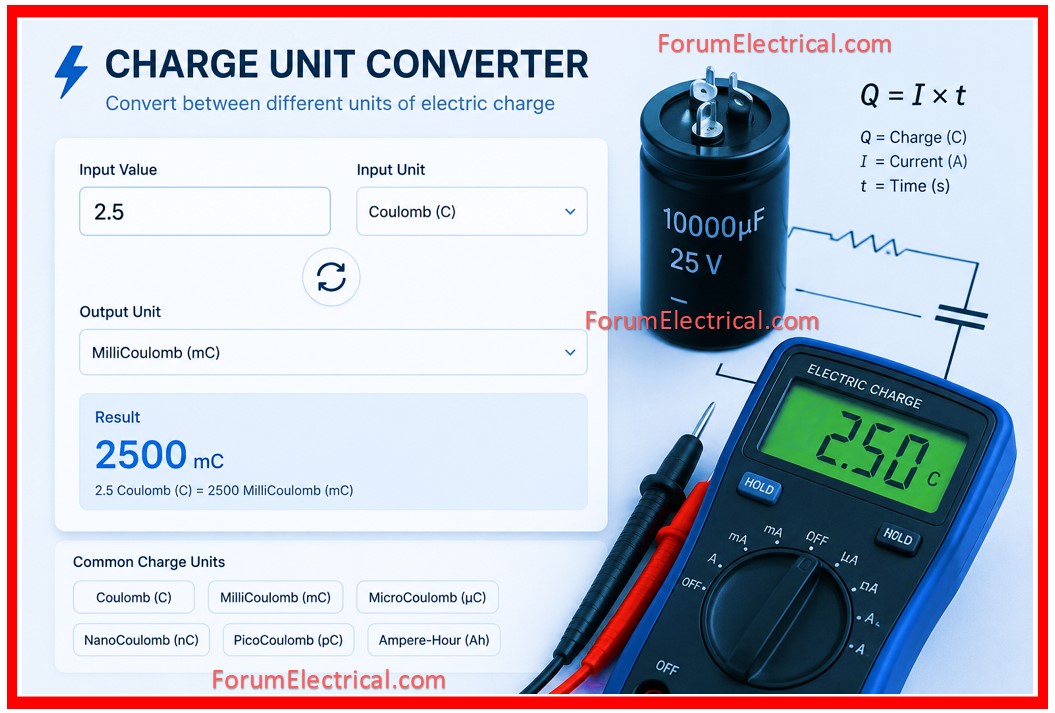
The Charge Unit Converter is an online unit calculator tool designed to convert electric charge measurements between the multiple international standards and scientific units.
If you are working in physics, chemistry, electrical engineering (or) related fields, this tool provides accurate and instant conversions across 17+ different charge units.
This post provides a comprehensive detail about understanding charge units using the converter tool and referencing conversion factors.
Calculator
Convert Charge Units
📊 Conversion Reference
| From Unit | To Coulomb | Factor |
|---|---|---|
| Megacoulomb [MC] | Coulomb [C] | 1×10⁶ |
| Kilocoulomb [kC] | Coulomb [C] | 1×10³ |
| Millicoulomb [mC] | Coulomb [C] | 1×10⁻³ |
| Microcoulomb [μC] | Coulomb [C] | 1×10⁻⁶ |
| Nanocoulomb [nC] | Coulomb [C] | 1×10⁻⁹ |
| Picocoulomb [pC] | Coulomb [C] | 1×10⁻¹² |
| Abcoulomb [abC] | Coulomb [C] | 10 |
| Statcoulomb [stC] | Coulomb [C] | 3.34×10⁻¹⁰ |
| Franklin [Fr] | Coulomb [C] | 3.34×10⁻¹⁰ |
| Ampere-hour [A·h] | Coulomb [C] | 3,600 |
| Ampere-minute [A·min] | Coulomb [C] | 60 |
| Faraday [F] | Coulomb [C] | 96,485.31 |
| Elementary charge [e] | Coulomb [C] | 1.602×10⁻¹⁹ |
Related Electrical Calculators
Related Electrical Calculators
All Categories
Electrical Converters
Electrical Machines Calculators
Transformer Calculators
Power Systems Calculators
Battery Calculators
Electrical Engineering Excel Calculators
Unit Converters
Click here for more Electrical Calculators
You can also follow us on Facebook and Linkedin to receive daily updates.
What is Electric Charge?
Electric charge is a fundamental property of matter that is used to determine the electromagnetic interaction of particles.
It is measured in a wide range of units depending on the system of measurement being used (SI, CGS (or) practical units).
Why Multiple Units?
The different scientific parameters and international standards use the different charge units.
The Charge Unit Converter bridges these differences by allowing seamless conversion across legacy systems (CGS) and modern standards (SI) as well as practical units that are utilized in electrical engineering.
SI System Units
The SI (Système International) is the standard unit system utilized globally.
The base unit for an electric charge in the SI system is the Coulomb [C].
SI Unit Prefixes
| Unit | Conversion Factor |
| Megacoulomb [MC] | 1 × 10⁶ C |
| Kilocoulomb [kC] | 1 × 10³ C |
| Millicoulomb [mC] | 1 × 10⁻³ C |
| Microcoulomb [μC] | 1 × 10⁻⁶ C |
| Nanocoulomb [nC] | 1 × 10⁻⁹ C |
| Picocoulomb [pC] | 1 × 10⁻¹² C |
CGS System Units
The CGS (Centimeter-Gram-Second) system is an older system still used in some scientific and engineering applications particularly in physics and chemistry.
CGS Charge Units
- Abcoulomb [abC] / EMU of charge: Electromagnetic unit of charge
- Statcoulomb [stC]: Electrostatic unit of charge
- Franklin [Fr]: Alternative name for Statcoulomb
Time-Based Units
Time-based charge units combine electric current (measured in Amperes) with time.
These units are commonly used in practical applications like battery capacity and electrical systems.
- Ampere-hour [Ah]: The charge is transferred by 1 ampere flowing for 1 hour = 3600 Coulombs
- Ampere-minute [Amin]: The charge is transferred by 1 ampere flowing for 1 minute = 60 Coulombs
- Ampere-second [As]: The charge is equivalent to 1 Coulomb
Atomic & Molecular Units
These units are more essential in chemistry and atomic physics for working with charges at the molecular & atomic scales.
- Faraday [F]: Charge equivalent to 1 mole of elementary charges = 96485.309 Coulombs
- Elementary charge [e]: Charge of a single electron = 1.60217733 x 10⁻¹⁹ Coulombs
How to use the Charge Converter?
Step 1: Enter the Value
In the Enter Value field type the numeric amount you want to convert. The tool accepts all decimals, scientific notation and very large (or) very small numbers.
Step 2: Select the ‘From’ Unit
From the ‘From Unit’ dropdown menu select the unit you are converting from.
All 17+ supported units are listed here.
Step 3: Select the ‘To’ Unit
From the ‘To Unit’ dropdown menu select the unit you want to convert to.
Step 4: Click Calculate
Press the ‘CALCULATE’ button (or) press Enter on your keyboard.
The result will be shown below with the converted value and target unit clearly displayed.
Tool Features
- Real-time conversion processing.
- Support for 17+ charge units.
- Automatic scientific notation for very large/small numbers.
- High accuracy calculations (10 significant figures).
- Reset button to clear all the inputs.
- Responsive design for all mobiles and desktops.
- Built in reference table with the conversion factors.
Common Conversion Examples
| From | To | Result |
| 1 Ah | Coulomb | 3600 C |
| 1 MC | Coulomb | 1000000 C |
| 1 F | Coulomb | 96485.31 C |
| 100 μC | nC | 100000 nC |
Real World Applications
Battery and Energy Systems:
Battery capacity is primarily expressed in Ampere-hours (A·h).
Use this converter to evaluate the actual charge capacity in Coulombs.
Physics Research
Convert between SI & CGS units when working with the documentation papers and legacy data that use the different standards.
Chemistry and Electrochemistry
Use Faraday units when calculating molar amounts of charge in electrochemical reactions.
Atomic and Molecular Physics
Work with elementary charge units when utilizing atomic scale phenomena and quantum mechanics.
Frequently Asked Questions
1). What is the difference between Coulomb and Ampere-hour?
Both the Coulomb and Ampere-hour measure electric charge but represent different things.
| Coulomb | Ampere-hour |
| A Coulomb is the SI base unit of charge. | An Ampere-hour is a practical unit combining current (amperes) and time (hours). |
1 A·h = 3600 Coulombs.
2). What is a Faraday?
A Faraday is the charge equivalent of 1 mole of electrons.
It equals the 96485.309 Coulombs and is more essential in electrochemistry for relating electrical measurements to chemical quantities.

