What is a Capacitor?
A capacitor is an essential and primary electronic component that stores electrical energy in an electric field.
It consists of 2 conductive plates which are separated by a dielectric material (insulator).
When voltage is applied the charge accumulates on the plates which is storing energy temporarily.
Calculator
Capacitor Discharge Time Calculator
Calculate time constant and discharge characteristics
Related Electrical Calculators
ELECTRICAL CONVERTERS
ELECTRICAL MACHINES CALCULATORS
TRANSFORMER CALCULATORS
POWER SYSTEMS CALCULATORS
BATTERY CALCULATORS
ELECTRICAL ENGINEERING EXCEL CALCULATORS
UNIT CONVERTERS
Key Characteristics
It stores electrical charge temporarily.
It is measured in Farads (F) which is typically denoted as microfarads (µF) (or) nanofarads (nF)
It blocks direct current (DC) yet allows alternating current (AC).
Energy stored as E = ½CV²
It is utilized in power supplies, filters, timing circuits & energy storage.
Capacitor Discharge Process
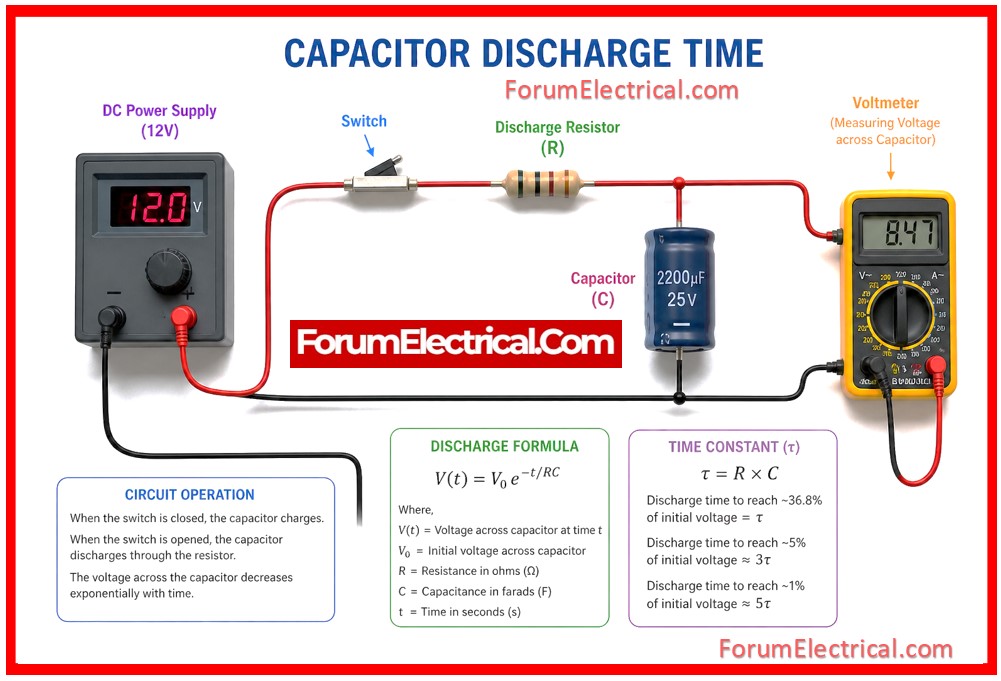
When a charged capacitor is connected to a resistor the stored charge gradually flows through the resistor back to ground.
This method is called discharge and it follows as an exponential decay pattern.
The Time Constant (τ – Tau)
The time constant is the process of capacitor discharge calculations.
It represents how quickly the capacitor charges (or) discharges via a resistor.
Time Constant Formula
τ (tau) = R x C
Where
R – Resistance (in Ohms Ω)
C – Capacitance (in Farads F)
τ – Time constant (in seconds s)
What is Time Constant?
τ = 1 second means the capacitor charges/discharges 63.2% in 1 second.
After 5τ (five time constants), the capacitor is considered fully charged/discharged (99.3%).
Larger R (or) C values result in slower charge/discharge rates.
The process is exponential and not linear.
Each time constant represents 63.2% of the remaining voltage difference.
Understanding Exponential Decay
Unlike charging a battery at a constant rate, capacitor discharge follows an exponential curve.
This represents
The voltage drops fastest initially.
The voltage drop rate gradually slows down.
Theoretically never reaches 0 (but practically reaches it after 5τ)
The discharge curve is predictable & mathematically consistent.
Capacitor Discharge Equation
The voltage across a discharging capacitor at any point in time is described by the exponential decay formula:
Voltage Discharge Formula
V(t) = V₀ x e(-t/τ)
Where:
V(t) – Voltage at time t
V₀ – Initial voltage
e – Euler’s number (≈ 2.71828)
t – Elapsed time (in seconds)
τ – Time constant (R x C)
Formulas
Essential Formulas for Capacitor Discharge
Time Constant
τ = R x C
Voltage at Time t
V(t) = V₀ x e(-t/τ)
Current at Time t
I(t) = (V₀/R) x e(-t/τ)
Time to Reach Target Voltage
t = τ x ln(V₀/Vf)
Energy Stored in Capacitor
E = ½ x C x V₀²
Charge Stored
Q = C x V₀
Cut off Frequency (for RC filters)
f = 1/(2πRC)
Time for 63.2% Discharge
t = τ
Time for 99.3% Discharge
t = 5τ
Discharge Time
If you want to find how long it takes to discharge from V₀ to a specific voltage Vf
Time to Reach Target Voltage
t = -τ x ln((Vf – V₀) / (0 – V₀))
Simplified
t = τ x ln(V₀ / Vf)
Where
ln – Natural logarithm (base e)
Vf – Final voltage target
Solved Examples
A camera flash needs to discharge a 1000 µF capacitor through a 10 kΩ resistor from 300V to 50V. How long does it take?
Step 1: Calculate Time Constant
τ = R x C = 10000 Ω x 1000 x 10⁻⁶ F = 10 seconds
Step 2: Use Time Formula
t = τ x ln(V₀/Vf)
t = 10 x ln(300/50)
t = 10 x ln(6)
t = 10 x 1.79 = 17.9 seconds
It takes about 18 seconds for the capacitor to discharge from 300V to 50V.
After about 50 seconds (5 x 10s) it will be nearly completely discharged.
Capacitor Discharge Timeline
Typical capacitor discharge cycle:
| Time Elapsed | Percentage of Initial Voltage Remaining | Percentage Discharged | Practical Meaning |
|---|---|---|---|
| 0τ (start) | 100% | 0% | Fully charged capacitor |
| 0.5τ | 60.65% | 39.35% | Gradual discharge begins |
| 1τ | 36.79% | 63.21% | One time constant mark |
| 2τ | 13.53% | 86.47% | Majority discharged |
| 3τ | 4.98% | 95.02% | Nearly complete discharge |
| 5τ | 0.67% | 99.33% | Practically complete |
Even after several time constants high voltage (HV) capacitors may retain dangerous residual charge.
Always use proper discharge procedures (e.g., resistive bleeder circuits) before touching high voltage (HV) capacitor circuits.
Application of Calculator
Power Supply Design
In AC to DC power supplies large electrolytic capacitors are utilized in the filter stage.
The time constant determines how smoothly the DC voltage remains constant between rectification cycles.
A longer time constant (larger capacitor / load resistance) provides better voltage stability.
Audio Equipment
Coupling capacitors in audio circuits use the RC time constant to filter out DC components while passing AC audio signals.
The cut off frequency depends directly on the RC time constant making it essential for sound quality.
Timer Circuits
The 555 timer IC (IC 555) and similar circuits use capacitor charging/discharging via resistors to generate accurate timing signals.
The RC time constant directly determines the frequency and duty cycle of the output.
Flash Photography
Camera flash units charge large capacitors to high voltages.
The flash discharge rate depends on the capacitor’s capacitance and the flash tube resistance following the exponential discharge curve.
Power Factor Correction
Capacitors in the power distribution systems discharge via system impedances with the time constant that is affecting how quickly the voltage stabilizes after switching that occurs.
Uninterruptible Power Supplies (UPS)
UPS (Uninterruptible Power Supply) backup time is partly used to determine capacitor discharge rates and the load resistance.
Understanding the discharge time constants assists design systems that provide sufficient hold up time.
Factors Affecting Discharge Time
Capacitance Value (C)
Effect: Higher capacitance = Slower discharge
Why: Larger capacitance use to stores more charge & takes longer to drain.
Range: pF to Farads
Resistance Value (R)
Effect: Higher resistance = Slower discharge
Why: Higher resistance use to limits current flow & extends discharge time.
Range: Ω to GΩ
Initial Voltage (V₀)
Effect: Higher voltage = More energy stored
Why: Energy depends on V² that affects total charge available.
Range: mV to kV
Temperature
Effect: Higher temp = Faster discharge
Why: Increases the leakage current in capacitor.
Range: -40°C to +85°C typical
Capacitor Type
Effect: Different leakage rates
Why: Different dielectric materials have many different losses.
Types: Ceramic, Film, Electrolytic & Tantalum
Load Impedance
Effect: Variable discharge rates
Why: Real world loads have frequency dependent impedance.
Impact: Affects actual discharge behaviour
Frequently Asked Questions
1). What is the difference between time constant and frequency?
Time constant (τ) used to relate to the time domain and describes how fast something changes.
Frequency (f) is the reciprocal and describes oscillations.
The relationship is: f = 1/(2πRC) for AC circuits.
2). How does temperature affect discharge time?
Higher temperatures that increase leakage current in capacitors which is causing faster discharge.
The effect varies by capacitor type but may be significant for electrolytic capacitors.
Some applications require temperature compensated circuits.

