
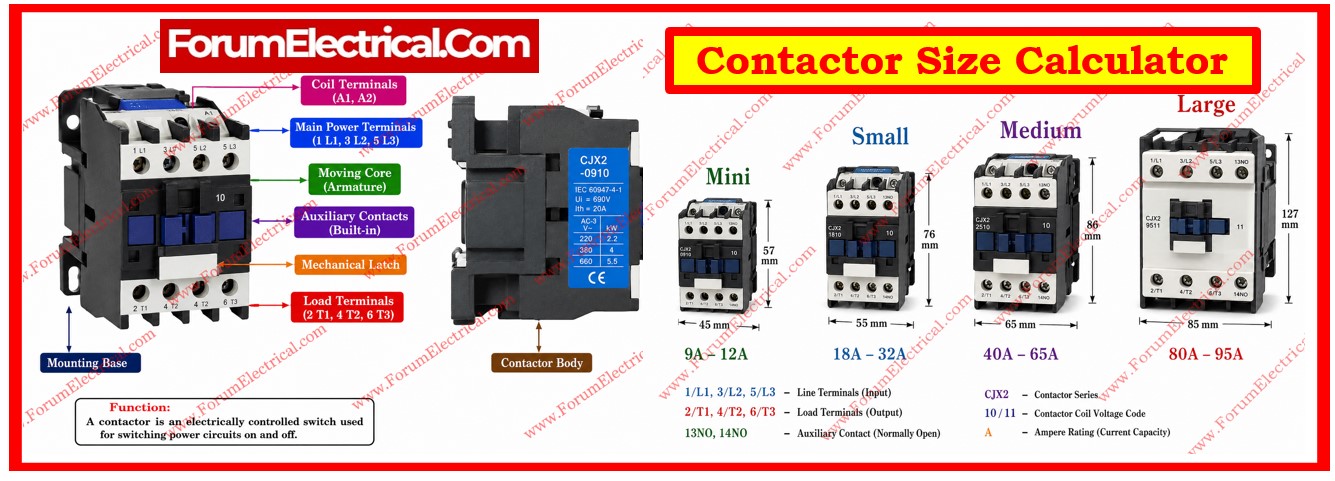
Selecting the correct contactor is one of the most essential steps in motor control circuit design.
Calculator
| Condition | Value | Derating Factor |
|---|---|---|
| Ambient Temperature | Up to 40°C (104°F) | kT = 1.00 |
| 50°C (122°F) | kT = 0.95 | |
| 55°C (131°F) | kT = 0.90 | |
| 60°C (140°F) | kT = 0.85 | |
| Altitude | Up to 2000 m (6560 ft) | kalt = 1.00 |
| 2500 m (8200 ft) | kalt = 0.95 | |
| 3000 m (9840 ft) | kalt = 0.90 | |
| 4000 m (13120 ft) | kalt = 0.80 | |
| Grouping | Single / Spaced | kG = 1.00 |
| Tightly Grouped | kG = 0.80 – 0.90 |
| Motor (kW) | Voltage | PF | IEC Size | NEC Size |
|---|
Related Electrical Calculators
Related Electrical Calculators
All Categories
Electrical Converters
Electrical Machines Calculators
Transformer Calculators
Power Systems Calculators
Battery Calculators
Electrical Engineering Excel Calculators
Unit Converters
Click here for more Electrical Calculators
You can also follow us on Facebook and Linkedin to receive daily updates.
An undersized contactor fails prematurely due to contact erosion and an oversized one adds unnecessary cost and cabinet space.
This post explains how to use the Contactor Size Calculator using an interactive calculator tool that combines
- IEC 60947-4-1 and
- NEC Article 430 methods
to attain at a properly rated contactor every time.
Standards
The calculator supports 2 globally recognised electrical standards:
- IEC 60947-4-1: Low-voltage switchgear and controlgear, Part 4-1: Contactors & motor-starters. Defines Ie (rated operational current), utilisation categories (AC-1, AC-3, AC-3e, AC-4), insulation voltage (Ui) and impulse withstand voltage (Uimp).
- NEC Article 430: Motors, Motor Circuits and Controllers. Covers conductor sizing at 125% FLA, branch-circuit OCPD limits, overload relay settings, disconnect ratings and controller HP ratings.
Important Engineering Considerations
Short-Circuit Protection & Coordination
Every contactor must be applied within a tested combination starter (Type 1 / Type 2 coordination) (or) with a verified upstream SCPD (fuse or MCCB).
The available fault current at the installation point should not exceed the combination Short Circuit Current Rating (SCCR).
Always consult the manufacturers coordination tables.
Overload Relay Selection
Pair the contactor with an electronic (or) bimetallic overload relay whose current adjustment range includes the motor FLC.
Use Trip Class 10 for standard motors and Class 20 (or) 30 for high inertia (or) frequent start applications.
Class selection directly affects motor protection response time during locked-rotor conditions.
Control Circuit & Coil
Match the contactor coil voltage to your control supply (common options: 24 V DC, 110 V AC, 230 V AC).
Size any control transformer for the inrush (pickup) VA which is typically 6 to 10 times the sealed VA and not the continuous sealed VA alone.
Failure to account for inrush results in nuisance control-supply dropout during starting.
Mechanical & Auxiliary Details
Specify the correct number and type of auxiliary contacts (NO / NC) for seal-in circuits, remote indication and PLC feedback.
For reversing starters use mechanical interlocks in addition to electrical interlocking to prevent phase-to-phase short circuits.
Verify terminal wire-size compatibility and published tightening torques to ensure reliable connections throughout the service life of the equipment.
Full Load Current (FLC) Calculation
The full load current is the foundation of every sizing of contactor.
The calculator uses the following relationships:
Three-phase: I = P / (√3 x V x PF x η)
Single-phase: I = P / (V x PF x η)
Where
P - Motor shaft power in watts (converted from kW or HP as entered)
V - line-to-line voltage for three-phase (or) line-to-neutral for single-phase
PF - Power Factor (cos φ)
η - Motor Efficiency
Both PF and η default to typical values of 0.85 and 0.90 respectively but SHOULD be verified against the motor nameplate for accurate sizing.
Environmental Derating
Standard contactor ratings are certified at 40°C ambient and altitudes up to 2000 m.
When site conditions exceed these limits the rated operational current must be reduced by a combined derating factor:
Ie(required) = FLC / (kT x kalt x kG)
The 3 derating factors are:
- kT: Temperature derating factor - Accounts for reduced heat dissipation at the elevated ambient temperatures.
- Kalt: Altitude derating factor - Air density decreases with altitude reducing the cooling capability of both the contactor & associated insulation.
- kG: Grouping factor - When multiple contactors are mounted in a tightly packed enclosure and mutual heating reduces individual ratings. Typical values range from 0.80 to 1.00.
Reference Derating Table (IEC 60947)
| Condition | Factor | Impact |
|---|---|---|
| ≤ 40°C (104°F) | kT = 1.00 | No derating required |
| 50°C (122°F) | kT = 0.95 | 5% current reduction |
| 55°C (131°F) | kT = 0.90 | 10% current reduction |
| 60°C (140°F) | kT = 0.85 | 15% current reduction |
| ≤ 2000 m (6560 ft) | kalt = 1.00 | No derating required |
| 2500 m (8200 ft) | kalt = 0.95 | 5% derating |
| 3000 m (9840 ft) | kalt = 0.90 | 10% derating |
| 4000 m (13120 ft) | kalt = 0.80 | 20% derating |
Quick Reference Size Chart
The table below summarises typical contactor selections for standard 3 phase motors at 400 V (IEC) and 480 V (NEC) with PF = 0.85 and efficiency = 0.90.
| Motor Power | Voltage | PF | IEC Size (AC-3) | NEC Size |
|---|---|---|---|---|
| 5.5 – 11 kW | 400V / 480V | 0.85 | AC-3, 18–25 A | NEMA Size 1–2 |
| 12.5 – 22 kW | 400V / 480V | 0.85 | AC-3, 32–50 A | NEMA Size 2–3 |
| 25 – 37 kW | 400V / 480V | 0.85 | AC-3, 50–80 A | NEMA Size 3 |
| 40 – 55 kW | 400V / 480V | 0.85 | AC-3, 95–115 A | NEMA Size 4 |
| 60 – 75 kW | 400V / 480V | 0.85 | AC-3, 150 A | NEMA Size 4 |
| 80 – 100 kW | 400V / 480V | 0.85 | AC-3, 185–225 A | NEMA Size 5 |
Note
IEC sizes shown for AC-3 category at 400 V.
NEC NEMA sizes based on 480 V, 3-phase.
Always confirm with the manufacturer datasheets.