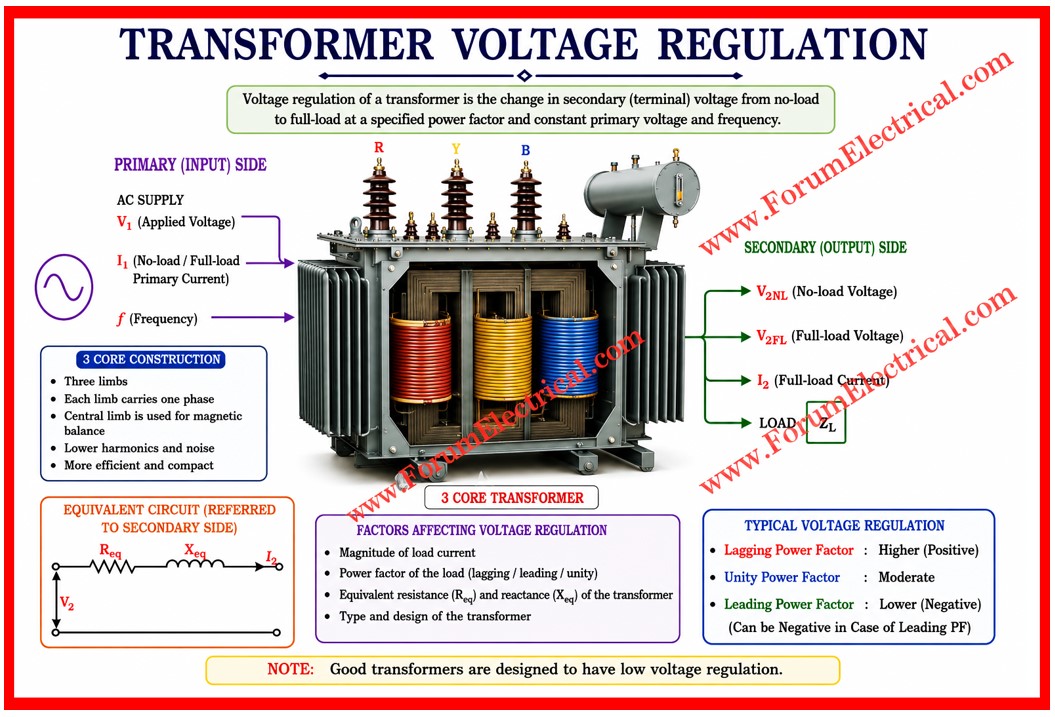
Voltage regulation is an essential parameter in electrical power systems primarily in transformer design and operation.
Calculator
Transformer Voltage Regulation
Calculate transformer performance under load
Lower percentages indicate better voltage stability. An ideal transformer maintains steady voltage under load. Typical values range from 2-5% for distribution transformers.
Related Electrical Calculators
Related Electrical Calculators
All Categories
Electrical Converters
Electrical Machines Calculators
Transformer Calculators
Power Systems Calculators
Battery Calculators
Electrical Engineering Excel Calculators
Unit Converters
Click here for more Electrical Calculators
You can also follow us on Facebook and Linkedin to receive daily updates.
It quantifies the change in secondary (output) voltage as the transformer used to transits from no load to full load conditions.
Understanding & calculating voltage regulation is essential for:
- Ensuring a stable power delivery to equipment,
- Preventing the equipment damage because of voltage fluctuations,
- Optimizing the system efficiency,
- Selecting the appropriate electrical transformer ratings and
- Attaining the industry standards and regulations.
What is Voltage Regulation?
Voltage regulation is defined as the percentage (%) change in secondary voltage as the transformer load used to change from no load to full load conditions.
It is expressed as a percentage (%) of the (FLV) – full load voltage.
Why Does Voltage Drop occur?
When a transformer operates under load the current flows through its windings and resistance.
This creates a voltage drop proportional to the load current and winding resistance.
The voltage drop opposes the transformers secondary voltage resulting in a lower terminal voltage at the full load compared to no load conditions.
Typical Voltage Regulation Values
Excellent Performance: < 3%
Modern high efficiency transformers maintain the voltage very stable across load variations.
Good Performance: 3% – 5%
Standard distribution transformers is typically fall within this range that is providing the adequate voltage stability.
Fair Performance: 5% – 10%
Older transformers (or) those with the higher impedance may exhibit this range.
Poor Performance: > 10%
A significant voltage drop may cause operational issues & must be analyzed.
Parameters
| Parameter | Symbol | Definition |
|---|---|---|
| No Load Voltage | Vnl | Secondary voltage with no load connected.Reference voltage under an ideal no load conditions (Volts) |
| Full Load Voltage | Vfl | Secondary voltage at rated full load current. Actual output voltage under the operating conditions (Volts) |
| Voltage Drop | ΔV | Absolute difference between no load & full load voltages. Represents magnitude of voltage change (Volts) |
| Voltage Regulation | VR (%) | Percentage change from no load to full load and calculated as (ΔV / Vfl) x 100. Lower = Better stability (%) |
| Power Factor | PF | Ratio of real to apparent power (0 to 1.0). Lower PF increases voltage drop. Typical industrial: 0.85-0.95 |
| Impedance | Z (%) | Total opposition to current flow. Combines resistance and reactance. Typical: 2-6%. Also affects voltage regulation (%) |
Calculation Methods
Basic Formula
The primary formula for calculating voltage regulation is:
Voltage Regulation (%) = ((Vnl – Vfl) / Vfl) x 100%
Where
Vnl – No Load Voltage (Secondary) in Volts
Vfl – Full Load Voltage (Secondary) in Volts
% – Percentage (multiply by 100)
Voltage Drop Calculation
Before calculating regulation determine the voltage drop (Vd or ΔV)
ΔV = Vnl – Vfl
Solved Example
A 10 kVA transformer has a secondary no load voltage of 240V & a full load voltage of 218V. Calculate the voltage regulation (%).
Given
kVA – 10 kVA
No Load Voltage – 240 V
Full Load Voltage – 218 V
Formula
Voltage Regulation (%) = ((Vnl – Vfl) / Vfl) X 100%
Solution
Calculate voltage drop: ΔV = 240 V – 218 V = 22V
VR = (22 / 218) X 100% = 10.09%
Result
This transformer has a voltage regulation of approximately (approx) 10.1%, indicating the fair performance.
Practical Applications
Distribution Transformers
Distribution transformers serves residential and commercial areas.
They are typically maintain voltage regulation across 2-6% to make sure consistent power delivery to end users.
Poor regulation in distribution systems can cause lights to dim when heavy loads are applied.
Industrial Applications
Industrial facilities with large motor loads need transformers with better regulation (< 4%) to prevent voltage sag that could damage sensitive equipment (or) reduce motor efficiency.
Voltage regulation becomes essential in facilities with fluctuating loads.
Renewable Energy Systems
In solar and wind energy systems transformers should maintain tight voltage regulation as renewable sources produce variable output.
Voltage regulation affects the efficiency of the power conditioning and power grid interconnection equipment.
Hospital and Data Center Applications
Essential facilities like hospitals and data centers need ultra low voltage (ULV) regulation (< 2%) to protect the sensitive medical equipment and servers.
Voltage fluctuations may cause data corruption and equipment failure.
Frequently Asked Questions (FAQs)
1). What is considered acceptable voltage regulation?
Acceptable voltage regulation depends on the application.
Generally distribution transformers must maintain < 5% and industrial applications require < 4%, and critical facilities aim for < 2%.
Always consult applicable standards (ANSI, IEC) for your specific application.
2). Why voltage regulation is important?
Voltage regulation assures that the connected electrical equipment receives a stable voltage within the acceptable ranges.
Poor regulation can
- Shorten equipment life,
- Reduce efficiency
that cause
- Operational failures and
- Increase energy consumption.
3). How to improve voltage regulation?
Methods include:
- Selecting a transformers with lower impedance,
- Installing the voltage regulators (or) automatic voltage control (AVC) systems,
- Improving power factor (PF),
- Upgrading the conductor sizes and
- Proper system design to minimize the voltage drop.
4). Does power factor affect voltage regulation?
Power factor use to influence the voltage drop & regulation.
Lower power factors (LPF) increase the reactive current which increases the voltage drop due to the transformer reactance.
Improving the power factor reduces voltage drop and improves regulation.
5). What tools can calculate voltage regulation?
Modern tools include
- Online calculators,
- Engineering software packages,
- Transformer design programs and
- Mobile applications
are the tools that streamline calculations and assist engineers to select appropriate transformers for specific applications.

