
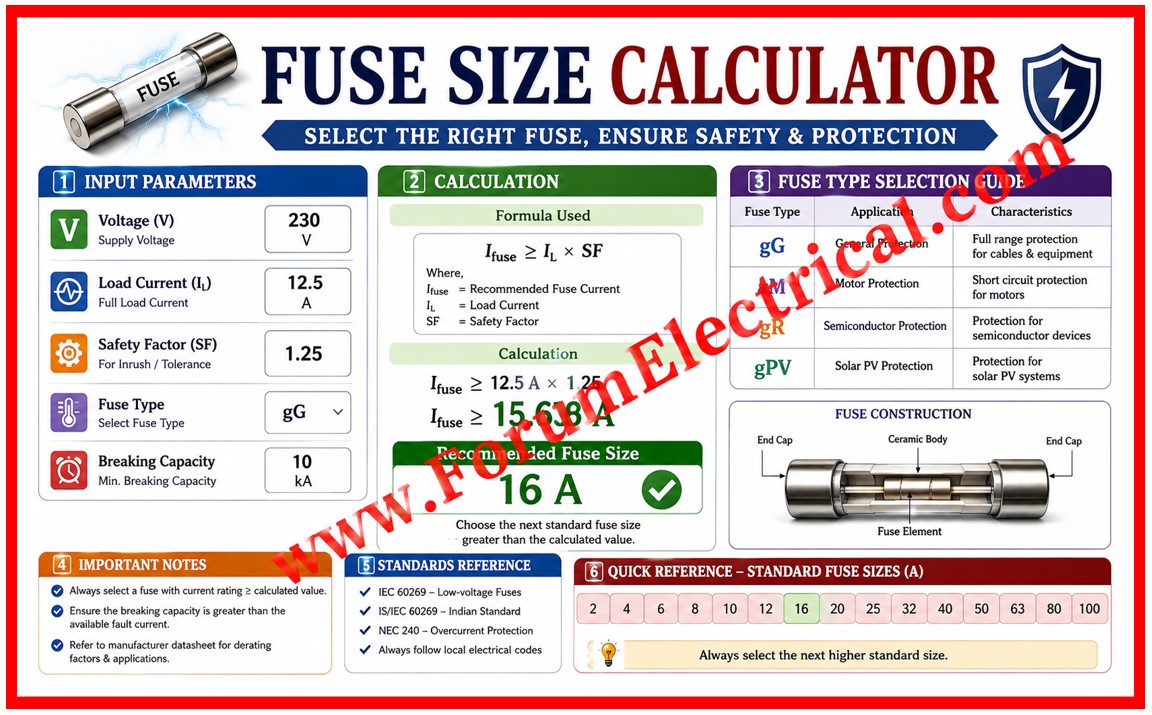
A fuse protects electrical circuits from overloads and short circuits by interrupting the excessive current flow.
Calculator
Fuse Size Calculator
NEC / IEC — Compliant Sizing Reference
Standard sizes: 1, 3, 6, 10, 15, 20, 25, 30, 35, 40, 45, 50, 60, 70, 80, 90, 100, 110, 125, 150, 175, 200 A…
Motor note: If TD fuse trips during start-up, NEC permits increasing up to 225% of FLC.
Related Electrical Calculators
Related Electrical Calculators
All Categories
Electrical Converters
Electrical Machines Calculators
Transformer Calculators
Power Systems Calculators
Battery Calculators
Electrical Engineering Excel Calculators
Unit Converters
Click here for more Electrical Calculators
You can also follow us on Facebook and Linkedin to receive daily updates.
Selecting the correct fuse size is essential for
Electrical safety,
Equipment protection and
System reliability.
Using a fuse size calculator simplifies the process and ensures compliance with NEC and IEC standards.
What is a Fuse Size Calculator?
A Fuse Size Calculator is an electrical tool used to determine the recommended fuse rating based on current, load type and system characteristics.
It helps engineers and electricians choose the right fuse size for AC, DC, motor and continuous loads.
Why Fuse Sizing is Important?
Incorrect fuse sizing can result in
- Nuisance tripping,
- Equipment damage,
- Overheating and
- Fire hazards.
Proper sizing ensures safety, efficient operation and compliance with electrical codes.
Fuse Sizing Formulas
NEC Continuous Load: Fuse = Current x 1.25
NEC Motor Load: Time Delay Fuse = FLC x 1.75
NEC Motor Load: Non-Time Delay Fuse = FLC x 3.00
DC Load: Fuse = Current x 1.50
IEC mode applies specifically to motor loads (DOL starters) using the motor nameplate current (In). IEC 60947-4-1 defines 2 fuse types for motor protection:
IEC aM Fuse = Current x 1.6 to 2.0 (Lower bound to Upper bound)
IEC gG/gL Fuse = Current x 2.0 to 2.5 (Lower bound to Upper bound)
For DC circuits: 150% is the safe standard practice for both time-delay and non-time-delay fuses.
Both fuse types yield the same result.
For AC continuous loads: 125% accounts for heat developed over extended operation.
Common Motor FLC Table (NEC Table 430.250 – 3-Phase AC Motors)
| HP Rating | 208V FLC (A) | 230V FLC (A) | 460V FLC (A) | 575V FLC (A) |
| 1/2 | 2.4 | 2.2 | 1.1 | 0.9 |
| 3/4 | 3.5 | 3.2 | 1.6 | 1.3 |
| 1 | 4.6 | 4.2 | 2.1 | 1.7 |
| 1-1/2 | 6.6 | 6.0 | 3.0 | 2.4 |
| 2 | 7.5 | 6.8 | 3.4 | 2.7 |
| 3 | 10.6 | 9.6 | 4.8 | 3.9 |
| 5 | 16.7 | 15.2 | 7.6 | 6.1 |
| 7-1/2 | 24.2 | 22.0 | 11.0 | 9.0 |
| 10 | 30.8 | 28.0 | 14.0 | 11.0 |
| 15 | 46.2 | 42.0 | 21.0 | 17.0 |
| 20 | 59.4 | 54.0 | 27.0 | 22.0 |
| 25 | 74.8 | 68.0 | 34.0 | 27.0 |
NEC Standard Fuse Size Chart
Always round UP to the next standard fuse size from this list:
| Rating (A) | Rating (A) | Rating (A) | Rating (A) | Rating (A) |
| 1 | 15 | 45 | 90 | 175 |
| 3 | 20 | 50 | 100 | 200 |
| 6 | 25 | 60 | 110 | 225 |
| 10 | 30 | 70 | 125 | 250 |
| – | 35 | 80 | 150 | 300+ |
Verify against manufacturer time-current curves. The motor starting current (Ist ≈ 6-8x In) for the start duration must fall in the non melting zone of the fuse.
Confirm against manufacturer coordination tables (Type 1 / Type 2 coordination).
IEC Motor Starting Considerations
When sizing fuses for motor loads under IEC the following starting current characteristics should be considered:
- Direct-On-Line (DOL) start: Ist ≈ 6–8x In, duration 2–10 seconds
- Star-Delta start: Initial Ist ≈ 2–3x In (reduced starting torque)
- Soft starter: Ist ≈ 2–4x In (adjustable ramp-up time)
- VFD (Variable Frequency Drive): Ist ≈ 1.0–1.5x In (near-zero inrush)
IEC Fuse Selection Table
Fuse selections based on motor nameplate current (In):
| In (A) | aM Fuse Range (A) | gG/gL Fuse Range (A) | Nearest Standard (IEC) |
| 5 | 8.0 – 10.0 | 10.0 – 12.5 | 10 A |
| 10 | 16.0 – 20.0 | 20.0 – 25.0 | 20 A |
| 16 | 25.6 – 32.0 | 32.0 – 40.0 | 32 A |
| 20 | 32.0 – 40.0 | 40.0 – 50.0 | 40 A |
| 25 | 40.0 – 50.0 | 50.0 – 62.5 | 50 A |
| 32 | 51.2 – 64.0 | 64.0 – 80.0 | 63 A |
| 40 | 64.0 – 80.0 | 80.0 – 100.0 | 80 A |
| 50 | 80.0 – 100.0 | 100.0 – 125.0 | 100 A |
| 63 | 100.8 – 126.0 | 126.0 – 157.5 | 125 A |
NEC vs IEC Comparison Table
| Parameter | NEC | IEC |
| Governing Standard | NEC 430.52 / 210.20(A) | IEC 60947-4-1 |
| Current Reference | FLC from Table 430.250 | Motor nameplate (In) |
| Motor TD/aM Factor | 1.75× (175%) | 1.6× to 2.0× |
| Motor NTD/gG Factor | 3.00× (300%) | 2.0× to 2.5× |
| AC Continuous Load | 1.25× (125%) | N/A (motor only) |
| DC Load | 1.50× (150%) | N/A |
| Primarily Used In | USA, Canada | Europe, International |
| Overload Protection | Separate OLR required | Separate relay required |
NEC vs IEC Comparison Table
| Feature | NEC | IEC |
| Motor Fuse | 175–300% FLC | 1.6–2.5 × In |
| Standard | NEC 430.52 | IEC 60947-4-1 |
| Load Types | AC/DC/Motor | Motor |
Applications
Fuse size calculators are widely used in industries, substations, residential systems, motor control centers and maintenance activities.
Advantages
• Accurate calculations,
• Faster design process,
• Standards compliance and
• Improved electrical safety.
FAQs
1). How to calculate fuse size?
Multiply load current using NEC or IEC multipliers.
2). What is the 125% rule?
Continuous loads require 125% sizing under NEC.
3). Why are motor fuses larger?
They handle motor starting current without nuisance tripping.
Conclusion
The Fuse Size Calculator is an essential tool for selecting correct fuse ratings according to NEC and IEC standards. It improves safety, reliability and compliance in electrical systems.