
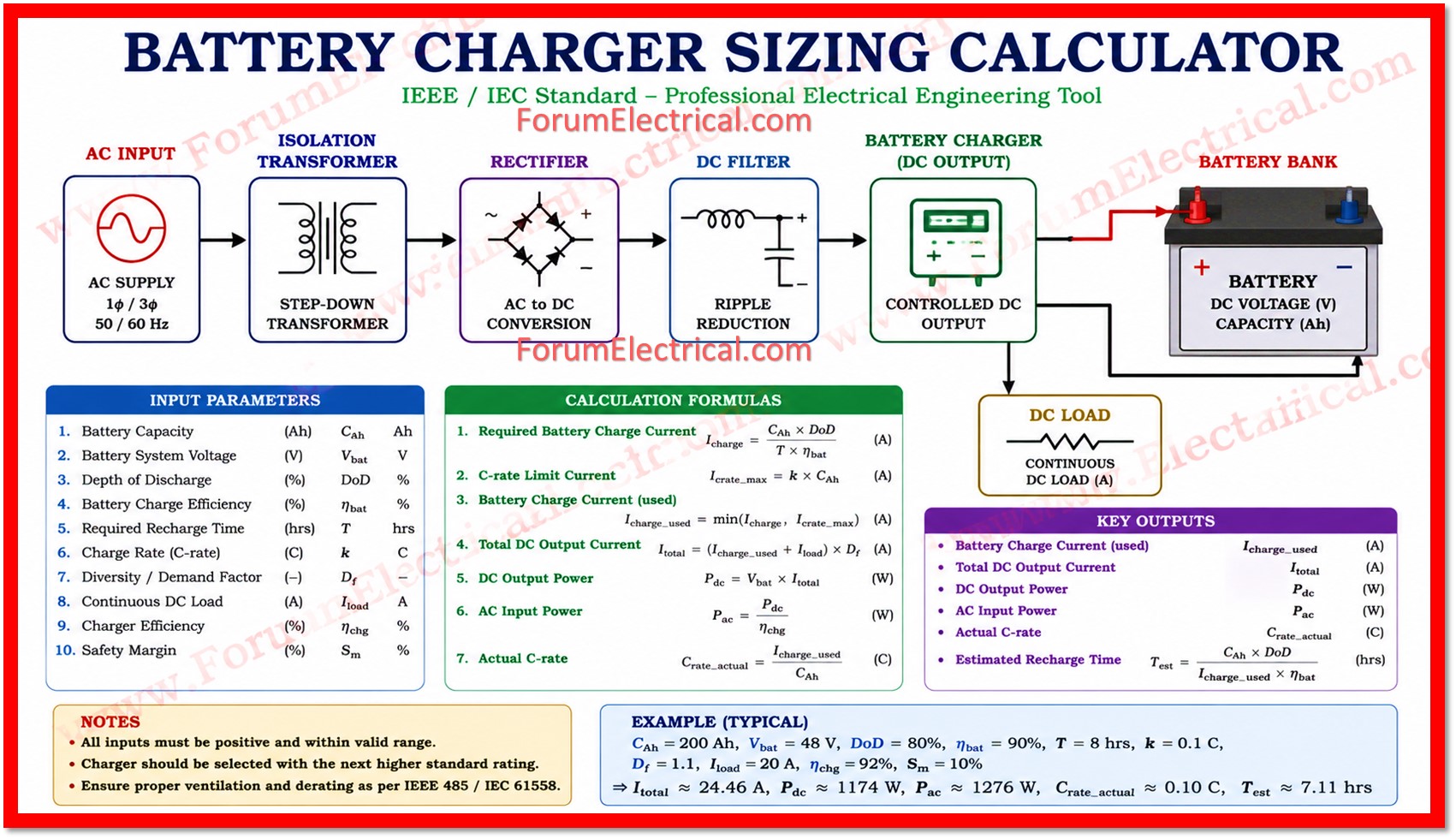
Selecting the correct battery charger is one of the most important factor in any DC power system design.
Calculator
Battery Charger Sizing Calculator
IEEE / IEC Standard — Professional Electrical Engineering Tool
C/10 = 0.10 · C/5 = 0.20 · C/2 = 0.50 · 1C = 1.00
Related Electrical Calculators
Related Electrical Calculators
All Categories
Electrical Converters
Electrical Machines Calculators
Transformer Calculators
Power Systems Calculators
Battery Calculators
Electrical Engineering Excel Calculators
Unit Converters
Click here for more Electrical Calculators
You can also follow us on Facebook and Linkedin to receive daily updates.
An undersized charger will fail to restore the battery bank within the required recharge window reducing system reliability & shortening battery life.
An oversized charger wastes capital expenditure & may damage batteries via excessive charge rates.
This post provides a complete, step-by-step methodology for sizing the battery chargers in accordance with IEEE Standard 485 and IEC 60896 guidelines.
Applications covered by this calculator include
- Telecommunications DC power plants,
- UPS systems,
- Industrial control panel battery backup,
- Solar energy storage systems,
- Emergency lighting systems and
- Substation battery banks.
Input Parameters
Understanding each input parameter is important to obtaining accurate sizing results.
The following table used to summarizes every parameter used in the calculator
| Parameter | Unit / Range | Description |
|---|---|---|
| Battery Capacity (Ah) | Ah / > 0 | Rated ampere-hour (Amp-hr) capacity of the battery bank. For a bank of cells in parallel sum the individual Ah ratings. |
| System Voltage (V) | V / > 0 | Nominal DC bus voltage. Common values: 12, 24, 48, 110, 125 and 220 V DC. |
| Depth of Discharge (DoD) | % / 1–100 | Maximum allowable discharge: 50–80% for VRLA/lead-acid; up to 90% for lithium-ion. Higher DoD increases usable energy but accelerates ageing. |
| Battery Charge Efficiency | % / 1–100 | Coulombic (Ah-in / Ah-out) efficiency.Typically 85–95% for lead-acid; 97–99% for Li-ion. |
| Required Recharge Time | hrs / > 0 | Target time to fully recharge after a discharge event. IEEE 485 commonly uses 8 hours. |
| Max Charge Rate (C-Rate) | C / 0.01–2 | Maximum charge current as a multiple of Ah capacity. C/10 = 0.10. Acts as an upper limit and the calculator raises a warning if the time-based current exceeds this value. |
| Diversity / Demand Factor | — / ≥ 1.0 | Accounts for simultaneous loading of multiple circuits. Typically 1.0–1.25 per IEC 60364. |
| Continuous DC Load (A) | A / ≥ 0 | Steady-state current the charger must supply to DC loads while simultaneously charging the battery. |
| Charger Efficiency | % / 50–100 | Power conversion efficiency of the rectifier/charger. Modern SMPS units: 88–96%. Older ferro-resonant: 75–85%. |
| Safety / Design Margin | % / 0–50 | Additional capacity buffer added to the final result. IEEE 485 recommends 10–15% to account for ageing, temperature & design uncertainties. |
IEEE 485 Calculation Methodology
The calculator implements the following 7 step procedure as specified in IEEE Standard 485.
Step 1: Usable Capacity
Usable Capacity (Ah) = Battery Capacity x (DoD / 100)
This represents the actual energy available for discharge accounting for the depth-of-discharge (DoD) limit.
It is the energy the charger should restore in the target recharge window.
Step 2: Required Charge Current
Icharge (A) = Usable Capacity / (Recharge Time x ηbattery)
The battery efficiency factor (ηbattery) compensates for the charge losses during the absorption phase.
If the resulting current exceeds the maximum C-rate limit the current is capped & the actual recharge time is recalculated with a warning.
Step 3: DC Load with Diversity
Iload (A) = Continuous DC Load x Diversity Factor
The charger should be simultaneously supply power to all connected DC loads while charging the battery.
The diversity factor needs for the statistical requirements that all loads operate concurrently.
Steps 4–7: Summation, Safety Margin & Power
Itotal (A) = Icharge + Iload
Ifinal (A) = Itotal x (1 + Safety Margin / 100)
PDC (W) = Ifinal x System Voltage
PAC (W) = PDC / Charger Efficiency
Ifinal is the minimum DC output current the charger should be rated.
PAC is utilized to determine the AC supply circuit protection (MCB/fuse) and wiring size.
C-Rate Guidance by Battery Chemistry
The maximum charge rate varies significantly by battery chemistry & has a major impact on battery longevity.
The table below provides recommended values
| Chemistry | Typical Max C-Rate | DoD Limit | Notes |
|---|---|---|---|
| VRLA / AGM | C/10 (0.10 C) | 80% | Standard for most UPS & stationary systems. |
| Flooded Lead-Acid | C/10 – C/5 | 50 – 80% | Requires ventilation. Gassing above C/5. |
| Gel Cell | C/20 (0.05 C) | 80% | Low charge rate essential and overcharging causes the irreversible damage. |
| LiFePO4 | 0.5 C – 1 C | 90% | Fast charge capable and BMS protects against overrate. |
| Li-NMC / Li-NCA | 0.5 C – 2 C | 85 – 90% | High energy density and thermal management required above 1C. |
| NiCd (Vented) | C/5 – C/3 | 85% | Robust and tolerates high rates. Memory effect consideration. |
Solved Example
The following example explains a typical telecommunications DC power plant sizing exercise utilizing the calculator:
Given Inputs
- Battery Capacity: 200 Ah
- System Voltage: 48 V DC
- Depth of Discharge: 80%
- Battery Charge Efficiency: 90%
- Required Recharge Time: 8 hours
- Max C-Rate: 0.10 (C/10)
- Diversity Factor: 1.10
- Continuous DC Load: 20 A
- Charger Efficiency: 92%
- Safety Margin: 10%
Calculation
Step-1: Usable Capacity = 200 x 0.80 = 160.000 Ah
Step-2: Icharge = 160.000 / (8.00 x 0.90) = 22.222 A
Within C/10 limit (20.0 A)
If 22.2 A > 20 A – C-rate cap applies
Icharge used = 20.0 A
Step-3: Iload = 20 x 1.10 = 22.000 A
Step-4: Itotal = 20.000 + 22.000 = 42.000 A
Step-5: Ifinal = 42.000 x 1.10 = 46.200 A ← Recommended Charger Current
Step-6: PDC = 46.200 x 48 = 2217.6 W
Step-7: PAC = 2,217.6 / 0.92 = 2410.4 W
Result:
Select a charger rated at minimum 46.2 A DC output at 48 V with AC input supply rated for at least 2.5 kW.
Because the time based charge current (22.2 A) slightly exceeded the C/10 maximum and the actual recharge time will be approximately 8.89 hours rather than the target 8 hours.
Consider utilizing a 200 Ah / 0.125C capable battery (or) reducing the DoD to resolve this.
Standards & References
The methodology & parameter guidance are derived from the following standards and references.
- IEEE Std 485-2010: Recommended Practice for Sizing Lead-Acid Batteries for the Stationary Applications
- IEEE Std 1184-2006: Guide for Batteries for Uninterruptible Power Supply Systems
- IEC 60896-21/22: Stationary Lead-Acid Batteries – Requirements & Test Methods (VRLA)
- IEC 62485-2: Safety requirements for the secondary batteries and battery installations
- IEC 60364-5-55: Low-voltage electrical installations – Selection and erection of electrical equipment
- NFPA 70 (NEC) Article 480: Storage Batteries