
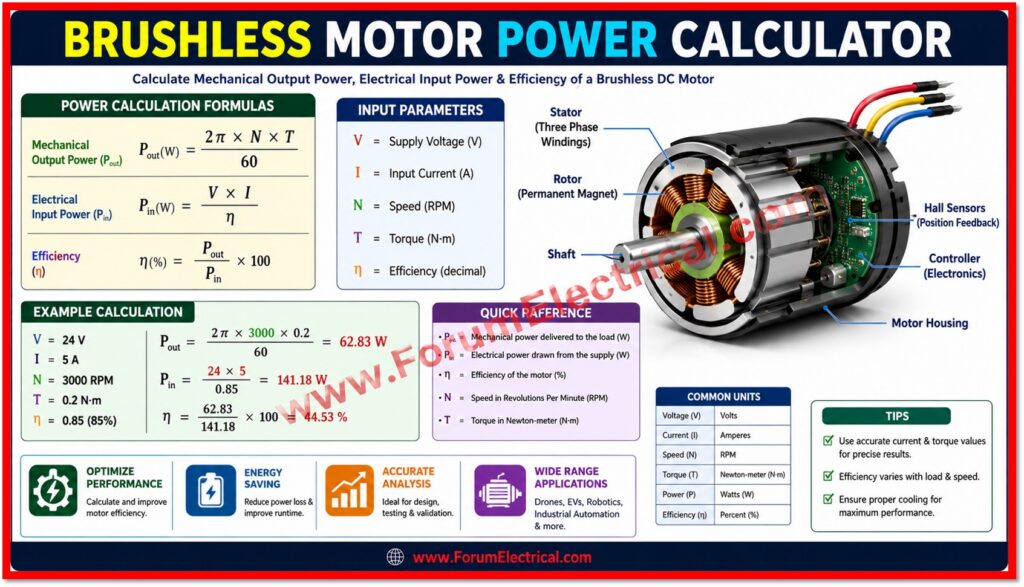
This post explains the engineering formulas used by the Brushless Motor Power Calculator online calculator tool.
Calculator
Related Electrical Calculators
Related Electrical Calculators
All Categories
Electrical Converters
Electrical Machines Calculators
Transformer Calculators
Power Systems Calculators
Battery Calculators
Electrical Engineering Excel Calculators
Unit Converters
Click here for more Electrical Calculators
You can also follow us on Facebook and Linkedin to receive daily updates.
It covers 4 calculation modules
1). Power & Efficiency,
2). Torque & Speed,
3). Kv-to-Kt Conversion and
4). Electrical & Runtime sizing
and demonstrates each with a manual step-by-step calculation.
Power & Efficiency
Electrical input power is the product of the supply voltage and current draw.
Output (mechanical shaft) power is obtained by applying the estimated motor efficiency and the difference between input and output power is dissipated as heat which is primarily winding (I²R copper loss) & core loss.
Pin = V x I
Pout = Pin x eta
Ploss = Pin – Pout
Where
V is supply voltage (V),
I is current draw (A), and
eta is efficiency expressed as a decimal (e.g. 0.85 for 85%).
Output power converts to kilowatts by dividing by 1000 and to horsepower by dividing by 745.7.
Torque & Speed
Given mechanical output power and shaft speed, angular velocity is found intially then torque follows directly from the power-torque-speed relationship.
omega = RPM x 2*pi / 60 (rad/s)
T (N.m) = P / omega
T (oz.in) = T(N.m) x 141.6119
T (lb.in) = T(N.m) x 8.8507
Where
P is the mechanical output power in watts (typically the Pout value calculated in Section 2)
RPM is the measured or rated shaft speed.
Kv-to-Kt Conversion
Kv (the velocity constant in RPM per volt) is the specification most manufacturers publish but Kt (the torque constant in N.m per amp of current) is that which is needed for torque calculations.
For an ideal motor these two are reciprocally linked through a fixed constant and the back EMF constant Ke follows from the same relationship.
Kt (N.m/A) = 9.5493 / Kv
Kt (oz.in/A) = Kt(N.m/A) x 141.6119
Ke (V/RPM) = 1 / Kv
This is a no-load and ideal-motor approximation.
Real motors depart from it slightly due to winding resistance and iron losses so that the datasheet Kt values must be used when available.
Electrical & Runtime Sizing
Runtime is derived from usable battery capacity that is the fraction of rated capacity that can be discharged while protecting battery health which is divided by the average current draw.
The ESC (motor controller) current rating is sized with a safety margin above which is the expected peak current not the average current since the peak current determines controller heating & survival during transients.
Usable capacity (mAh) = Rated capacity x (Discharge% / 100)
Runtime (min) = (Usable capacity / 1000 / Iavg) x 60
ESC rating (A) = Ipeak x Safety factor
Fully Solved Example
Consider a brushless drive motor operating from a 6S lithium-polymer pack (22.2 V nominal) rated Kv = 920 RPM/V drawing 18 A in steady flight with an estimated 85% efficiency and spinning at 8500 RPM under a 5000 mAh battery discharged to an 80% safe limit with a peak current draw of 35 A and a 1.2 x ESC safety margin.
Given
The steps below explains through all 4 modules for this single motor.
Solution
Power & Efficiency
| Step | Description | Calculation | Result |
|---|---|---|---|
| 1 | Input power | Pin = 22.2 V x 18 A | 399.60 W |
| 2 | Output power | Pout = 399.60 W x 0.85 | 339.66 W |
| 3 | Power loss | Ploss = 399.60 – 339.66 | 59.94 W |
| 4 | Output in HP | 339.66 / 745.7 | 0.456 HP |
Torque & Speed
Using the mechanical output power of 339.66 W found above at a shaft speed of 8500 RPM:
| Step | Description | Calculation | Result |
|---|---|---|---|
| 1 | Angular velocity | omega = 8500 x 2*pi / 60 | 890.12 rad/s |
| 2 | Torque (N.m) | T = 339.66 / 890.12 | 0.3815 N.m |
| 3 | Torque (oz.in) | 0.3815 x 141.6119 | 54.02 oz.in |
| 4 | Torque (lb.in) | 0.3815 x 8.8507 | 3.377 lb.in |
Kv-to-Kt Conversion
For the motors rated Kv of 920 RPM/V:
| Step | Description | Calculation | Result |
|---|---|---|---|
| 1 | Torque constant | Kt = 9.5493 / 920 | 0.01038 N.m/A |
| 2 | Torque constant | 0.01038 x 141.6119 | 1.470 oz.in/A |
| 3 | Back-EMF constant | Ke = 1 / 920 | 0.001087 V/RPM |
As a cross-check, the ideal no-load current for 0.3815 N.m of torque would be I = T / Kt = 0.3815 / 0.01038 ~ 36.8 A – reasonably close to the 35 A peak current specified for this motor which is expected since the actual figure includes real world losses not captured by the ideal Kt relationship.
Electrical & Runtime
| Step | Description | Calculation | Result |
|---|---|---|---|
| 1 | Usable capacity | 5000 mAh x 0.80 | 4000 mAh |
| 2 | Runtime | (4000/1000/18) x 60 | 13.3 min |
| 3 | ESC rating | 35 A x 1.2 | 42.0 A |
Results
- Input power 399.60 W,
- Output power 339.66 W (0.456 HP),
- Shaft torque 0.3815 N.m (54.02 oz.in),
- Torque constant 0.01038 N.m/A,
- Estimated flight time 13.3 minutes on the 5000 mAh pack and
- Minimum recommended ESC rating of 42 A.
Limitations
- All formulas are engineering estimates. So, always cross check against the motor & ESC manufacturer datasheets before final selection.
- The Kv-Kt relationship assumes an ideal, lossless motor; real Kt is typically slightly lower than the ideal value because of winding resistance.
- ESC sizing must always be based on peak current, never average current and should include a margin for inrush & stall conditions.
- Runtime estimates assume a constant average current draw; real flight (or) duty profiles vary & will change the achievable runtime.

